

Audio By Carbonatix
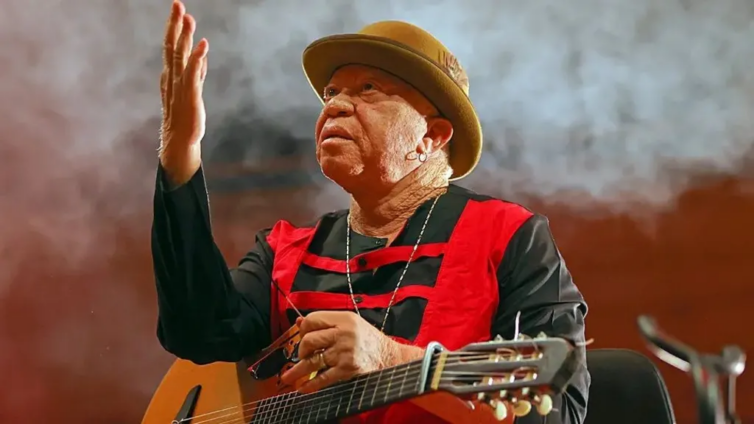
The decision by world-famous Malian musician Salif Keïta to stop touring in South Africa over what he called "xenophobic violence" has been met with disappointment by the province hosting a festival he was due to perform at next month.
South Africa has been hit by a wave of protests demanding that undocumented migrants leave the country - the latest unofficial deadline set is 30 September.
Tens of thousands of Africans have been voluntarily repatriated in recent months, some saying they have been the targets of intimidation and attacks.
While cracking down on illegal immigration, the South African government has said that those who have taken the law into their own hands have been arrested.
South Africa is Africa's wealthiest nation and has long attracted migrants searching for better economic opportunities.
But illegal immigration has become a highly contentious political issue, with protesters accusing undocumented migrants of placing pressure on South Africa's public services, as well as being involved in crime.
In a message explaining why he would not be performing at the Macufe festival in Free State province next month, Keïta said he could not "ignore the reports of xenophobic violence against our African brothers and sisters.
"When I see migrants attacked, I do not see 'politics'. I see people looking for work, safety, and dignity."
The 77-year-old star added that this did not reflect the country that he knew and that cancelling the appearance was "a rejection of hate" rather than a rejection of South Africans, leaving the door open for a return at some point.
In its response, the Free State's culture department said it "regrets the decision taken by the renowned musician".
It emphasised that the Macufe festival was a celebration of African unity.
Keïta, known to some as the "Golden Voice of Africa", was a pioneer who helped put African music on the global map and after 50 years in the music business remains influential.
News of the cancellation of his concert came as the first group of 173 Tanzanians returned from South Africa as part of a voluntary repatriation programme.
For some of them the flight home from Durban, which has seen some of the biggest protests, marks the end of decades spent in South Africa.
Abdul Idi, who went there in 2006 hoping to build a better life, said he was grateful to have returned safely after what he described as difficult and dangerous circumstances in South Africa.
"Foreigners are not wanted there," he said on arrival at Dar es Salaam's international airport on Wednesday night.
Another returnee, Rashid Ramadhan, said he had spent 30 years in South Africa.
The 53-year-old explained how he and others had been forced out of their accommodation in Durban and had been living outside for the past two months, with their jobs gone and life becoming increasingly difficult.
More than 160,000 people have left the country on similar repatriation schemes since May, according to a count by the AFP news agency. Malawians, Zimbabweans, Zambians, Ghanaians and Nigerians are among those who have returned.
The anti-migrant group March and March has announced a second wave of nationwide protests set for 30 September.
Earlier this month, the group called on leaders attending the Southern African Development Community (Sadc) summit in Durban to "fetch your people".
March and March says its September action will be bigger and better organised than the demonstrations on 30 June, which were accompanied by violence in some areas.
Those returning to their home countries from South Africa often need support, having abandoned their livelihoods and many of their possessions.
But Ghana's government has rejected a donation of about $1.7m (£1.25m) from MTN Ghana, a subsidiary of South African telecoms giant MTN Group, offered to support Ghanaians repatriated from South Africa.
Ghana's foreign ministry said that the government was committed to funding the evacuation and reintegration of its repatriated citizens.
Latest Stories
-
Mason jailed 35 years for defiling two daughters
8 minutes -
Ghana among 8 countries selected to pilot WHO tool for stronger clinical trial systems
28 minutes -
Selma Yudha joins race for 60th NUGS President with promise of student-focused leadership
36 minutes -
NSMQ 2026: Botwe denies Wesley Girls’ seeded spot, secures quarter-final spot after fierce battle
41 minutes -
Zoomlion begins disinfection and disinfestation exercise across Upper East Region
48 minutes -
Ghana AIDS Commission strengthens community-level HIV data collection to track 2030 target
48 minutes -
Parliament approves three new Supreme Court Justices
55 minutes -
Zoomlion intensifies disinfection, disinfestation exercise across Ahafo Region
1 hour -
GHASALC income rises 89% to GH¢1.84m as sector prepares for 2027 reforms
1 hour -
‘Africa is being short-changed because we fail to negotiate well’ – Col Festus Aboagye
1 hour -
NSMQ 2026: PRESEC Legon keeps 9th title dream alive as Mfantsipim looms in quarter-finals
1 hour -
Zoomlion begins fumigation exercise across Eastern Region after floods
2 hours -
Police suspend concrete mixer truck operations in Accra and Tema for 3 days
2 hours -
Parliament approves Mahama Ayariga and Zanetor Agyeman-Rawlings as ministers
2 hours -
NACOC, University of Ghana strengthen collaboration to tackle drug abuse on campus
2 hours