

Audio By Carbonatix
Ghana’s efforts to register mobile phone users have evolved significantly over the past 16 years, with successive exercises aimed at strengthening subscriber identification and tackling mobile fraud.
The country has moved from an initial registration system that relied on several forms of identification to the use of the Ghana Card and, now, plans for a more advanced system involving real-time biometric verification.
The latest phase is expected to begin before the end of 2026.
The first SIM registration exercise
Ghana’s first nationwide mandatory SIM registration exercise began in July 2010, under the supervision of the National Communications Authority (NCA).
The exercise was introduced to ensure that SIM cards could be linked to identifiable individuals and to support efforts to combat mobile fraud and other forms of telecommunications-related crime.
At the time, subscribers could use various identification documents, including voter identity cards, passports and driver’s licences.
However, the system had limitations, particularly around the verification of identity documents, with significant elements of the process relying on manual checks.
That left gaps in the ability to establish with certainty that the person registering a SIM was the legitimate holder of the identity document presented.
The Ghana Card era
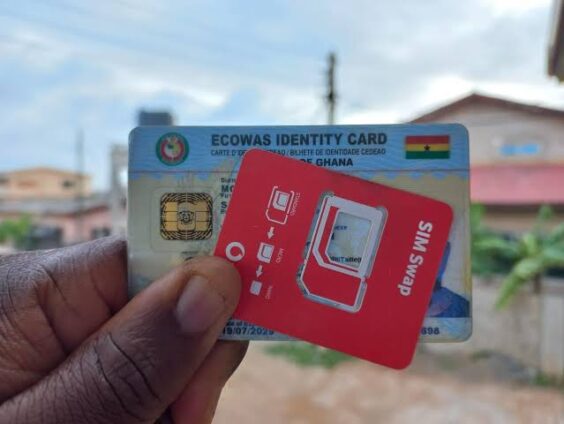
A second and more comprehensive SIM registration exercise began on October 1, 2021.
This time, the government sought to link SIM cards to the Ghana Card, making the national identification system central to subscriber registration.
The exercise involved two key stages.
First, subscribers linked their SIM cards to their Ghana Card details, initially through a USSD process.
They were subsequently required to complete the registration process through biometric capture, including the collection of fingerprints and photographs at designated service points.
The exercise encountered several challenges, including long queues at registration centres, technical difficulties, and delays associated with obtaining Ghana Cards.
The deadline was extended several times before the exercise officially ended on May 31, 2023.
Millions of SIM cards that had not met the registration requirements were subsequently deactivated.
Problems with the database
The exercise was intended to create a more reliable database of mobile subscribers by linking SIM ownership to Ghana’s national identification system.
However, subsequent validation exercises raised questions about the integrity of some of the registration data.
The NCA reported in 2025 that a joint validation exercise found that 81.1% of records matched official identity data, highlighting gaps that still needed to be addressed.
The findings reinforced concerns about the reliability of the subscriber database and the need for stronger verification mechanisms.
A new biometric phase
The government is now preparing another major change to the SIM registration system, with real-time biometric verification expected to be introduced before the end of 2026.
Unlike previous processes, the new system is designed to verify the identity of the person registering a mobile number against the records of the National Identification Authority (NIA).
The process is expected to involve biometric authentication, including fingerprint and facial verification, requiring the physical presence of the subscriber.
For Ghanaian citizens, the Ghana Card will remain the primary identification document, while non-citizens will use the Non-Citizen Ghana Card.
SIM, identity and device
Another significant feature of the new system is the proposed Central Equipment Identity Register (CEIR).
The system will use the unique International Mobile Equipment Identity (IMEI) number associated with mobile devices to improve the ability of authorities and network operators to identify and manage devices connected to telecommunications networks.
The broader objective is to strengthen the connection between the subscriber, mobile number, identity and device.
This could also support efforts to tackle the use of stolen or illegally obtained devices.
Why the new system matters
The latest phase comes against the backdrop of continued concerns about mobile fraud, identity misuse and the use of telecommunications services in criminal activity.
The government's position is that stronger identity verification will make it more difficult for individuals to register and use mobile numbers anonymously or under another person's identity.
Authorities have also warned subscribers against registering SIM cards for other people.
Under the proposed system, linking a subscriber's identity more closely to the mobile number and device means misuse of a number registered in another person's name could have serious consequences for the legitimate identity holder.
From registration to verification
Ghana's SIM registration journey has therefore moved through three broad stages.
2010: The first nationwide registration exercise sought to establish the identity of mobile subscribers using several forms of identification.
2021–2023: The second exercise placed the Ghana Card at the centre of SIM registration and introduced biometric capture as part of the process.
2026: The planned new phase seeks to introduce real-time biometric verification and strengthen the link between a subscriber's identity, mobile number, and device.
Latest Stories
-
Here’s how much Government spent evacuating Ghanaians from South Africa
33 seconds -
GIGS commends Armed Forces for Accra-Kumasi Expressway progress
1 minute -
Ibrahim Mahama’s Engineers & Planners contributed GH¢16m as gov’t spent GH¢33.72m on SA evacuation
16 minutes -
Errand boy linked to murder of Dr Jesse Amuah, wife deported from Dubai
23 minutes -
New cost-sharing model for Digital TV broadcasters to take effect in 2027
51 minutes -
Poor English, Maths performance shows Ghana’s literacy crisis – Dr Peter Anti
53 minutes -
Xenophobic attacks: 1,964 Ghanaians evacuated from South Africa – Ablakwa
1 hour -
Ghana’s SIM registration history from 2010 to the new biometric verification system
1 hour -
Police arrest dozens, recover weapons in nationwide anti-robbery operations
1 hour -
Parents cautioned against fraudsters promising SHS placement changes
1 hour -
Selecting schools after results a backward approach – Abuakwa MP
1 hour -
Ransford-Yeboah Königsdörffer scores on emotional return as Mainz hammer Hamburg 5-0
1 hour -
Xenophobic attacks: Ghana spent GH¢49.72m evacuating 1,900 citizens from South Africa
2 hours -
A rising number of women have never been screened for cervical cancer. Here are the risks
2 hours -
Ghanaian youngster Sam Amo-Ameyaw scores brace in Strasbourg’s big win
2 hours