

Audio By Carbonatix
Sampson Ahi, the Deputy Minister of Trade and Industry, has reaffirmed the government’s commitment to implementing policies that support investment, innovation, production, and job creation.
He said the Government was rolling out policies in sectors including textiles and garment, pharmaceuticals, automotive, and agribusiness to turn Ghana’s productive potential into real economic opportunities.
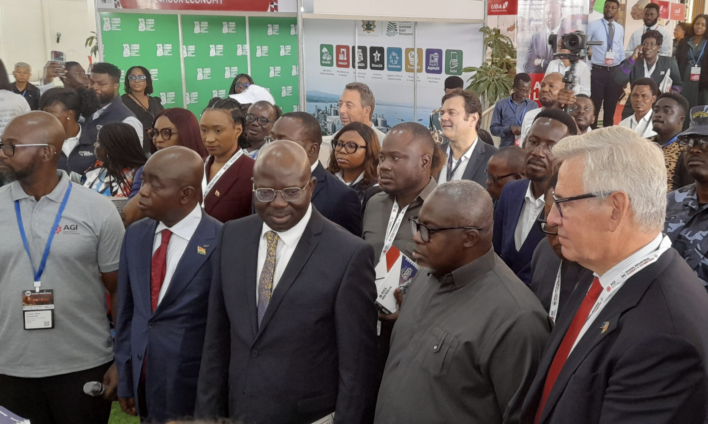
Opening the Ghana Industrial Summit and Exhibition (GISE) in Accra on Tuesday, Mr Ahi said the Government would provide incentives, tax relief, and duty-free machinery imports to support enterprises and manufacturing companies through the 24-Hour Economy Secretariat and related policies targeted at local value addition.
He said a “1.5-gigawatt renewable energy pipeline” would help supply stable energy for manufacturing, agro-processing, and other energy-intensive industries.
“Reliable and affordable power turns business plans into a practical reality. Digital tools properly deployed, convert local production into continental reach. These are the two levels that will decide the next chapter of Ghana’s industrial story,” he said.
The summit, organised by the Association of Ghana Industries (AGI), on the theme: “Driving Sustainable Export- Led Industrial Growth Through Energy Reliability and Digital Innovation,” brought together policymakers, and industry leaders to deliberate on practical solutions to help advance the country’s export-led growth agenda.
Mr Ahi said the economy attracted 652 million dollars in Foreign Direct Investment (FDI) in 2024 and an additional 2.63 billion dollars in 2025, adding that extra momentum and digital tools were required to accelerate the growth.
He said the Government would continue to support micro, small and medium scale enterprises by providing performance-based tax rebate, digital infrastructure support, among other packages in line with the country’s growth agenda.
“The nations we admire did not industrialise by accident, and they did not industrialise alone. They built the discipline of energy security, the culture of quality, and the habit of exporting relentlessly,” Mr Ahi said.
“Ghana has the talent, the enterprise, the natural resources, the institutions and the strategic positioning to succeed…what we need now is consistent execution, strong coordination, and the confidence to pursue our industrial objective with purpose.”
The deputy minister emphasised partnership with the business community while enabling them to produce competitively, create jobs, and support economic growth.
Dr Pharma Kofi Nsiah-Poku, President, Association of Ghana Industries (AGI], urged the Government to roll out incentive packages that would motivate businesses to operate beyond their traditional working hours under the 24-Hour Economy Policy.
He emphasised the role of the private sector in the country’s industralisation agenda and called on development partners to continue providing technical and financing support for the sector.
“If our Ghanaian industry is to move up the value chain and compete on quality and consistency, digital adoption cannot remain optional. It must become as fundamental to our operations as the raw materials we process,” Dr Nsiah-Poku.
“We must invest as businesses, and as a nation in digital literacy, in affordable connectivity, and in the digital infrastructure that allows our exporters to move at the speed the global market now demands.”
Mr Anthony Kwesi Sarpong, Commissioner General, Ghana Revenue Authority (GRA) said the Authority would continue to implement legal and digital transformation reforms to facilitate trade.
He said the GRA would continue to collaborate with the business community, resolve business complaints swiftly, while aiming to double revenue in the years ahead.
Mr Rune Skinnebach, the European Union Ambassador to Ghana, reiterated the EU’s support as a trade partner and would help Ghana to become a regional and continental trade hub.
Dr Ishmael Nii Dodoo, Chief Partnership Officer, 24Hr Economy Secretariat, said the programme would support efforts aimed at moving the country from energy insecurity to energy sufficiency, and help provide an enabling environment for local businesses to compete internationally.
Dr Philip Bradu-Otoo, Economist with the Bank of Ghana, tasked AGI to help develop the requisite manpower and skills to support the country’s economic growth, while the Bank continued to invest and support economic activities.
Latest Stories
-
Akufo-Addo to attend NPP National Delegates Conference as party begins rebuilding process
1 minute -
GRA questions GH¢79.65m Servestar Minwax claim, seeks independent audit
13 minutes -
PROTOA sets September 21 for indefinite strike over rising transport costs
14 minutes -
NPP must unite and rebuild for 2028 – Akufo-Addo
18 minutes -
Ex-convict arrested for allegedly posing as soldier and extorting residents in Ashaiman
23 minutes -
Diesel could hit GH¢28 without government support – NPA CEO
28 minutes -
Four-year water crisis deepens hardship in Agbozume
33 minutes -
Denmark, Ghana must deepen green industrial partnership
39 minutes -
LEAP new grant rates take effect this month, says Gender Minister
45 minutes -
Ghana shifts from advocacy to enforcement on gender equity, disability inclusion
51 minutes -
Ho West communities benefit from 2026 big push rural electrification
57 minutes -
Dorcas Afo-Toffey pledges to sustain SHS scholarship support in Jomoro
1 hour -
Afo-Toffey Supports 1,000 Jomoro SHS freshers with educational materials
1 hour -
Gender Minister hails Ghana School Feeding Programme
1 hour -
Ghana must turn research into practical solutions for development – Chief of Staff
1 hour