

Audio By Carbonatix
Long before Africans interacted with Europeans, Africans had cultivated scientific knowledge that guided them in performing technical activities such as building, farming, fishing, healing the sick, and communicating. Through scientific principles, they could study astronomy, which allowed them to determine seasons for farming, fishing, and hunting.
The knowledge of scientific principles is universal, but the application of these principles to constitute technology is culturally specific. The history of Africa therefore provides evidence that the continent’s people were not strangers to scientific knowledge or its application long before their interaction with Europeans.
However, the contemporary study of science in our schools is one of the enduring legacies of the interactions Africans, including Ghanaians, formerly Gold Coasters, had with Europeans.
Since then, the political class has invested in science education, the outcome of which has seen some Ghanaians, including Prof. Francis Allotey and Letitia Obeng, become pioneers in their respective fields in science related education.
Some historic mission schools have also become noted for their exploits in offering cutting-edge science education. One such institution is Presbyterian Boys’ Senior High School, Legon. As of 2026, PRESEC-Legon remains the only school to have won the National Science and Maths Quiz (NSMQ) nine times.
The record of institutions such as PRESEC-Legon points to what is possible when science education receives the necessary attention and support. Nevertheless, Ghana still has a need to continue supporting science education, especially in less endowed schools across the country.
In the twenty-first century world, scientific knowledge and its application to supporting human flourishing have no equivocation. Yet, given the demand for facilities to aid the study of science education at the pre-tertiary level, the government alone is unable to meet the need.

The conditions necessary for science education further deepen this challenge. An adequate supply of teaching and learning materials, well-trained and dedicated teachers, supportive parents, and disciplined students are all necessary for students to excel. The absence or inadequacy of these conditions can create the perception that excelling in science education is the preserve of a section of the Ghanaian populace.
That perception has, in turn, contributed to the myth that science is extremely difficult. It continues to limit the number of young people who could have otherwise gone into science. Meanwhile, Ghana has a growing need for medical doctors, engineers, and other technocrats to broaden the frontiers of human welfare.
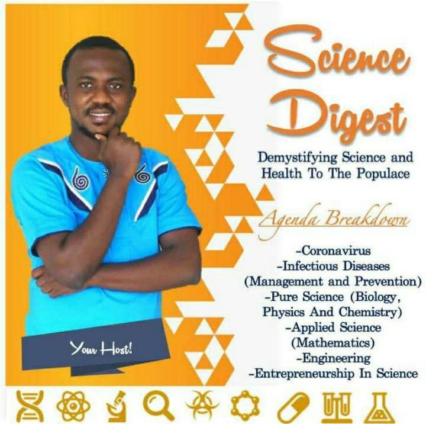
It is against this backdrop that the Science Digest Show, established six years ago, has sought to deconstruct the myths about science education, as well as provide health education to the Ghanaian populace and beyond.
To reach the various social groups in Ghana, members of the Science Digest Show, led by its pioneering founder, Dr Solomon Bediako-Frempong, adopt a teaching and learning approach that communicates scientific and health facts in an easy-to-understand manner for everyone.
The Show’s interest in science education has also brought it into close attention to the National Science and Maths Quiz. The NSMQ, which commenced in 1994, has become an important nationwide platform for second cycle schools to demonstrate their wits in science related education and to stir up the passion of students to go into science education.
But while the NSMQ has provided a national platform for celebrating excellence in science, not every school is well endowed to support science education for its students. It is this gap that has informed some of the initiatives of the Science Digest Show.
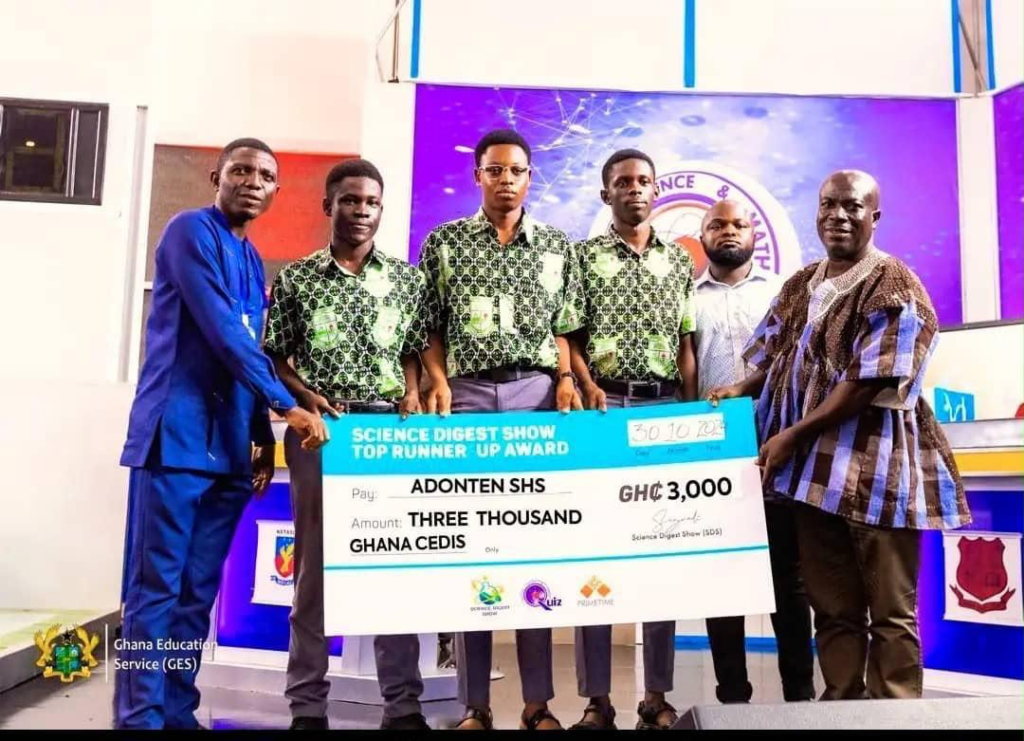
Since 2024, the Show has introduced an award scheme for top runner-up schools in the NSMQ competition. In 2024, the Show awarded a cash prize of GH¢3,000 to Adonten Senior High School.
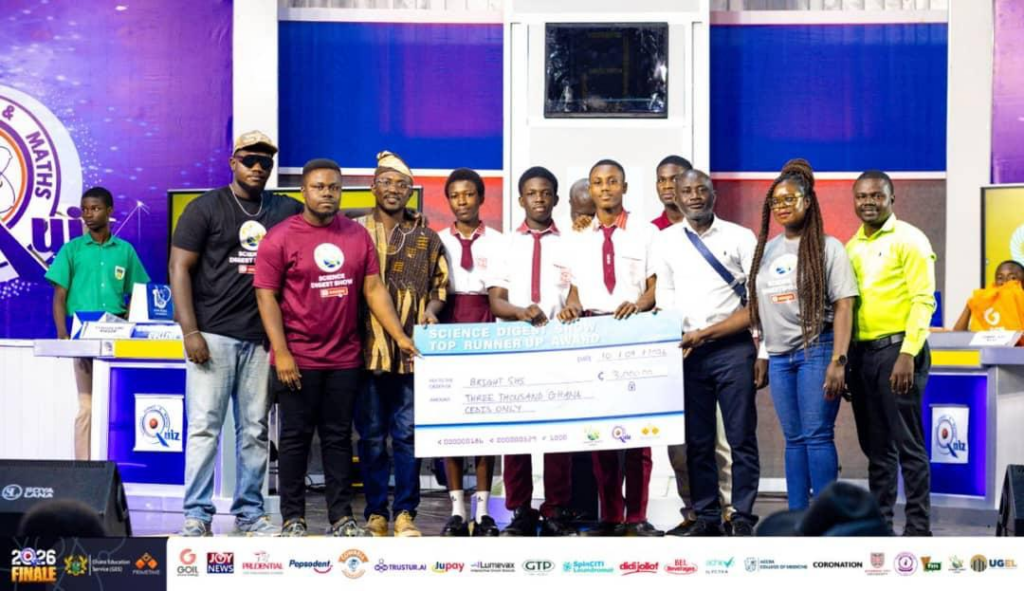
After taking a year off to attend to other pressing needs, the Show returned during the 2026 NSMQ competition to award GH¢3,000 to Bright Senior High School in Kukurantumi in the Eastern Region for being the first private school to reach the semifinals of the competition.
Beyond the cash awards, the Show also offers mentorship training and participates in public education to motivate students with an interest in science education to pursue their passion.
These initiatives speak to a broader concern about the place of science education in Ghana’s development. For the leadership of the Science Digest Show, science education is not only about winning competitions. It is also about creating an environment in which young people can overcome the myths surrounding science, discover their abilities, and pursue fields that can contribute to human welfare.
In all of these activities and initiatives, the leadership of the Science Digest Show, comprising young men and women of conviction and commitment to broadening science education, envisions a country where science and technology would align seamlessly with the philosophy of Ghanaians to keep humanity afloat, making the Earth a potential heaven annex until the end of time.
Latest Stories
-
Lekzy DeComic to feature four generations of comedians on upcoming show
33 minutes -
Nigeria wins arbitration as Sunrise’s $400 million hydropower claim dismissed
40 minutes -
Xhaka under investigation over Covid-19 certificate
51 minutes -
FAW chief questions Infantino’s Fifa reform claims
1 hour -
La Liga chief dismisses Real’s ref conspiracy claims
1 hour -
GMA rejects claims its vessel monitoring system is ineffective
1 hour -
I was close to joining Liverpool in 2016 – Mbappe
1 hour -
Ministry of Sports and Recreation holds national validation workshop on National Sports Policy Draft
1 hour -
‘Do you want me to be happy with this poor performance?’ – Bono East Minister fumes over Kintampo market project with less than 1% work done
2 hours -
London screening honours Nkrumah and 103 years of Ghana cinema
2 hours -
Founder’s Day: Is Nkrumah’s glory fading? – Nkrumah’s iconic fountain at Circle runs dry
2 hours -
GHS calls for stronger systems to ensure safe care for NCD patients
2 hours -
Kufuor calls for Africa’s resources and youthful population to be transformed into opportunities
2 hours -
Mahama administration not clamping down on free speech – Shamima Muslim
2 hours -
Ghana TVET Service, UNESCO, KPMG, Microsoft to train 100,000 facilitators in AI
2 hours