

Audio By Carbonatix
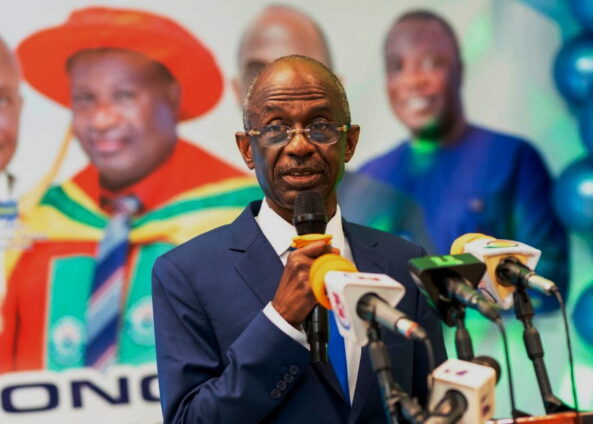
The National Chairman of the National Democratic Congress (NDC), Johnson Asiedu Nketiah, has criticised Ghana’s tendency to discontinue or substantially alter development programmes whenever political power changes hands, saying the practice undermines long-term national development.
He said Ghana needs to develop a culture of institutional and policy continuity in which successive governments build on what is working rather than repeatedly starting afresh.
“A serious country cannot start afresh every four years,” Mr Asiedu Nketiah said while speaking at the 4th Bono Regional Ghana Journalists Association (GJA) Awards in Sunyani on Saturday, September 19, 2026.
Mr Asiedu Nketiah said Ghana has developed a political culture in which programmes associated with a previous administration can become difficult to continue simply because of their political origins.
He said a new government can change the name or structure of an existing programme and sometimes spend additional public funds to arrive at substantially the same destination.
While acknowledging that governments needed to discontinue policies that were not working, he said effective programmes should be improved and maintained for the benefit of citizens.
“Of course, a government must change policies that are failing, and nobody should continue a bad programme for the sake of continuity,” he said.
“But where something is working and public money has already been invested in it, the sensible thing is to improve it and allow the country to receive the benefit.”
Mr Asiedu Nketiah said the principle should extend beyond individual projects to national economic planning.
He said Ghana had experienced severe economic difficulties in recent years, which had constrained government's ability to finance development and placed pressure on households and businesses.
He said the country should learn from that experience rather than repeatedly moving through cycles of crisis and recovery.
“Every government must understand that economic discipline is part of development because the people who eventually pay for indiscipline are ordinary citizens,” he said.
The National Chairman said the improving economic indicators provided an opportunity for Ghana to focus on long-term development rather than merely repairing past difficulties.
The Ghana Statistical Service reports that the economy grew by 6.0% in the second quarter of 2026, while consumer inflation stood at 5.0% in August.
Mr Asiedu Nketiah said the next phase should involve determining how to use improved economic stability to expand productive jobs, strengthen businesses, support agriculture, develop industry and provide the infrastructure required by a growing population.
He said Ghana could predict many of the pressures it would face, including population growth, urban expansion, increased demand for energy, transport and housing, and changing requirements in the labour market.
“Much of this is predictable, which means government has the opportunity to prepare for it,” he said.
He called for forward-looking investments in industrial land, skills development, infrastructure and agriculture before shortages and other pressures became crises.
Mr Asiedu Nketiah also cited infrastructure development in the Bono Region as an example of the need to link public investment to broader economic outcomes.
He said government had committed approximately GH¢4.12 billion to road projects covering about 252 kilometres in the region, including the Jinijini-Sampa corridor, Wenchi-Nsawkaw-Debibi-Sampa, Berekum-Seikwa and the Sunyani Outer Ring Road.
He said such investments should be accompanied by measures to promote agricultural processing, storage, logistics and market access so that communities could derive greater economic benefits from improved connectivity.
Mr Asiedu Nketiah said Ghana's development required consistency over time and urged political leaders to use their accumulated experience to improve future decisions.
“We have tried many things. Some have worked and others have not. We should know enough by now to avoid repeating every mistake before accepting that it was a mistake,” he said.
He also urged journalists to contribute to long-term accountability by tracking government commitments and maintaining accurate records of projects, expenditure and outcomes.
According to him, such records would enable citizens and future generations to establish what governments promised, what they spent and what they ultimately delivered.
“Development is easier to sustain when governments know that somebody is keeping track,” he said.
Latest Stories
-
Mahama has ordered NACOC back into port container inspections – Tanko-Computer
9 seconds -
Photos: Vice President joins ECOWAS Parliament, calls for stronger regional cooperation
44 seconds -
Two arrested over alleged GH¢30k bribe attempt in narcotics case
3 minutes -
Bodi, Juaboso and Bibiani SHSs qualify for 2026 National Public Speaking Competition
5 minutes -
Energy Committee Ranking Member backs TOR turnaround, urges government to sustain local crude supply
7 minutes -
Ghana Water ordered to pay $235m over Teshie desalination plant dispute
7 minutes -
Ghana overlooking therapeutic value of flowers despite $1.49m import bill – Parks and Gardens Administrator
13 minutes -
NPP demands immediate removal of institutional heads over cocaine trafficking cases
19 minutes -
Parliament’s Energy Committee commends TOR for using local engineers in ongoing development
31 minutes -
Share intelligence you have with authorities to deal with drug trafficking – NDC to NPP
39 minutes -
‘You promised 24-Hour economy not 24-hour cocaine trafficking’ – Nana B to Mahama
43 minutes -
Nana Konadu dedicated her life to community transformation — Yaa Asantewaa Agyeman-Rawlings
44 minutes -
Protect the customer by changing who owns the loss
52 minutes -
Counterfeit currency syndicates used churches to hide printing operations – National Security Council Secretariat
1 hour -
NPP press conference on drug busts should be treated with contempt – NDC
1 hour