

Audio By Carbonatix
A major shift is underway in the global climate system, and Ghana should be paying attention.
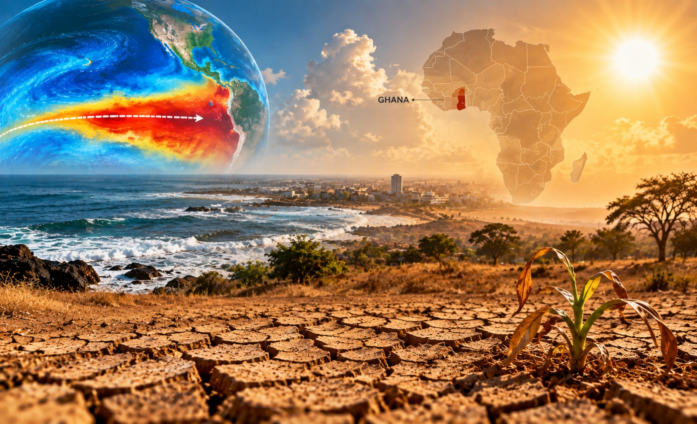
El Niño is strengthening. The latest outlook from the World Meteorological Organization (WMO) indicates that El Niño is now firmly established in the tropical Pacific Ocean and is expected to strengthen further towards the end of 2026 1. Current forecasts indicate an exceptionally high likelihood that El Niño conditions will persist through February 2027.
For Ghana, however, the important question is not simply whether El Niño is occurring. It is “what could it mean for our rainfall, temperatures, agriculture, water resources and livelihoods?”
What exactly is El Niño?
El Niño is a naturally occurring climate phenomenon associated with unusually warm ocean temperatures in the central and eastern equatorial Pacific. Although the Pacific Ocean is thousands of kilometres away from Ghana, changes in its temperature can alter large-scale atmospheric circulation and consequently influence weather patterns across many parts of the world.
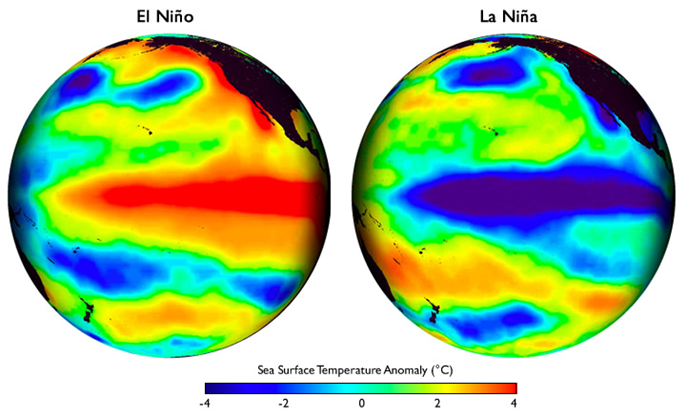
The current event deserves particular attention because it is strengthening considerably. The latest assessment by the National Oceanic and Atmospheric Administration (NOAA) indicates a greater than 90% chance of a very strong El Niño during the Northern Hemisphere autumn and winter of 2026 - 27.
But there is an important caution: a strong El Niño globally does not automatically translate into an equally strong impact in Ghana.
Ghana's climate is influenced by several interacting systems, including the West African Monsoon (WAM), the position and strength of the Inter-Tropical Discontinuity (ITD), sea-surface temperatures in the tropical Atlantic and Gulf of Guinea, atmospheric circulation patterns, land-surface conditions and other regional processes. El Niño is therefore one important driver among several.
What might Ghana experience?
Historically, El Niño has been associated with changes in rainfall over parts of West Africa, but the relationship varies considerably by location and season.
Research from Ghana shows this complexity. A long-term study in the Ho Municipality, for example, found lower mean annual rainfall and reduced major-season rainfall during El Niño years compared with La Niña years 2. However, ENSO accounted for only part of the observed rainfall variability.
Analysis of Accra’s over a century-long rainfall record shows that ENSO influences the major rainy season, with historically lower May–June rainfall during El Niño than La Niña, while Gulf of Guinea and tropical Atlantic temperatures play a stronger role in the short dry and minor rainy season 3.
This means El Niño should not be interpreted as an automatic indication that Ghana will experience drought.
Instead, it should be viewed as “a change in the background climate conditions that can shift the probability of particular weather outcomes.”
For Ghana, one concern will be rainfall variability. Depending on how El Niño interacts with Atlantic Ocean conditions and the West African Monsoon, some parts of the country could experience suppressed rainfall, changes in the timing of rains, longer dry spells or an earlier cessation of seasonal rainfall.
These changes can be important even when the total seasonal rainfall does not appear exceptionally low. A farming community, for example, may receive near-normal seasonal rainfall but still experience crop losses if that rainfall arrives at the wrong stages of crop development or is interrupted by prolonged dry spells.
Agriculture may be one of the most sensitive sectors
This is particularly important for Ghana because much of our agriculture remains rain-fed.
Changes in rainfall onset, distribution and dry-spell frequency can affect planting decisions, crop development and yields. Climate-sensitive crops may be particularly vulnerable where farmers depend heavily on seasonal rainfall.
The agricultural conversation around El Niño should therefore move beyond the question, "Will rainfall be above or below normal?"
We should also be asking: When will the rains start? How well will they be distributed? How long could dry spells last? And when might the rains end?
These are often the questions that matter most to farmers.
Heat should not be overlooked
Rainfall is only one part of the story. WMO forecasts indicate an increased likelihood of above-normal temperatures across much of the world's land areas during the current El Niño period 4.
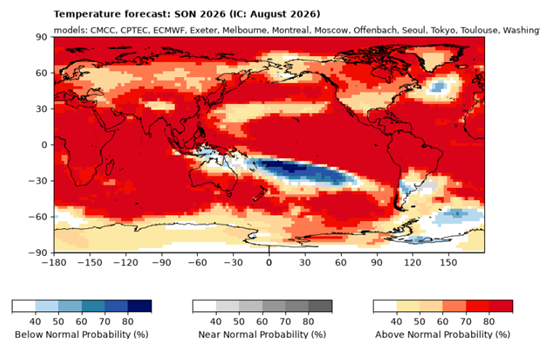
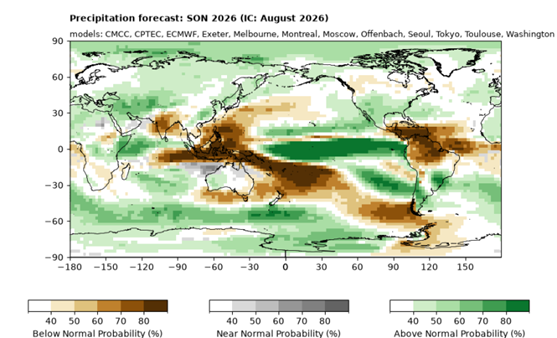
For Ghana, elevated temperatures combined with periods of reduced rainfall could increase heat stress, evaporation and water demand. This has implications not only for agriculture but also for human health, livestock, water resources and electricity demand.
Urban areas deserve particular attention because the urban heat-island effect can compound already high background temperatures.
El Niño does not eliminate the risk of flooding
One misconception must also be addressed. The possibility of an overall drier season does not mean Ghana cannot experience severe floods.
A season can record below-normal total rainfall while still producing individual episodes of extremely heavy rainfall.
Ghana must therefore prepare for the possibility of both rainfall deficits and high-impact rainfall events. In Accra, Kumasi and other rapidly urbanising areas, a few hours of intense rainfall can cause serious flooding regardless of the seasonal rainfall total.
El Niño preparedness should consequently not replace flood preparedness.
The advantage we have is advance warning
Unlike an earthquake, El Niño does not arrive without warning. Scientists can monitor the Pacific Ocean and atmosphere months ahead and track the development of the event.
That allows Ghana to move from climate information to early action.
Agricultural agencies can strengthen seasonal advisories for farmers. Water-resource managers can assess reservoir and supply scenarios. Health authorities can prepare for periods of extreme heat and climate-sensitive diseases. Disaster-management agencies can maintain readiness for both dry conditions and extreme rainfall. The energy sector can also examine how possible changes in rainfall and temperature may affect hydropower generation and electricity demand.
Most importantly, seasonal and sub-seasonal forecasts of the Ghana Meteorological Agency (GMet) should remain central to decision-making. Global El Niño forecasts provide the large-scale picture, but Ghana-specific forecasts are necessary to determine how those global conditions are likely to translate into weather and climate at the national and sub-national levels.
Ghana should prepare, not panic
El Niño is not a forecast of disaster. It is a warning that the climate system is entering a state in which the probabilities of certain weather conditions are changing. The appropriate response is therefore neither alarm nor complacency. It is preparedness.
For Ghana, the coming months should be used to strengthen climate monitoring, communicate forecasts clearly, improve agricultural advisories and ensure that climate-sensitive sectors understand the range of plausible conditions.
The Pacific Ocean may be thousands of kilometres away, but what happens there can eventually influence farms, reservoirs, cities and households here in Ghana.
The key message is simple: El Niño is strengthening, but its Ghanaian impacts are not predetermined. Our best defence is to monitor closely, forecast locally and act early.
****
Author
Jeffrey N. A. Aryee (PhD)
Senior Lecturer & Lab Lead, Climate Diagnostics, Air Quality & AI (CDAI) Lab, Department of Meteorology and Climate Science, KNUST
Latest Stories
-
‘I am disappointed’ – Yaw Ampofo Ankrah breaks silence after NSA suspension
23 minutes -
UK in talks with EU partners to release strategic fuel reserves if needed, BBC understands
26 minutes -
Douglas Boateng receives IMM Institute Supply Chain Lifetime Achievement Award
38 minutes -
Pentecost University to host international sustainability conference
1 hour -
Ampofo Ankrah did not collect World Cup visa money – Lawyer
1 hour -
Baffour Awuah to spend night in EOCO custody – Atta Akyea
1 hour -
Torgbiga Wenya III opposes proposed elevation of 36 Anlo chiefs to Paramount status
1 hour -
The strengthening El Niño and what it could mean for Ghana
2 hours -
Baffour Awuah formally charged with money laundering, loss of public funds – Lawyer
2 hours -
Drone flight over EOCO building could attract 30-year jail term – Security consultant
2 hours -
Flying drone over EOCO premises is strictly prohibited – Security consultant
2 hours -
SIC file was surrendered to client, EOCO has no reason to search Manhyia South MP’s firm – Atta Akyea
2 hours -
EOCO search of Baffour Awuah’s law firm raises confidentiality concerns – Atta Akyea
2 hours -
“I will never ignore an invitation from EOCO if I had received one” — Manhyia MP
2 hours -
Baffour Awuah ready to cooperate fully with EOCO investigation – Bosome Freho MP
2 hours