

Audio By Carbonatix
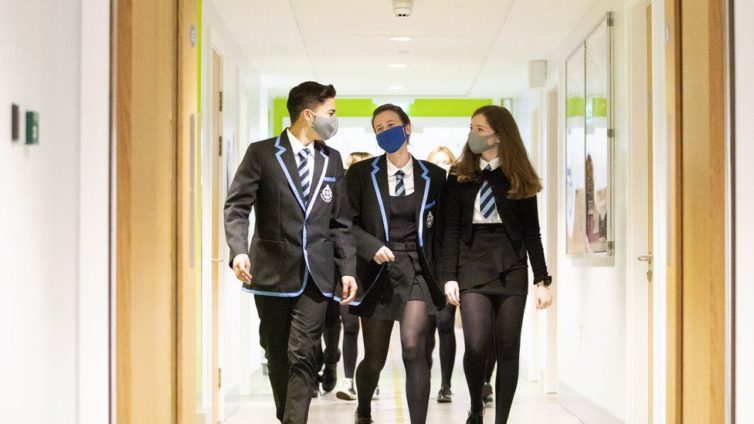
Face masks are to be worn in secondary classrooms in England's schools to reduce the spread of the Omicron variant, the government has announced.
The temporary reintroduction of face coverings aims to address concerns about schools remaining open for face-to-face learning this coming term.
Meanwhile, six school staff unions have issued a demand for urgent action to limit the spread of the virus.
They warned national exams would be put at risk without further measures.
They also called for air-cleaning units, financial support for absence cover, help with on-site testing and a relaxation of the Ofsted inspection regime.
Doubts that ex-teachers will return by JanuaryTeaching union calls for school reopening delayWill schools be open in January?
Schools across the UK are re-opening after the Christmas break over the next week, with pupils being asked to take part in onsite Covid testing.
Until now, England was the only one of the four UK nations where face masks were not recommended for pupils in classrooms. Teachers will not have to wear them under the new guidelines.
'Herculean effort'
Announcing the change - just a few days before schools reopen - Education Secretary Nadhim Zahawi said face coverings would be required until 26 January.
This is when the current national Plan B Covid measures run out, although they will be reviewed on or close to 4 January.
He said: "I'm looking forward to welcoming pupils back next week to continue their face-to-face learning, which is so important for their education and wellbeing.
"There is no doubt that the Omicron variant presents challenges but the entire education sector has responded with a Herculean effort, and for that I thank each and every one of you.
"The prime minister and I have been clear that education is our number one priority. These measures will bolster our support to schools as we do everything in our power to minimise disruption."
The government also announced it would be making 7,000 air cleaning units available to early years setting, schools and colleges.
Staff absences and rising Covid rates at the end of last term - caused by the rapid spread of the Omicron variant - have led to fears of further disruption to education.
Staff absences
The four main teaching unions covering England, Wales and Northern Ireland - ASCL, NAHT, NEU and NASUWT - plus the GMB and Unison, have issued a joint statement calling for urgent steps to help schools.
"We need the minimum amount of educational disruption this term in order to avoid a third successive year where GCSEs, A-levels and other exams have to be cancelled, and thereby removing the uncertainty and additional workload for students and teachers," it says.
"It is essential, therefore, that the government takes immediate and urgent steps to mitigate the risk of Covid transmission and that it provides more support to minimise disruption in schools and colleges."
Geoff Barton, General Secretary of the Association of School and College Leaders, said while there were obvious drawbacks to using face coverings in classrooms, it was clear that the Omicron variant poses a very significant additional risk.
"It is absolutely essential that everything possible is done to reduce transmission and ensure that children remain in school."
He added that the government's decision on masks was recognition that the spring term will be extremely challenging.
"The biggest problem they face is the likelihood of high levels of staff absence caused by the prevalence of the Omicron variant."
He added that while schools and colleges will do their best to minimise the impact on pupils, there was a real possibility that some classes and year groups may have to be sent home for short periods of remote learning.
Ventilation units
General Secretary of the National Association of Head Teachers Paul Whiteman said reintroducing face masks in secondary classrooms was a sensible move, but that more should be done.
"Where schools need air filtration units to improve areas of poor ventilation, they should be provided with them, without delay."
He welcomed the 7,000 new units but said "adequate ventilation in classrooms should not be limited to first come, first served".
The process by which schools can obtain these units is due to be set out by the DfE shortly.
Dr Mary Bousted, Joint General Secretary of the National Education Union, said "finally, the government has been forced to recognise, and react to, the scale of the Omicron variant and its potential impact on education".
"The recommendation on wearing facemasks in secondary school classrooms is overdue - but it should be a requirement."
Latest Stories
-
Haruna Iddrisu calls for limits on annual university accommodation fee increases
18 minutes -
Today’s front pages: Tuesday, October 13, 2026
1 hour -
Wealth Over Water: How Galamsey Is Threatening Ghana’s Water Security
2 hours -
LA 2028: Black Queens pumped up for second leg of Mauritius tie
2 hours -
LA 2028: Black Queens hold final training session ahead of second leg against Mauritius
2 hours -
Standards are not Seasonal: What the EC appointments teach both sides
3 hours -
King Mohammed VI urges private sector to create youth jobs and spread benefits of growth
3 hours -
KGL U17 Colts 2026: Greater Accra win title after penalties win over Western Region
3 hours -
UK Investment Roadshow opens in London to advance UK-Ghana growth partnership
3 hours -
Assemblies of God requires pastors to resign before entering partisan politics – Rev. Wengam
3 hours -
Ghana targets 20% annual reduction in maternal deaths – Health Minister
3 hours -
Cyber attacks in Africa grow faster than global rate, report finds
3 hours -
Ghana signs UAE deal to create 5,000 overseas jobs
3 hours -
One Million Coders Programme targets 100,000 digital jobs in two years – Sam George
3 hours -
John Jinapor, Italian Ambassador explore opportunities for energy sector investment
3 hours