

Audio By Carbonatix
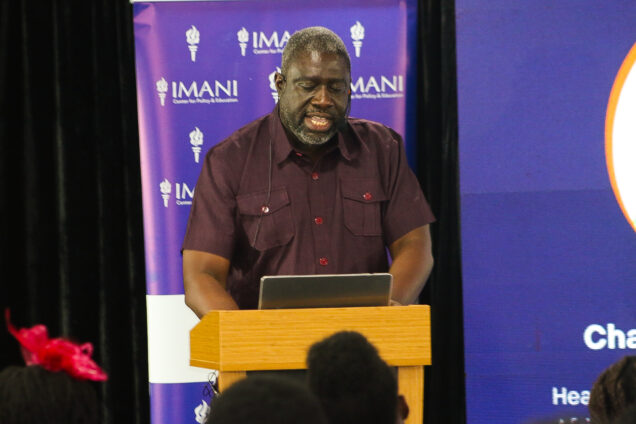
The Head of Capacity Development at the West Africa Civil Society Institute (WACSI), Charles Kojo Vandyck, has urged civil society organisations (CSOs) in Africa to reduce their dependence on donor funding and develop more diverse and sustainable sources of income.
He said relying heavily on grants could undermine the long-term sustainability of civil society organisations, stressing that grants should form only part of a broader financing structure.
Speaking on Tuesday, August 25, at the Students and Young Professionals African Liberty Academy (SYPALA) 2026, organised by the IMANI Centre for Policy and Education in partnership with the University of Professional Studies, Accra (UPSA), Mr Vandyck said African CSOs needed to look beyond traditional donor support.
“Grants will always remain important, but grants should be one part of the financing architecture, not the entire architecture. It should be just an option,” he said.
He identified diaspora giving, social enterprise, digital fundraising, trading, investment income, government contracts and strategic partnerships as some of the avenues CSOs could explore to broaden their financing base.
Mr Vandyck said diaspora communities, in particular, represented a significant but underused source of funding for development initiatives on the continent.
“Most of our brothers and sisters, mothers, fathers, uncles, who send money to us, sometimes when they collect all that money, it's more than the money that we receive from our foreign partners and development assistance. So there's an opportunity to tap into their resources,” he said.
He also called for the development of an African giving ecosystem in which businesses, institutions, individuals and diaspora communities could contribute to social development.
“We need institutions to give, we need African businesses to give, we need African individuals to give, we need diaspora communities to give. So we really need to build that infrastructure that allows people to give with confidence,” he said.
Mr Vandyck further urged CSOs to become more economically aware by identifying and making productive use of the assets and expertise they already possess.
He clarified that becoming more entrepreneurial did not mean turning civil society organisations into businesses, but rather developing the capacity to understand their economic value and use it to strengthen their institutions.
“I'm saying that organisations, NGOs, CSOs, FCOs, they need to become more economically intelligent. They need to understand their assets. They need to understand the value of their knowledge. They need to understand how to monetise their expertise, their research capabilities, their networks, their facilities, their intellectual property,” he said.
He said organisations should also place greater emphasis on unrestricted or flexible funding, which he noted could be used to strengthen institutions rather than being tied exclusively to specific project activities.
“Restricted money is for project activities. Unrestricted money or flexible money can help you actually build your organisation,” he said.
Mr Vandyck also encouraged CSOs to strengthen relationships beyond donors by engaging more closely with communities, businesses, policymakers, academia, journalists, movements and philanthropists.
He said shrinking resources should not push organisations into unhealthy competition, but should instead encourage greater collaboration.
“The new competitive advantage is collaboration advantage. It's about how we come together, what we can achieve together. Because a lot of things we can achieve together, we cannot achieve alone,” he said.
The four-day SYPALA 2026 brings together students, young professionals, academics, entrepreneurs and policy thinkers to examine issues including governance, economic freedom, development and public policy.
Latest Stories
-
Embassy of Denmark celebrates World Maritime Day
6 minutes -
Linking LEAP to productive inclusion could cut extreme poverty by 2030 – UNICEF
1 hour -
Trade Ministry backs use of creative arts to rehabilitate prison inmates
1 hour -
Negotiations with government to continue despite strike suspension – GNAT
1 hour -
‘Ghana cannot afford to waste public resources; every cedi has a job’ – Ato Forson
1 hour -
Ghana expects economic boost as World Assemblies of God Congress brings 10,000 delegates to Accra
1 hour -
Joy in Nayilifong as Farouk Aliu Mahama donates 100kVA transformer to improve power supply
2 hours -
Chief Justice urges employers to tackle mental health stigma in workplaces
3 hours -
Analysis: Ghana’s yellow fever numbers reveal a gap between vaccination and protection
3 hours -
Education Ministry welcomes suspension of teachers’ strike
3 hours -
Vice Chancellors Ghana appeal to striking university administrators to resume work
4 hours -
KNUST postpones 2026/2027 academic year reopening indefinitely amid GAUA strike
4 hours -
Fire destroys mattress factory at Sokoban in Kumasi
4 hours -
ECOM-SMS Ghana launches ‘Agriculture Our Future Clubs’ to address threat of ageing farmer population
4 hours -
Nicholas Atsu Kumi
4 hours