

Audio By Carbonatix
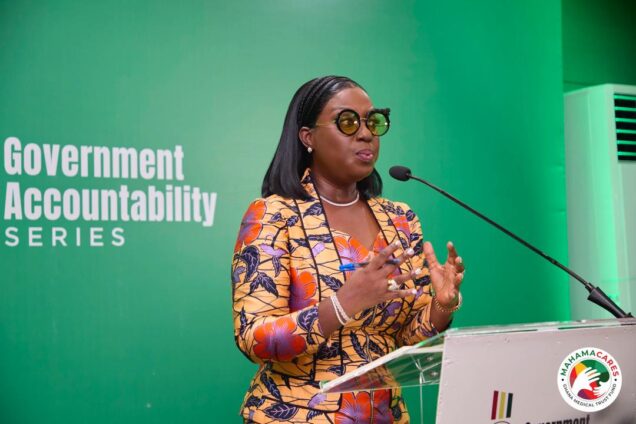
The Administrator of the Ghana Medical Trust Fund (GMTF), Obuobia Opoku-Darko, has opened up about the financial difficulties she faced after losing the 2012 parliamentary election in the Weija-Gbawe Constituency.
According to her, the immediate aftermath of the election exposed her to a sharp change in circumstances, including a period when she and her household struggled to afford basic needs.
“When we lost the 2012 one, at a point in time we couldn't even buy pre-paid credit for the house because there was no money.”
Speaking to a group of people at a thanksgiving service to mark her 49th birthday, Ms Opoku-Darko recalled how her home, which was ordinarily busy with people seeking her assistance, suddenly became quiet after her electoral defeat.
She said she had become accustomed to people arriving at her residence from the early hours of the morning, often with various requests for assistance.
“And the day we lost that election, I woke up in the morning, drew my curtain upstairs, and I realised that there was nobody at the gate.”
Listen to her in the audio below:
She added: “Ordinarily by 4.30 a.m. my gate is full. They come with all sorts of stories. They come with all sorts of stories, and I had to help. When I didn't have, I had to borrow to help.”
However, she said the reality changed dramatically after the election, when those who ordinarily turned to her for assistance were no longer around.
“But when I lost the elections, and I woke up that morning, and I drew my curtain, there was nobody there.”
For Ms Opoku-Darko, the experience offered a profound lesson about the nature of relationships, particularly during periods of difficulty when the attention and support that often accompany political influence disappear.
“That is life. In your times of despair, in the times that you wake up and you feel that you need that warm hug, you need that one person that can say a word to you, just to calm you down, just to let you know that you are not alone, my dear. I am here with you.”
She said such moments can reveal who is genuinely available to offer support when circumstances become difficult.
“In those times, in those times, who do you find? Who is that person that will lend that shoulder?”
She said her own experience ultimately reminded her of her faith.
“And in those times, that's when you remember your God. And that's why this morning I ask you, where is your God?”
Ms Opoku-Darko said she intended to use her personal experience to encourage those listening to reflect on where they turn for support when they face difficult moments.
“And I'm going to take you through exactly what I have here, and by the time I am done, I'm sure you will understand, and you will answer that question before you leave here. You will know where your God is.”
‘Everybody needs help’
The GMTF Administrator also reflected on the demands placed on people who are often perceived as strong, dependable and capable of helping others.
She said although she may appear cheerful and energetic in public, she also has personal challenges that people may not necessarily see.
“You may see me all smiles every day, jumping around, organising my mentees, planning who is going where, what's happening to this one, doing all sorts of things. One way or the other, everybody needs help. We need to look for help for them.”
But she questioned whether people who constantly turn to others for assistance ever stop to consider the difficulties those people may themselves be facing.
“But I ask, has anybody thought how I feel? What are my issues? What am I going through?”
She said people can become so accustomed to receiving help from someone that they fail to recognise when that person is also in need of support.
“You just simply keep pouring out. You are always pouring out, and I'm telling you, you will be empty soon.”
Using the analogy of a cup, Ms Opoku-Darko said people who continually give to others must also find ways to replenish themselves.
“As you pour out, if you don't get a refill, what happens? The cup will be empty.”
She therefore challenged her audience to consider what they were doing to replenish their own emotional and personal resources while dealing with the demands of everyday life.
“So, what are you doing to fill that cup that you keep pouring out?”
She cited the various pressures people face, including financial obligations, business difficulties and problems in relationships.
“The kids are going to school, you are looking for school fees, your chop money, your business is down, your marriage is some way, your relationship is some way, and all you keep doing is that you keep pouring out.”
She concluded that people who continually support others must also seek support for themselves.
“You need a refill. Who is going to help you with that refill? Who is going to help you with that refill? And then you throw your hands up in despair.”
Latest Stories
-
Power restoration fault suspected in Kumasi Central Market fire
5 hours -
The 7-foot giant of Ngleshie Amanfro: Seven-foot Ghanaian Ephraim Saawa dreams of joining the national basketball team
6 hours -
Government promises support for Kumasi Central Market fire victims
6 hours -
Vibes The Movie: Big Ghun’s Ghanaian film earns five nominations at 2026 REFFA
6 hours -
‘I’m a fulfilled man’—Justice Korbieh on missing out on Supreme Court despite two nominations
7 hours -
MamaCare CEO warns unresolved conflicts among health workers could undermine maternal and neonatal care
7 hours -
Health professionals urged to translate medical knowledge into practice to save mothers
7 hours -
Retired judge Justice Francis Korbieh charges 1,568 new lawyers to uphold integrity
8 hours -
Conflicts among care providers linked to maternal, neonatal deaths – Expert
8 hours -
GIS marks 10th TIME conference, champions improved teaching practices
9 hours -
BRICS Or Balance? What Ghana’s bid really means
9 hours -
GPRTU wants full TRAFFITECH-GH implementation to start in 2027
9 hours -
How 10-mile walks for basic education birthed a 50-year legal career for Justice Korbieh
9 hours -
Mahama announces plans to import electric wheelchairs for PWDs
9 hours -
KGL U17 Colts 2026: Western beat Prempeh Elite Academy to set up final final with Greater Accra Region
10 hours