

Audio By Carbonatix
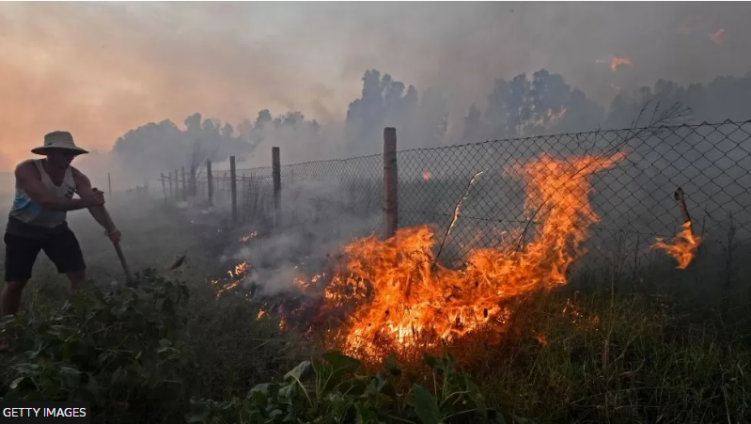
At least 34 people have been killed and thousands evacuated after wildfires broke out across Algeria, the country's interior ministry says.
Outbreaks of 97 wildfires were recorded across 16 provinces affecting forest, crops and farmland on Monday.
About 8,000 firefighters were working to bring the blazes under control, authorities said.
Twenty-six people were also injured and 1,500 evacuated from their homes in Fenaia, Bejaia, Zbarbar and Bouira.
Ten soldiers were killed battling the fires in Bejaia, the Algerian defence ministry said.
The most extensive fires, in the mountainous Kabylie region to the east of Algiers, spread to residential areas in the coastal towns of Bejaia and Jijel, fanned by high winds.
Authorities said they had launched a judicial investigation into the causes of the fires.
Northern Algeria has been experiencing a record heatwave in recent days, with temperatures reaching 48C.
Temperatures in several regions in North Africa are up to 7C higher than normal for the time of year.
Algeria's Meteorological Office has warned that temperatures of more than 48C are likely to continue until the end of the month in the north of the country.
On Monday, Algeria's national electricity and gas company, Sonelgaz, said it had recorded a "historic peak" in electricity consumption.
A leading outlet critical of the government, Tout Sur l'Algerie (TSA), reported earlier this month there had been an unprecedented use of air conditioners, saying current methods of construction were less effective than traditional bricks in keeping homes cool.
Meanwhile, southern Europe has been dealing with a challenging heatwave that has seen Greece ravaged by wildfires.
The UN weather agency, the World Meteorological Organization, has warned that the heatwave in Europe could continue into August and that the extreme temperatures sweeping the globe are the new normal in a world warmed by climate change.
The three hottest days ever recorded were in July, according to the EU climate and weather service, Copernicus.
The average world temperature hit 16.89C on Monday 3 July and topped 17C for the first time on 4 July, with an average global temperature of 17.04C.
Provisional figures suggest that was exceeded on 5 July when temperatures reached 17.05C.
The World Meteorological Organization says extreme weather patterns highlight the need for greater climate action.
Climate change increases the risk of the hot, dry weather that is likely to fuel wildfires. The world has already warmed by about 1.1C since the industrial era began and temperatures will keep rising unless governments around the world make steep cuts to emissions.
Latest Stories
-
6,079 promotion cases fully processed and paid – CAGD says amid nationwide teachers’ strike
3 minutes -
Teacher unions to meet government Monday over nationwide strike
18 minutes -
Photo story: Republic Bank-JoyNews Habitat Fair clinic wraps up after three days of housing solutions, expert engagement
21 minutes -
National Peace Council urges investment in youth to sustain Ghana’s peace
43 minutes -
Afenyo-Markin urges youth to speak up against injustice
54 minutes -
CAF annuls Edo Queens victory, orders WAFU B final to resume from extra time
1 hour -
Interior Minister urges traditional authorities to enforce anti-bushfire bye-laws
1 hour -
3rd Republic Bank-JoyNews Habitat Fair Clinic ends on a high note after three days of strong patronage
1 hour -
Ten climbers missing after avalanche hits Himalayan base camp
2 hours -
NPP had more permanent fuel relief measures than current GH¢2 diesel cut – Amin Adam
2 hours -
Photos from the 3rd Republic Bank-JoyNews Habitat Fair Clinic
2 hours -
Ethiopia’s army promises restraint amid fears of new civil war
3 hours -
Amin Adam calls for review of fuel taxes as diesel prices remain above GH¢18
3 hours -
World Vision Ghana, Ahafo districts sign MoU for universal WASH coverage
4 hours -
When the gold engine stutters: What Ghana’s Cedi and reserves are telling us about the new economic architecture
4 hours