

Audio By Carbonatix
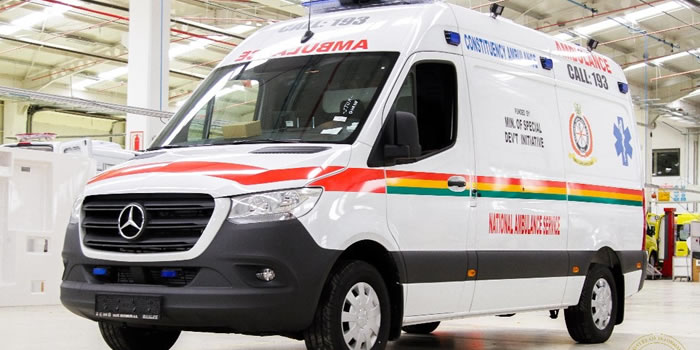
The National Ambulance Service (NAS) has issued a rebuttal to allegations of negligence following the viral circulation of a video involving a newborn baby.
The footage, which sparked widespread public outrage, alleged that the NAS declined a request to transfer a neonate from the Kukuom District Hospital to the Goaso Government Hospital due to a purported lack of oxygen.
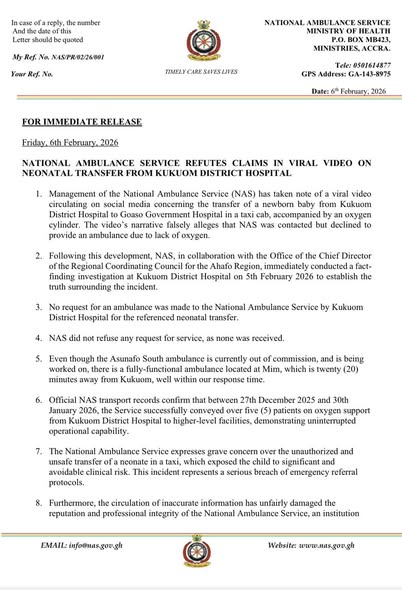
However, in a detailed statement released on Friday, 6th February 2026, the NAS clarified that a forensic audit of dispatch logs and on-site investigations conducted at the Kukuom District Hospital on 5th February 2026 proved no such call was ever placed.
The Service maintains that the narrative suggesting they refused to assist is factually incorrect, as they were never activated for the emergency.
“No request for an ambulance was made to the National Ambulance Service by the Kukuom Government Hospital for the referenced neonatal transfer,” the statement confirmed.
Addressing the specific claim that a lack of oxygen prevented the transfer, the NAS stated that because no request was received, the issue of oxygen availability never arose during the period in question.
The Service emphasised that it did not refuse any request, as the Kukuom facility failed to follow the standard operating procedures required to trigger a neonatal emergency dispatch.
The Service expressed grave concern that the infant was eventually moved in a taxi, a mode of transport entirely unsuited for a critical medical referral.
The NAS described this unauthorised and unsafe transfer as a serious risk to the health and safety of the newborn, noting that such actions bypass the life-saving equipment and trained paramedics available in state ambulances.
The incident has highlighted a critical lapse in inter-facility coordination within the region.
To prevent a recurrence, the National Ambulance Service has called on all health facilities to strictly adhere to established emergency protocols.
Key procedural requirements for neonatal transfers include:
- Official Dispatch Request: Facilities must contact the NAS control room to log a formal request for transfer.
- Pre-arrival Coordination: Ensuring the receiving hospital (Goaso Government Hospital) is prepared for the incoming neonate.
- Qualified Supervision: Ensuring patients are moved in an environment equipped with oxygen and neonatal support systems.
The NAS reiterated that it remains committed to providing 24-hour emergency medical services across the country.
By condemning the use of taxis for medical emergencies, the Service is pushing for a revision in how district hospitals manage critical referrals to ensure patient safety is never compromised for the sake of convenience.
Latest Stories
-
A source of excellence across generations – Vice President Opoku-Agyemang lauds Mfantsipim
51 minutes -
(Photos) Mfantsipim School launches historic 150th anniversary
1 hour -
Knights and Ladies of Marshall group backs Catholic Bishops’ stance on anti-LGBTQ+
2 hours -
Bright Simons writes: All the Filla in the Ibrahim Mahama/E&P – Gold Fields Saga
3 hours -
Monetise Idiocy In Ghana
3 hours -
The Ghanaian prophet and the mysterious death of his scottish wife Charmain Speirs
3 hours -
Nearly 400 sentenced in Nigeria for links to militant Islamists
4 hours -
Ghana’s recovery supported by gold strength despite global oil price pressures – Standard Bank Research
4 hours -
Methodist Church hails Mfantsipim@150; calls for “fresh consecration” to excellence
4 hours -
‘Excellence is our inheritance’ – Nana Sam Brew-Butler hails Mfantsipim’s 150-year reign in leadership
4 hours -
Kwaku Azar writes: A-G vs OSP
4 hours -
Mfantsipim–Adisadel rivalry built excellence, not division – Sam Jonah
5 hours -
Vice President launches Mfantsipim’s 150 years of shaping Ghana’s greatest mind
5 hours -
I assure Otumfuo, Mahama will join him to commission KNUST Teaching Hospital by end of this year – Haruna Iddrisu
6 hours -
Barcelona dominate derby to extend La Liga lead
6 hours