

Audio By Carbonatix
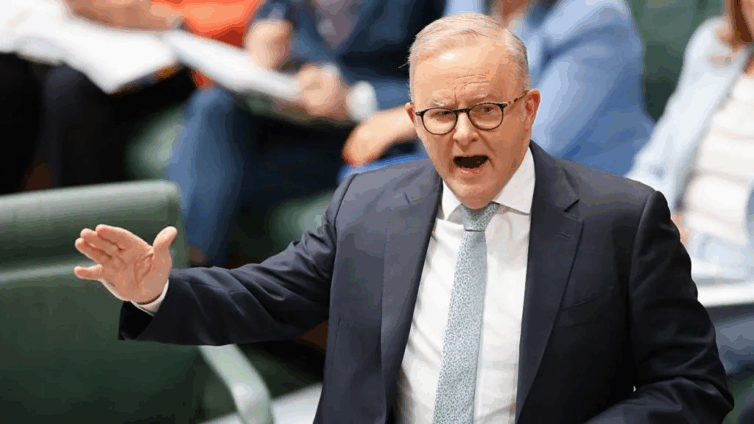
Australian Prime Minister Anthony Albanese says his government will crack down on hate speech following Sunday's deadly shooting at Bondi Beach that targeted a Jewish festival.
Fifteen people were killed when two gunmen opened fire at an event to mark the first day of Hanukkah.
New laws will target "those who spread hate, division and radicalisation", Albanese told reporters in Canberra.
The home affairs minister will also be given new powers to cancel or refuse visas for those who spread hate and a new taskforce will be set up to ensure the education system "prevents, tackles and properly responds to antisemitism".
The new laws will also include penalties for preachers and leaders who promote violence, a new federal offence of "aggravated hate speech", and the introduction of "hate" as an aggravating factor in sentencing crimes for online threats and harassment.
"Every Jewish Australian has the right to feel safe, valued and respected for the contribution that they make to our great nation," Albanese said.
"The terrorists, inspired by ISIS... sought to turn Australians against each other. Australians have responded to that act of hatred with love and sympathy for those in mourning."
Tensions have been high in the country since the shooting, with police detaining seven men in southwest Sydney on Thursday after receiving a tip that a "violent act was possibly being planned", New South Wales Police said in a statement.
Police said they did not identify "any connection" to their investigation into Sunday's attack in Bondi.
Two cars were "intercepted" at George Street, police said. In videos shared by local media sites, armed officers appeared to detain people on the street just hours after Albanese made his speech.
Antisemitism envoy Jillian Segal, who also spoke at the press conference, said the country was "at a very important moment not only for our community, but for fighting antisemitism around the world."
Albanese said his government would be "fully supporting and adopting" the recommendations Segal put forward in July in a report.
Her report was criticised by some upon its release in July due to its implications for free speech, including plans to monitor universities and arts organisations and withhold funding if they were deemed to have failed to act against antisemitism. There were concerns for instance, that the funding could be used to silence pro-Palestinian protests.
The Jewish Council of Australia said it supported Albanese's commitment to act, including his focus on gun reform and online hate.
But, it said it was "concerned that elements of today's announcement resemble long-standing proposals from the pro-Israel lobby which have nothing to do with addressing violent extremism."
"If education initiatives like university scorecards become a form of ideological policing - particularly where they are used to limit legitimate criticism of Israel - they will only make Jews less safe, and do the opposite of combating antisemitism," Jewish Council of Australia executive officer Dr Max Kaiser said.
Meanwhile, Albanese acknowledged accusations from the Jewish community that his government had not done enough to prevent antisemitism since the 7 October attack on Israel by Hamas, and said more could have been done.
"I accept my responsibility for the part in that as prime minister of Australia," he said. "But what I also do is accept my responsibility to lead the nation and unite the nation. Because what people are looking for at this time isn't more division."
Home Affairs Minister Tony Burke said the government was "shifting the threshold" on hate speech.
"There have been individuals who have managed to exploit a nation that had different principles of freedom of speech and have gone right to the limits of language that is clearly dehumanising, unacceptable, having no place in Australia, but have not quite crossed the threshold to violence," he said.
Daniel Aghion, the President of the Executive Council of Australian Jewry, the peak body representing Australian Jews, said he would "need to see the details before making an assessment as to whether the measures are likely to live up to their billing."
"We warned of the risk of not dealing with antisemitism in this country promptly and effectively after 7 October. It is an absolute tragedy that it has taken a massacre of Jewish and other Australians for that step to be taken."
Latest Stories
-
Investigators meet family, community over deaths of 3 children found in car trunk
7 minutes -
Teacher strike: FWSC blames new allowance demand for deadlock with teacher unions
40 minutes -
Aboboyaa Company Ltd CEO donates 5 tricycles to Ghana Prisons Service
52 minutes -
National Cathedral: ‘There’s no clarity as to what they want to use the site for’ – Afenyo-Markin on site’s future
54 minutes -
Investigators meet family, community over deaths of 3 children found in car trunk
55 minutes -
Teachers have legitimate concerns, but prolonged strike will affect pupils – Joseph Kumah
1 hour -
Ahafo NHIA Beats 2025 Target to Secure Second Year of Universal Health Coverage
1 hour -
Innovative Teachers threatens legal action over exclusion from Collective Bargaining Agreement negotiations
1 hour -
17-member committee formed to address concerns over Adipa landfill
1 hour -
Team Volta wins NPA 2026 Staff Welfare Week Quiz
2 hours -
Team Eternity Ghana releases new album “The Promise – Phase 1”
2 hours -
Inside the human genome: Why scientists are still discovering who we are
2 hours -
PAC grills Central Regional Coordinating Council over GH¢14.9m payments processed outside GIFMIS
2 hours -
Ghana’s industrial dream at risk? How the Yuan policy could deepen China dependence
2 hours -
Teachers’ strike: Government has funds, but processes are causing delays – Education Committee Vice Chair
2 hours