

Audio By Carbonatix
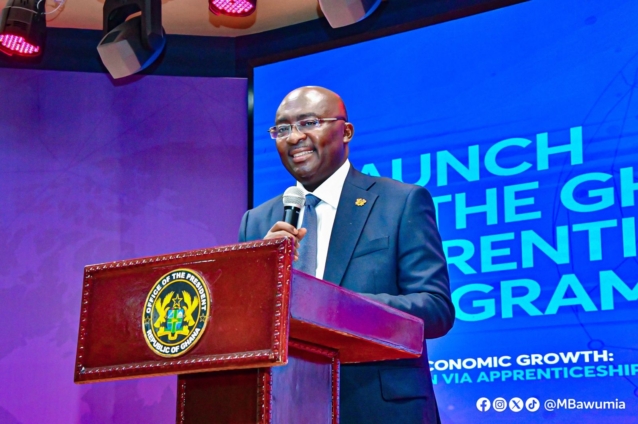
Vice President Dr Mahamudu Bawumia Wednesday, March 13, unveiled the School Licensing and Inspection Management System (SLIMS) to promote efficiency in education data management and streamline the licensing regime of pre-tertiary schools.
The initiative, developed by the National Schools Inspectorate Authority (NaSIA), is to help regulate and supervise more than 80,000 pre-tertiary schools across the country.
It would revolutionise the way all pre-tertiary schools are licensed, inspected and evaluated.
The system stands as a testament to Ghana’s commitment to educational excellence and digital innovation.
The SLIMS was piloted in 2023 to ensure real-time data collection and submission of reports at the school level.
Speaking at the launch of SLIMS in Accra, Vice President Bawumia said the Akufo-Addo-led Government was determined to transform the country’s education system using innovative technology.
“In 2017, the President Akufo-Addo-led administration set out to fulfill the promises outlined in the New Patriotic Party’s 2016 Manifesto,” he said.
“This include shifting the structure and content of our education system from merely passing examinations to building character, nurturing values, and raising literate, confident, and engaged citizens who can think critically.”
It, therefore, resulted in the enactment of the Education Regulatory Bodies Act, 2020 (Act 1023), which changed the name of the then National Inspectorate Board (NIB) to the National Schools Inspectorate Authority (NaSIA).
The Act empowered, strengthened, and equipped NaSIA as an independent body to fully discharge its mandate.
Thus, NaSIA is the first attempt by the Government to regulate private education effectively, the Vice President explained.
“Our government understands and appreciates the role digitalisation is playing to support us in better policy design, and improved public sector accountability, by strengthening how we collect and analyse data, as well as how effectively we deliver public services and raise revenues,” he said.
“The Authority identified several challenges associated with the issuance of licenses to private schools. Key among them being Inspectors having to go to the school and complete a number of paper forms.”
Data entry, analysis and processing took weeks, while collection of cash associated with services took an average of four months turnaround time for the issuance of licenses, with several challenges regarding the delivery of licenses to schools.
The Authority, in its determination to resolve those challenges, embarked on a much-needed digitalization initiative in 2019, resulting in the development of the School Licensing and Inspection Management System, Dr Bawumia added.
The SLIMS has streamlined inspection and licensing processes facilitating customised interventions and support to all schools.
Its database could be accessed by school stakeholders through a password-controlled login.
Each school would also have a mini dashboard populated with reports and other information needed to improve learning outcomes.
The system is also integrated with the Ministry of Education’s dashboard, ensuring seamless data submission.
The Vice President said the system had further deepened the country’s resolve to ensuring reform in education based on the principles of transparency and accountability.
Dr Haggar Hilda Ampadu, the Inspector-General of Schools, NaSIA, in her welcome remarks, said with the advent of SLIMS, proprietors could sit in the comfort of their offices, log in to their school’s portal, request for inspection, apply for a license, and make payment through Ghana.gov.
Upon the approval of the application by the Authority, SLIMS issues the proprietors a temporary License and upon inspection, the school is issued a hardcopy license from the SLIMS within a week.
She said the system was accessible even in the remotest areas of the country, possessing offline capabilities for data collection anytime, anywhere with or without internet connectivity.
The Licensing and Inspection modules of SLIMS were deployed in 2023.
The Inspection module was used to inspect 1,107 schools in 2023, and the Licensing module contains data on all 16,299 private schools that had been licensed by the Authority so far.
Dr Ampadu urged private schools to cooperate with the Authority in this much-needed effort.
In addition, the Inspection module contains data on 22,717 public schools, she said.
Currently, the Authority provides data on private schools to the Ghana Statistical Service (GSS), demonstrating its vital role in educational data management.
The data further equips policy and decision makers with the insights needed to make informed decisions and identify gaps in the education system to guide resource allocation.
Latest Stories
-
Today’s front pages: Friday, October 2, 2026
8 minutes -
GPL 2026/27: Opoku Agyemang strike sends Kotoko third after Karela win
13 minutes -
Government ‘cannot dissolve’ GFA – Sports Minister Kofi Adams
26 minutes -
Baffour Awuah granted GH¢50m bail after EOCO detention
1 hour -
“Every genre we create doesn’t have to be ‘Afro’ something” – M.anifest
1 hour -
GMTF marks first anniversary with lifesaving equipment for 9 more hospitals
2 hours -
NAIMOS seizes 10 excavators in raid on illegal mining sites blocking River Pra’s flow
2 hours -
Pump prices may stay unchanged as government holds TOR, Sentuo prices
2 hours -
Akra Reads! 2026: Ladé Wosornu poetry contest expands to JHS
2 hours -
K9 dog sniffs out 72lbs of prohibited Ghanaian food items at JFK
2 hours -
If family planning is our choice, why isn’t it in our budget?
2 hours -
Mahama, Lordina to attend World Assemblies of God Congress opening in Accra
2 hours -
‘The power play is disgusting’ – Atta Akyea questions Baffour Awuah’s detention by EOCO
2 hours -
Ghana to review all public-sector AI acquisitions under new directive
2 hours -
NPP ready for national elections; 7,121 delegates to vote
2 hours