

Audio By Carbonatix
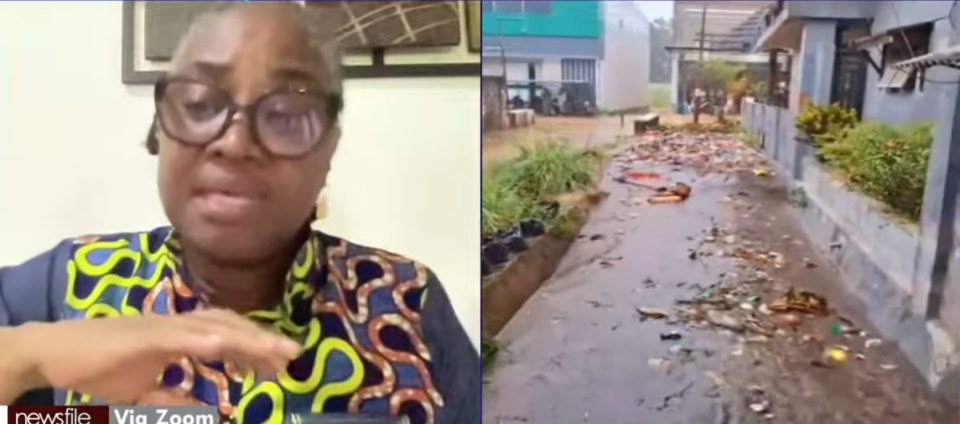
Executive Secretary of the National Interest Movement, Susan Adu-Amankwah, has said Ghana’s response to flooding in Accra must go beyond the construction of drains and culverts, saying that the city’s recurring flood crisis is also rooted in weak policy controls, a broken land tenure system and poor enforcement of planning rules.
Speaking on JoyNews’ Newsfile on Saturday, July 4, during a discussion on the Accra floods, Madam Adu-Amankwah said the country needed a broader and more realistic approach to urban planning, one that reflects how people actually live and behave.
According to her, engineering solutions remain essential, but they must be designed with resilience in mind and should be strong enough to withstand pressure even when residents fail to follow rules.
“The engineering controls must be in place, and modern engineering is not just about drains and culverts,” she said.
“We would want to see what the engineers are coming up with because we want to see proper living dynamic engineering that takes into consideration the type of people who are living there.”
She said that urban engineering must be built around the realities of Ghanaian cities, where rapid population growth, weak enforcement and public indiscipline often place infrastructure under strain.
“Urban engineering, resilience engineering, you know, so robust that even if the people misbehave, the system can hold,” she said.
In her view, drainage systems and other flood-control structures should be designed not only for ideal conditions, but also for situations where residents dump waste indiscriminately or where poor planning places extra pressure on existing infrastructure.
“We must see that a certain drainage or a system is built in such a way that when there’s indiscipline, even though the system will come under pressure, it would hold,” she said.
To explain her point, Madam Adu-Amankwah referred to how some countries design public spaces by first observing how people naturally use them before putting permanent infrastructure in place.
“There are certain countries when they build a park, what they do is to allow people to walk in the park and they look at the natural walkways in which the people would walk,” she said. “And it is from that that they build maybe pavements.”
She questioned whether Ghanaian engineers and planners were applying a similar practical approach in designing infrastructure for local communities.
“I’m not sure our engineers are doing similar. So that must be looked at in consideration of the type of people that we are,” she added.
But beyond engineering, Madam Adu-Amankwah said one of the biggest problems feeding the flood crisis is the failure of policy and legal systems, especially in relation to land administration and urban development control.
“Apart from the engineering controls, we must also have the policy controls,” she said.
She singled out Ghana’s land tenure system as one of the major structural causes of poor planning and unregulated development, describing it as deeply flawed and vulnerable to abuse.
“One of the things that we should look at is our land tenure system. The land system is a mess,” she said. “And if it were not such a mess, we would not have this situation.”
According to her, the confusion surrounding family lands, stool lands, and government lands, combined with corruption in land transactions, has created an environment where people are able to build in unsuitable and unsafe locations with little accountability.
“Family lands, stool lands, government lands, and the corruption in that system,” she said.
“If we had a system where all the lands were probably under government and were probably democratised and people were not being corrupt and collecting all sorts of monies and whatever and the chiefs selling the lands 10 times, people probably would not be building anyhow.”
She said that tackling floods in Accra will require the state to go beyond physical infrastructure and deal with the legal and institutional weaknesses that allow disorderly construction to continue.
“So we must make sure that it is not just the engineering controls, but we are looking at the policy controls, the legal controls that people must adhere to, and people must be punished,” she said.
Madam Adu-Amankwah also called for stronger planning systems, including proper flood-risk mapping, disaster mapping and early warning mechanisms that can alert residents before heavy rains turn into life-threatening emergencies.
“We must map up. We must do a proper cost mapping. Look at our disaster mapping. What are the early warning systems we can put into place that will ensure that people will know ahead of time what has to be done?”
She also questioned the country’s preparedness culture, asking how often authorities conduct emergency drills to prepare communities and rescue teams for disasters.
“I mean, how many times have we done just drills?” she asked.
During the discussion, Madam Adu-Amankwah also pushed back against the idea that residents in planned communities are insulated from the consequences of poor sanitation and indiscipline elsewhere in the city. In her view, flooding, disease, and environmental degradation are interconnected problems that do not respect neighbourhood boundaries.
“The fact that you live in a planned area, you don’t live on an island. Nobody lives on an island.”
To make the point, she said the effects of poor sanitation or open defecation in one community can easily spread to another community that may not be directly responsible for the problem.
“The people in Chorkor will probably get cholera not because they are the ones doing the open defecation, but maybe the open defecation coming from elsewhere is the one that is coming to give them the cholera there,” she said.
Latest Stories
-
Absa Bank Ghana names Stephen Ato Frimpong as Board Chair
7 minutes -
Pickford ‘almost caused crash’ with careless driving
8 minutes -
Author and former politician Jeffrey Archer dies aged 86
19 minutes -
No education reform can succeed without teachers – Education Ministry
28 minutes -
Gauff condemns racist abuse after China Open win
44 minutes -
Medvedev disqualified for hitting spectator with ball
53 minutes -
Oliseh scores twice in late comeback win for France
1 hour -
Pentagon stops using Anthropic AI tools after blacklisting company, BBC told
1 hour -
From despair to dance: Family of nurse Salomey Baffoe rejoices after GH¢100k bail granted
2 hours -
Kejetia Phase III pricing talks loom as government moves to restart stalled works
2 hours -
Nchiraa Yam festival: Two killed, 14 injured as police restore calm
2 hours -
I draw inspiration for my songs from Reggae music – Lyrical Joe
2 hours -
AI must not replace human judgment in public spending – BoG Governor
3 hours -
Ghana should withdraw from 2027 AFCON – Kojo Addae Mensah
3 hours -
Team Ghana departs Accra for Angola ahead of Karting Africa Trophy
3 hours