

Audio By Carbonatix
Beyond The Numbers on JoyNews with Isaac Kofi Agyei & Winston Tackie
Approximately $12 billion in remittances to Ghana went untracked and unaccounted for by the Bank of Ghana and the Auditor General from 2018 to 2022.
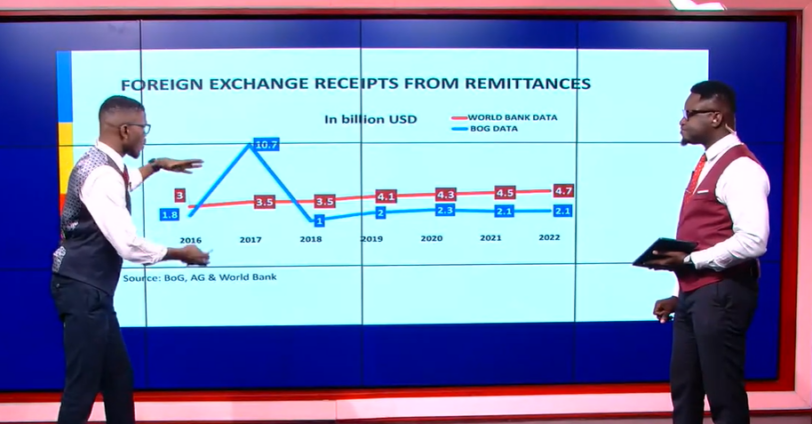
In the space of remittances, available data from the World Bank and the Bank of Ghana have contrasted each other. While the World Bank tracked a total of $21.1 billion as remittances inflow to Ghana from 2018 to 2022, the Auditor General’s reports on the Bank of Ghana’s consolidated statements of foreign exchange receipts and payments within the same period tracked and accounted for only $9.5 billion, leaving a gap of some $11.6 billion.
The Bank of Ghana's 2023 annual financial statement reveals that 11 licensed FinTech companies provided inward remittance services, with remittances totaling GH¢57 billion (US$5 billion) in 2023, up from GH¢18 billion (US$3 billion) in 2022.
Despite this, the Bank of Ghana failed to disclose the actual amounts received in their respective foreign currencies for both years, violating Accounting Standard 21 (IAS 21).
On top of this, the Bank of Ghana’s consolidated statements of foreign exchange receipts and payments report which is responsible for tracking, tracing and accounting for all forex inflows into Ghana has over the years failed to capture remittances held by payment platforms other than the 23 dealer banks.
In fact, existing regulatory frameworks have allowed for significant leakages, enabling payment platforms and some FinTech companies to illegally hold foreign exchange at the state's expense.
Watch this week's Beyond The Numbers with Isaac Kofi Agyei and Winston Tackie for more analysis:
The World Bank estimates that $4 billion worth of remittances flowed into Ghana's economy between 2016 and 2022. This makes forex inflows from remittances the highest compared to cocoa, oil and even gold if receipts are seasonalised to factor in the true amount surrendered.
To test the importance of remittance inflows to the Ghanaian economy, it is essential to consider the Bank of Ghana's statements in its 2023 audited report on inward remittances and their role in economic stability.
First, the bank disclosed that “in the foreign exchange market, the Ghana cedi remained relatively stable against the major trading currencies in 2023. This was due to improved inflows from the first tranche of the IMF ECF, the domestic gold purchase programme, remittances, and FX purchases from mining and oil companies, as well as tight monetary policy.”
Secondly, it stated that Ghana’s income account in 2023 “registered a lower deficit of US$2.08 billion in 2023, down by 53.8 per cent from US$4.51 billion in 2022. Current transfers, largely comprising private remittances, recorded a net inflow of US$3.93 billion in 2023, compared with US$3.57 billion net inflow in 2022.”
Finally, it dropped a bombshell that “in 2023, 11 licensed FinTech companies provided inward remittance service to customers. The total value of remittances received in 2023 was GH¢57 billion, compared to GH¢18 billion in 2022. The remittance space, over the years, has seen licensed FinTechs providing innovative solutions, hence the immense growth witnessed in the review year.”
The reason why this is a bombshell is that the Bank of Ghana failed to disclose the foreign exchange equivalent of these remittances as required by the International Accounting Standard 21 (IAS 21), which outlines how to account for foreign currency transactions and operations in financial statements, and also how to translate financial statements into a presentation currency.
Over the past eight years, available data from the World Bank and the Bank of Ghana have contrasted each other. While the World Bank recorded a total of $27.6 billion as remittances inflow to Ghana from 2016 to 2022, the Auditor General’s reports on the Bank of Ghana’s consolidated statements of foreign exchange receipts and payments within the same period accounted for only $22 billion, leaving a gap of some $5.6 billion. The key question is where did these inflows from remittances go?
Now, with the central bank’s latest admission that FinTechs in 2023 facilitated remittances amounting to GH¢57 billion, compared to GH¢18 billion in 2022, we ask if the previous gap in reporting between the Bank of Ghana and World Bank could be attributed to remittance inflows passing through FinTech and other platforms rather than the 23 dealer banks. This consideration is especially pertinent given that this is the first time within the period under review that the Bank of Ghana is reporting on remittance inflows in its annual audited reports.
Latest Stories
-
GPL 2025/26: Dreams FC stage stunning comeback to hammer Eleven Wonders
36 seconds -
Livestream: The Probe examines Kumasi’s looming water crisis
4 minutes -
MTN Ghana gears up to lead Africa’s AI revolution
5 minutes -
Philanthropist Alhaji FuZak donates Da’wah bus to Ambariya Sunni community
12 minutes -
GUTA calls for suspension of Publican AI system over trade disruptions, demands temporary halt in import activities
15 minutes -
TTAG raises alarm over proposed recruitment of 7,000 teachers, demands national posting roadmap
48 minutes -
Civilians feared killed after reports of air strike on Nigerian market
58 minutes -
Bishop Simon Kofi Appiah installed as new Jasikan Diocese Bishop
59 minutes -
Trump’s Strait of Hormuz blockade threat raises risks and leaves predicaments unchanged
1 hour -
US Court backs extradition of former MASLOC CEO Sedina Tamakloe-Attionu to Ghana
1 hour -
Seven arrested as NAIMOS dismantles illegal mining camp, seizes firearms at Boin River
1 hour -
Fire erupts at Madina Ritz Junction, destroys multiple wooden structures and containers
2 hours -
Daniel-Kofi Kyereh returns from long-term injury, registers assist for Freiburg U23
2 hours -
Knifeman calling himself ‘Lucifer’ slashes three at NYC’s Grand Central
2 hours -
Brands are built from within to without
2 hours