

Audio By Carbonatix
Israel's war cabinet has used a tried-and-trusted phrase to describe its next moves against Iran. Israel would respond "in the manner and at the time of our choosing".
Benny Gantz, the opposition leader who joined the war cabinet after the Hamas attacks of 7 October, emphasised the cohesion of Israel and its western allies.
"Israel against Iran, the world against Iran. This is the result. That is a strategic achievement which we must leverage for Israel's security."
The words Mr Gantz used did not rule out another attack on an Iranian target, or a first overt Israeli strike inside Iran (Israel has hit Iran's nuclear programme repeatedly, with cyber-attacks and the assassination of officials and scientists). But there might be time for the diplomatic response President Joe Biden wants from the meeting he has called of the G7, the richest western countries.
This most recent escalation of the war that has spread across the Middle East since Hamas attacked Israel began two weeks ago, when Israel attacked Iran's embassy compound in Damascus. The air strike, on 1 April, killed a senior general, his number two and other aides.
The decision to attack was not coordinated with the Americans. Israel must have assessed the opportunity to kill senior commanders of Iran's Islamic Revolution Guard Corps (IRGC) as a risk worth taking.
Publicly Israel offers an unconvincing argument that the presence of senior military officers on diplomatic premises made the building a legitimate target. More importantly is the fact that Iran chose to interpret the airstrike as an attack on its own ground.
Very quickly, it was clear that Iran would respond. Iran's message was not transmitted with nudges and winks, but in unequivocal statements from its supreme leader Ayatollah Ali Khamenei.
Israel, the US and their allies had plenty of warning. Mr Biden had time to get back to the White House from a weekend trip to his home state of Delaware. Iran chose to open the attack not with supersonic ballistic missiles, but with slow drones, that were on radar screens for two hours as they approached their targets.
It was a bigger attack than many analysts expected from Israel's most bitter enemy; plenty of reasons for many Israelis to expect a response from their own side. For the first time Iran launched weapons - around 300 drones, cruise and ballistic missiles - from its own territory at Israel's. Almost all of them were stopped by formidable air defences; Israel's own considerable capabilities, bolstered by the US, UK and Jordan.
Their allies, especially the US, helped them out enormously over the course of the night. President Joe Biden reiterated his promise: "ironclad" security for Israel, essentially saying 'we've got your back'.
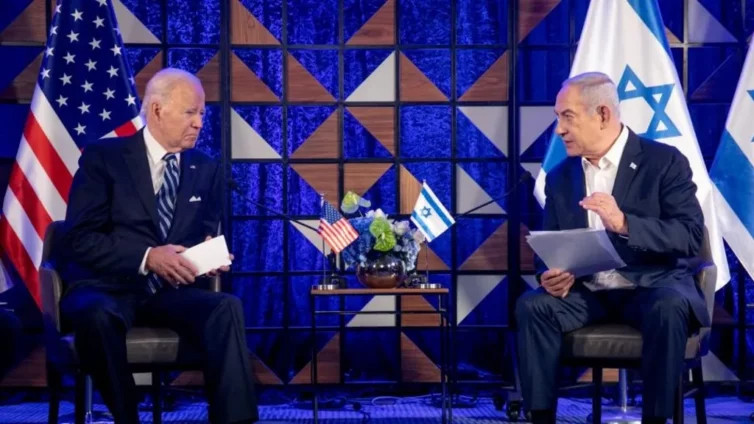
In return, the Americans want restraint from Israel. President Biden sent Prime Minister Benjamin Netanyahu a clear message. Iran's attack has been thwarted, Israel has a victory, so do not escalate this any further by responding with military strikes on Iranian soil. A senior western diplomat told me that it was now vital to draw a line, to stop further escalation.
Drawing a line seems to be Iran's hope too. It has signalled that Israel's attack in Damascus has been answered; it will only escalate further if it is attacked again. The Iranians seem to want to cool the two weeks of crisis and threats that started with the Israeli strike on their diplomatic compound in Damascus.
Perhaps Iran was hoping to do more damage than it did. Or it may have been open about its plans to give Israel less reason to hit back.
Iran wanted to restore the sense of deterrence it lost when Israel attacked the compound in Damascus. That might be harder after Israel and its allies stopped almost all the projectiles launched their way.
It was not a full-scale attack on Israel. Iran has been building up its rocket and missile forces for years. It could have fired many more weapons. Hezbollah in Lebanon would have joined in with an all-out offensive, and it did not. The Lebanese militia and political movement is Iran's strongest ally, with an arsenal of rockets and missiles.
Prime Minister Netanyahu might draw some satisfaction with the way that the Iran attack removed Gaza from the headlines. It gives him a respite from the humanitarian catastrophe, and Israel's failure to achieve its war aims of freeing the hostages and crushing Hamas.
A few days ago, international focus was on the rift between Mr Biden and Mr Netanyahu over the famine created by Israel's blockade of Gaza. Now they talk about unity. Mr Netanyahu can also present himself as a resolute and reasonable leader, the protector of his people even though his many enemies in Israel want him out of office. They say his rash, unsafe policies before 7 October led Hamas to believe Israel was vulnerable.
What has not changed is that the Americans want to find a way to stop the slide to an all-out Middle East war. Red lines have been crossed - Israel's attack on a diplomatic site, and Iran's direct attack on Israel. Immediately, some Israeli right-wingers demanded a response. Those calls will not stop.
The job of the diplomats at the G7 will be to prevent the region entering a damaging wider conflict. The slide has been slow, but also steady and in one direction, towards disaster, in the six months since Hamas attacked Israel.
If Israel takes President Biden's advice not to hit back, the Middle East might be able to take a breath. It is by no means certain that this is the end of this dangerous episode.
Latest Stories
-
Church of Pentecost supports over 2,000 BECE candidates in Obuasi with career guidance seminar
58 minutes -
Brandon Asante and Coventry all but promoted to Premier League despite Sheffield Wednesday draw
1 hour -
GPL 2025/26: Late Kwartemaa strike downs Hearts in Tema
1 hour -
Ghana Faces Sierra Leone Moment as Prosecutorial Powers come under strain
2 hours -
Don’t consume fish or seafood from Tema Shipyard until further notice – FDA warns
2 hours -
Why volunteering might be Africa’s most underrated career accelerator
2 hours -
ActionAid Ghana raises concern over gender gaps in Feed Ghana Programme
2 hours -
Windstorm wreaks havoc in Gushegu, displacing nearly 2,000 residents and damaging schools
2 hours -
Friends of Bridget Bonnie Marks her 35th birthday with donation to Kasseh Model Health Centre
3 hours -
From Ekumfi Kokodo to the Pulpit Stage: Essi Donkor’s gospel journey takes shape
3 hours -
Landfilling waste management creates no value, it’s an economic waste
3 hours -
Photos: Speaker Bagbin Commissions MPs constituency office under parliamentary decentralisation programme
3 hours -
Black Stars technical advisor Winfried Schäfer sacked as GFA shakes up backroom staff
3 hours -
Wenchi water project almost complete, critical to gov’t agenda – GWL MD
4 hours -
Anti-LGBTQ+ bill not part of government’s legislative agenda – Inusah Fuseini
4 hours