

Audio By Carbonatix
A Canadian who sailed on the cruise ship MV Hondius which was hit by a hantavirus outbreak in April has tested positive for the disease, officials in the province of British Columbia say.
The individual, one of four people isolating on Vancouver Island after leaving the ship, had developed mild symptoms.
The province's senior health officer said the four had not had any contact with the public since arriving in Canada.
The case brings the total number of infections to 11, all among cruise passengers. Three people who travelled on the ship have died, with two confirmed to have had the virus.
British Columbia health officer Bonnie Henry said the person's test came back as a presumptive positive on Friday, meaning that it still remains to be confirmed by a national microbiology lab.
"Clearly, this is not what we hoped for, but it is what we planned for," she said, quoted by national broadcaster CBC.
"I want to emphasise that hantavirus is a very different virus than the other respiratory viruses that we've been dealing with - like Covid, like influenza, like measles - and it remains one that we do not consider to have pandemic potential," Dr Henry added.
Of the six Canadians who were on the Dutch ship, two are self-isolating at their home in Ontario.
Two more couples are isolating on Vancouver Island, one from British Columbia and the other from Yukon. The person who tested positive is from Yukon.
None of the other five have tested positive so far.
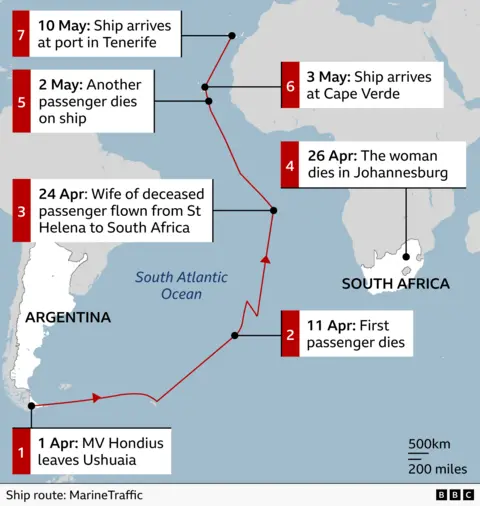
The cruise ship, which set sail from Argentina on 1 April, finally docked in Tenerife, in Spain's Canary Islands, less than a week ago, allowing its 147 passengers and crew from 23 countries to leave and go into isolation.
The WHO has recommended 42 days of isolation for each person. The Canadians were initially required to isolate for 21 days but Dr Henry said that timeline could now be adjusted.
Hantaviruses are usually carried by rodents, but human transmission of the Andes strain - which the WHO believes some of the ship's passengers contracted in South America - is possible.
Symptoms can include fever, extreme fatigue, muscle aches, stomach pain, vomiting, diarrhoea and shortness of breath.
Officials say the risk of a major outbreak is very low.
Latest Stories
-
Power restoration fault suspected in Kumasi Central Market fire
4 hours -
The 7-foot giant of Ngleshie Amanfro: Seven-foot Ghanaian Ephraim Saawa dreams of joining the national basketball team
5 hours -
Government promises support for Kumasi Central Market fire victims
5 hours -
Vibes The Movie: Big Ghun’s Ghanaian film earns five nominations at 2026 REFFA
6 hours -
MamaCare CEO warns unresolved conflicts among health workers could undermine maternal and neonatal care
6 hours -
Health professionals urged to translate medical knowledge into practice to save mothers
6 hours -
Conflicts among care providers linked to maternal, neonatal deaths – Expert
8 hours -
GIS marks 10th TIME conference, champions improved teaching practices
8 hours -
BRICS Or Balance? What Ghana’s bid really means
8 hours -
GPRTU wants full TRAFFITECH-GH implementation to start in 2027
9 hours -
How 10-mile walks for basic education birthed a 50-year legal career for Justice Korbieh
9 hours -
Mahama announces plans to import electric wheelchairs for PWDs
9 hours -
KGL U17 Colts 2026: Western beat Prempeh Elite Academy to set up final final with Greater Accra Region
9 hours -
Late Solanke strike salvages 10-man Spurs draw at Man United
9 hours -
Gender Ministry to monitor welfare of Nana Akua Addo’s children amid domestic violence case
9 hours