

Audio By Carbonatix
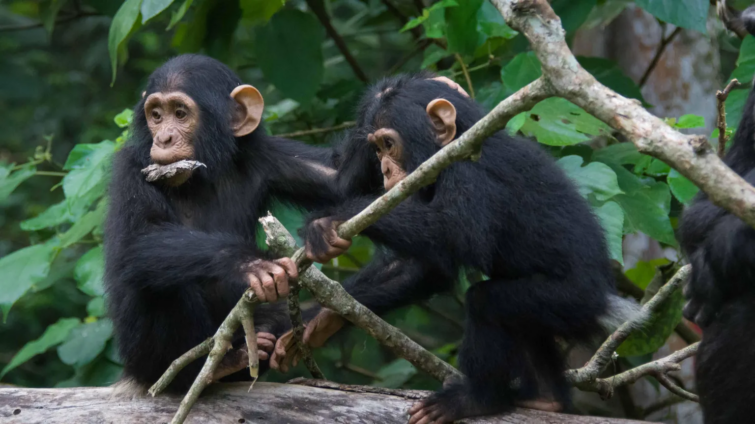
Like humans, wild chimpanzees engage in snappy, turn-taking conversations, where they wait just a fraction of a second for their turn to 'speak'.
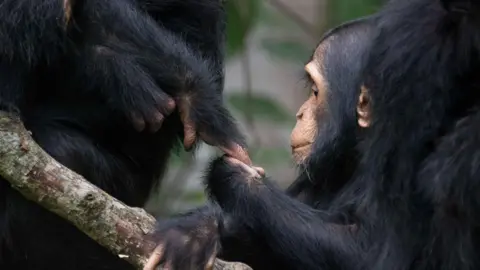
The animals communicate mostly with gestures including hand movements and facial expressions.
Scientists who studied their chats in detail found that they took "fast-paced turns" when they exchanged information and also occasionally interrupted one another.
The revelation suggests "deep evolutionary similarities [with humans] in how face-to-face conversations are structured," Prof Cat Hobaiter from the University of St Andrews told BBC News.
The findings are published in the journal Current Biology.
This fast turn-taking is a hallmark of human conversation, explained Prof Hobaiter, who studies primate communication. "We all take around 200 milliseconds between turns and show some interesting small cultural variations. Some cultures are ‘fast talkers’."
A millisecond is a thousandth of a second.
One 2009 linguistics study timed these differences - showing that, on average, Japanese speakers took seven milliseconds to respond while Danish speakers took about 470 milliseconds to intervene.
By examining thousands of instances of wild chimpanzees communicating with each other, Prof Hobaiter and her colleagues were able to time the animals' conversations.
“It’s amazing to see how close the chimpanzee and human timings were," she said.
Chimps had a bigger range in their conversational timings. "The gaps ranged from interrupting the signaller 1,600 milliseconds before they finished their gesture, to taking 8,600 milliseconds to respond," explained Prof Hobaiter.
“This could be because the chimps were in a natural setting, so they could express a wider range of behaviour - sometimes interrupting each other and other times taking a long time to respond."
As part of investigating the evolutionary origins of communication, the researchers have spent decades observing and recording the behaviour of five communities of wild chimpanzees in the forests of Uganda and Tanzania.
They have logged and translated more than 8,000 gestures from over 250 individual animals.
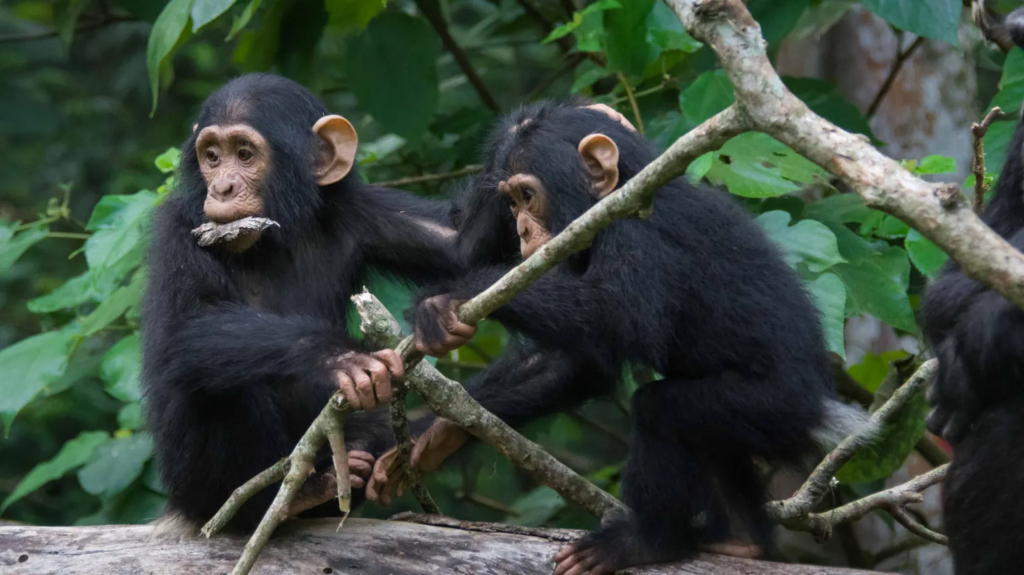
Lead researcher Dr Gal Badihi, also at the University of St Andrews, explained that gestures allowed the chimpanzees to avoid conflict and coordinate with each other.
“So one chimpanzee could gesture to another that they want food, and the other might give them food or, if they feel less generous, respond by gesturing for them to go away.
"They might come to an agreement about how or where to groom. It’s fascinating, and done in just a few short gesture exchanges.”
He said that future studies looking at communication in other primate species more distantly related to us will give us a more complete evolutionary picture of why we adopted this fast turn-taking chat.
"It will be a great way to better understand when and why our conversational rules evolved," he said.
Latest Stories
-
Mustapha Hamid misses out on NPP Vice Chairmanship by 31 votes despite early poll lead
6 minutes -
Kojo Bamba, Henry Nana Boakye and Nana Akomea elected NPP Vice Chairmen
52 minutes -
From Delta Force to NPP First Vice Chairman – Kojo Bamba’s political journey
57 minutes -
Police restore calm at Larteh following Odwira festival disturbance
2 hours -
‘All the camps will dissolve’ – Bawumia demands one NPP for 2028
2 hours -
There is no time to waste – Bawumia orders NPP to begin 2028 work
2 hours -
Sarkodie visits MobileMoney Fintech LTD
2 hours -
John Boadu unveils new NPP strategy to win back youth and modernise party
2 hours -
Hawa Koomson elected NPP National Women’s Organiser
2 hours -
John Boadu begins NPP rebuild from grassroots ahead of 2028 election
2 hours -
Titus Glover wins NPP National Organiser race on second attempt
2 hours -
Winning 2028 election won’t be easy; we must work harder – Bawumia
2 hours -
You’ll be part of 2028 campaign; there’s enough work for all of us – Bawumia to NPP aspirants
2 hours -
John Boadu moves to unite NPP after heated leadership contest
2 hours -
Today is not a day of victory but a day of responsibility and great unity – John Boadu
2 hours