

Audio By Carbonatix
African Environment Ministers have adopted a common position highlighting the continent’s priorities for the upcoming 28th Session of the Conference of Parties (COP28) of the United Nations Framework Convention on Climate Change (UNFCCC).
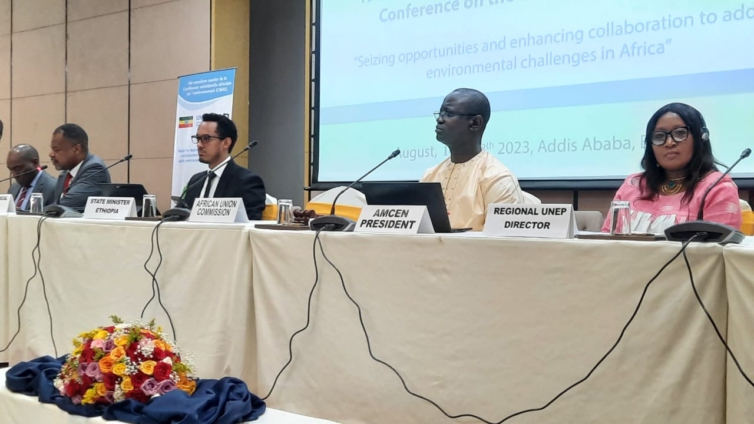
The 19th ordinary session of the African Ministerial Conference on Environment (AMCEN) in Addis Ababa, Ethiopia, discussed and strengthened environmental governance under the theme: “Seizing opportunities and enhancing collaboration to address environmental challenges in Africa”.
Key priorities for Africa contained in the adopted common position include; climate finance to meet the needs of the vulnerable, Global Stocktake of the implementation of the Paris Agreement, strengthening adaptation actions, operationalization of the Loss and Damage Fund, Just Transition Pathways and Africa’s special needs and special circumstances.
Ethiopia’s Deputy Prime Minister and Minister for Foreign Affairs, Demeke Mekonnen, in his keynote address, highlighted the important contribution of AMCEN in promoting collective environmental and climate action across the continent and allowing African countries to speak with one voice on the global diplomatic arena.
Over the years, a key agenda of AMCEN is the African common position on climate change negotiations—a Addis Ababa Declaration containing key priorities and demands in the various themes of the climate negotiation process.
The need to unlock climate finance has, for years, dominated the discussions for Africa, a continent that is especially vulnerable to the impacts of climate change, and yet contributes less than 4% to global climate causing emissions.
According to available statistics, Africa only has a fraction of the money it needs to contend with climate change. And in the years to come, the climate change tab is set to grow. According to UNEP, by 2030, Africa will require nearly $US3 trillion in climate financing.
Elizabeth Mrema, Deputy Executive Director of the UN Environment Programme (UNEP) made this clear in her remarks to the Ministers during the conference, saying:
“Surface temperatures here are climbing faster than the global average. Sea levels are rising more rapidly. And the continent has been hammered by disasters, from the three-year drought in the Horn of Africa, to Cyclone Freddy, one of the most powerful storms ever recorded in the southern hemisphere...It is a great injustice that Africa, which has contributed the least to climate change, is poised to suffer the most. The global community has a duty to lighten Africa’s debt load, which is vital if this continent is to finance the transition to a climate-resilient future.”
Alongside the need for climate finance, climate change discussions at the AMCEN 19 also revolved around the Global Stocktake (GST), enshrined in Article 14 of the Paris Agreement, whose objective is take stock of the implementation of the Paris Agreement and assess the global community’s collective progress towards achieving the purpose of the agreement and its long-term goals. The first stocktake got underway at the UN Climate Change Conference in Glasgow in 2021 and is expected to conclude at COP28 scheduled for Dubai, United Arab Emirates later this year.

Chair of the African Group of Negotiators (AGN) on Climate Change, Ephraim Mwepya Shitima, while presenting to both the Technical and Ministerial segments of AMCEN 19, pledged the AGN’s commitment to safeguarding Africa’s interests in the climate negotiation processes and emphasized on Africa’s expectations.
“We remain steadfast in our quest for fair and just outcomes from these processes,” said Shitima. “Our call is that COP 28 should deliver ambitious, balanced, fair and just outcomes that should set the world on course to effectively address climate change on several fronts including; adaptation, loss and damage, finance and mitigation. COP28 is also about the Global Stocktake; we expect the outcome of the GST to reflect and take into consideration Africa’s special development circumstances and provide the policy space necessary for Africa to achieve sustainable development and just transition to low emission and resilient development pathways.”
Meanwhile, AMCEN 19 also endorsed the development of the AGN Governance instrument—a flagship and top priority programme of Zambia’s Chairmanship of the AGN. The governance document, which is aimed at documenting and formalising core governance and operational procedures for the management and administration of the group, is expected to be adopted at COP28.
It is worth noting that the Africa Climate Summit, scheduled for Nairobi from 4-6 September 2023 was also a key highlight at AMCEN 19 as it is envisaged to discuss the continent’s development aspirations in relation to climate change and the green growth agenda.
Latest Stories
-
Vibes The Movie: Big Ghun’s Ghanaian film earns five nominations at 2026 REFFA
28 minutes -
MamaCare CEO warns unresolved conflicts among health workers could undermine maternal and neonatal care
52 minutes -
Health professionals urged to translate medical knowledge into practice to save mothers
58 minutes -
Conflicts among care providers linked to maternal, neonatal deaths – Expert
3 hours -
GIS marks 10th TIME conference, champions improved teaching practices
3 hours -
BRICS Or Balance? What Ghana’s bid really means
3 hours -
GPRTU wants full TRAFFITECH-GH implementation to start in 2027
3 hours -
Mahama announces plans to import electric wheelchairs for PWDs
3 hours -
KGL U17 Colts 2026: Western beat Prempeh Elite Academy to set up final final with Greater Accra Region
4 hours -
Late Solanke strike salvages 10-man Spurs draw at Man United
4 hours -
Gender Ministry to monitor welfare of Nana Akua Addo’s children amid domestic violence case
4 hours -
Benedict Okyere Yeboah: Ghana’s football problem goes beyond sacking a coach
4 hours -
GPL 2026/27: Darkwah Wiafe’s winner sees All Blacks beat Kotoko
4 hours -
ITF World Tour : Patel Wins Boys’ Singles Final at J100 Accra
5 hours -
Ghana must pursue BRICS partnership if it brings economic benefits – Kpebu
5 hours