

Audio By Carbonatix
Former President Nana Addo Dankwa Akufo-Addo has acknowledged that economic difficulties and persistent public protests during his tenure played a key role in diminishing his government’s popularity.
He admitted that the economic downturn, exacerbated by global challenges, fuelled widespread dissatisfaction among Ghanaians, leading to increased public demonstrations.
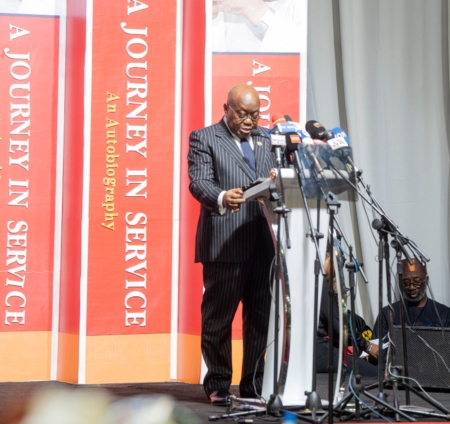
Speaking at the launch of a book by former Nigerian Military President, General Ibrahim Babangida, Akufo-Addo reflected on the economic turbulence that defined his presidency, particularly during the COVID-19 pandemic.
He noted that the crisis severely affected Ghana’s financial stability, limiting the government’s ability to sustain economic growth and meet public expectations.
Akufo-Addo conceded that the economic strain led to nationwide protests, with citizens expressing frustration over rising costs of living and policy decisions.
While he acknowledged that these demonstrations were not as severe as the Structural Adjustment Programme (SAP) riots that swept through Ghana and other African nations in the 1980s, he admitted that they were significant enough to weaken public confidence in his administration.
“We faced a major economic crisis and, with the world’s capital markets closed to us, we ended up going to the IMF. Not an easy decision to make. The economic difficulties brought people onto the streets,” he stated.
He further explained that his government had few options to navigate the crisis due to the limited accessibility of international capital markets.
As a result, the administration was ultimately compelled to seek financial assistance from the International Monetary Fund (IMF) to stabilise the economy.
“Even though the demonstrations were not on the scale of the SAP riots described in the book, they were serious enough, feeding into the growing disaffection against the government,” he noted.
Mr Akufo-Addo maintained that while the global economic downturn posed significant challenges, his government took difficult but necessary measures to restore economic stability.
He stressed that the long-term impact of those decisions would be evident in Ghana’s economic trajectory, urging future leaders to learn from the experience and prioritise policies that foster resilience in times of global uncertainty.
Latest Stories
-
Nigeria set to launch National Digital Address System 9 years after Ghana showed the way
1 minute -
Policy rate decision takes time to reflect in lower lending rates – BoG
11 minutes -
Western Regional Minister applauds Karpowership’s role in Ghana’s power sector
36 minutes -
Livestream: Road safety crises: Where are we getting it wrong?
38 minutes -
Enterprise Life celebrates 25 years of protecting families and building trust
46 minutes -
ICC London rules in favor of Ghana against Tullow over $400m tax charge
56 minutes -
We are disappointed in ICC’s ruling over our corporate income tax assessment in Ghana – Tullow Oil
1 hour -
Cost of building inflation for August 2026 increases to 4.6% – GSS
1 hour -
Today’s front pages: Wednesday, September 30, 2026
2 hours -
Bawumia highlights agricultural, compulsory insurance reforms in IBAG engagement
2 hours -
Ghana will secure Tullow tax revenues while protecting Jubilee, TEN investments – Ato Forson
2 hours -
Ghana wins $393m Tullow tax arbitration as tribunal upholds GRA assessment
2 hours -
Gender Minister assures women’s group of action on Affirmative Action, Development Bank
3 hours -
Over 2,000 teachers in Dormaa comply with strike – GNAT Secretary
3 hours -
Food Buffer Stock seeks stronger liquidity buffer despite record profit
3 hours