

Audio By Carbonatix
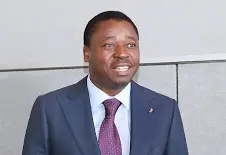
Togolese President Faure Gnassingbé has been sworn in as the first-ever Chairman of the Council of Ministers, assuming the highest executive position in the country following a contentious transition from a presidential to a parliamentary system.
This development marks a significant political transformation in the small West African nation, where Gnassingbé’s family has held power for nearly six decades.
The constitutional reform, passed amid strong opposition and public outcry, has redefined Togo’s governance structure, with executive authority now vested in the Chair of the Council of Ministers, while the presidency becomes a largely ceremonial role.
In a parallel move, the Togolese National Assembly has elected Jean-Lucien Kwassi Lanyo Savi de Tové, a former Minister of Trade (2007–2009) and seasoned opposition figure, as President of the Republic.
Under the new constitution, his role is largely symbolic, stripped of executive powers.
The revised constitution, adopted by the National Assembly in April 2024 and officially promulgated the following month, stipulates that the Chairman of the Council of Ministers must come from the majority party in Parliament.
That position currently belongs to Gnassingbé’s Union for the Republic (UNIR) party, which secured 108 out of 113 seats in legislative elections last year, elections widely condemned by the opposition as a “masquerade”.
Critics argue that the constitutional overhaul is a calculated manoeuvre by Gnassingbé to extend his grip on power indefinitely, especially as his final presidential term under the old constitution approaches its end in 2025.
“Fully aware that his current mandate is his last under the previous system, Faure Gnassingbé, with the support of a National Assembly whose mandate has already expired, engineered this reform to retain power indefinitely,” said Professor Aimé Gogué, leader of the opposition Alliance for Democracy and Integral Development (ADDI). “Under this new parliamentary arrangement, he can rule for decades, unchecked.”
The reform has drawn strong condemnation from opposition parties and civil society organisations, locally and internationally, who view the process as undemocratic and designed to consolidate authoritarian rule.
Gnassingbé, who turns 59 on 6th June, first assumed the presidency in 2005 following the death of his father, Gnassingbé Eyadéma, who had ruled Togo with an iron fist for 38 years.
As the political dynamics shift under the new parliamentary framework, questions remain about democratic accountability, institutional legitimacy, and the future of opposition politics in Togo.
Latest Stories
-
DVLA plans demerit point system, real-time monitoring of testing stations
1 minute -
Health Committee Chair lauds NHIA’s swift disbursement of insurance claims
1 minute -
Okada Association says it’s preparing training centre as gov’t works on new regulations
2 minutes -
Imperial General Assurance backs Team Auto Racing Ghana ahead of historic Angola showrun
10 minutes -
Before they failed the BECE, did Ghana fail them?
11 minutes -
Photos: Mahama swears in Emelia Afi Agbenyo, Joseph Kwaku Asamoah as EC Deputy Commissioners
14 minutes -
Centre for CSR, West Africa partners with Climate x Culture Summit to champion corporate sustainability at Google AI Centre
19 minutes -
Petrosol donates medical equipment to Bolgatanga Hospital
20 minutes -
Zongo Health Campaign screens over 110 Mamobi residents
34 minutes -
Cybercriminals using AI tools to carry out operations – Cyber Security Authority
41 minutes -
Ghana must invest more in mental health and healthier workplaces – Nurse advises
41 minutes -
NAPG Summit equips Administrative Professionals for strategic impact and the AI-driven workplace
50 minutes -
NHIA urges amendment of Health Insurance Act to accommodate free primary healthcare
53 minutes -
Ghana is tackling cybercrime head-on, not becoming a hub for it – CSA
55 minutes -
We’ll deliver without fear or favour – New EC Deputy Chairpersons assure Mahama
56 minutes