

Audio By Carbonatix
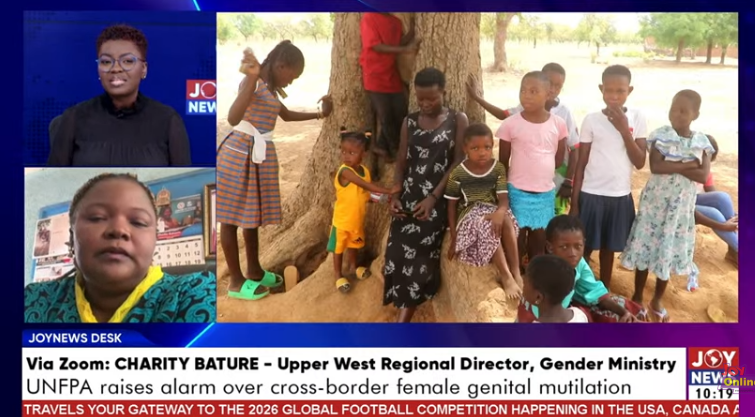
The Upper West Regional Director of the Department of Gender, Charity Bature, has disclosed that perpetrators of female genital mutilation (FGM) continue to exploit cross-border family ties and social events such as funerals to secretly transport young girls out of Ghana to have the practice carried out.
Speaking on Joy news Desk on Monday February 9, Ms. Bature said although FGM has been criminalised in Ghana, offenders have adapted by moving the act across neighbouring borders where enforcement may be weak.
“Often, they will claim they are attending funerals or visiting families across the border. They silently carry these young girls across, have the act performed, and then bring them back secretly,” she revealed.
According to her, there is no specific destination authorities can identify as a centre for the practice. However, once the girls cross into neighbouring communities, perpetrators are able to locate individuals who still carry out the practice.
“In the past, we had people locally referred to as wanzams who practiced this openly as a form of livelihood. With the introduction of laws in Ghana, they went into hiding. We are certain that across the borders, these people are known and easily identifiable, and innocent girls are taken to them,” she explained.
Ms. Bature stressed that although Ghana’s laws do not extend beyond its borders, perpetrators can still be prosecuted upon their return.
“The laws of Ghana end at our borders, but once these people return, they can still be held liable,” she stated.
She added that several local mechanisms have been put in place to detect and prevent the practice, including community sensitisation, watchdog committees, and training for teachers and health workers.
“When a child is absent from school for several days, we are alerted. When the child returns and her behaviour changes, we know something is wrong,” she said.
Health workers, she noted, are also playing a critical role.
“Infants brought to health facilities are inspected to ensure they have not been cut. These structures help us address the problem locally,” Ms. Bature added.
She further disclosed that Ghana is engaging neighbouring countries through cross-border and inter-regional collaborations to help curb the practice.
“We have been engaging our partners across the borders, even where the practice is not criminalised, to be on the lookout and deter people who cross over for such acts,” she said.
However, Ms. Bature acknowledged that porous borders continue to pose a major challenge.
“In some areas, it is just a river separating us. During the dry season, people simply walk across. Funerals are used as an opportunity to carry out the act,” she noted.
On the activation of ECOWAS protocols to address the issue, Ms. Bature said stronger action is needed at the national leadership level across member states, although community-level coordination is ongoing.
“At the local level, we are working with the Regional Coordinating Council, the Department of Gender, Ghana Education Service, Ghana Health Service and traditional leaders. But for it to move to the ECOWAS level, countries must engage at the highest leadership level,” she said.
She warned that the continued practice of FGM is reversing progress made in national development and gender equality.
“This practice contributes to maternal deaths, deepens poverty and increases gender-based violence. Some victims develop psychological conditions that prevent them from engaging in economic activities,” she stated.
Ms. Bature also highlighted the negative impact on education.
“Girls are often kept out of school for weeks or months to allow healing and to conceal the act. This affects their academic performance and future prospects,” she added.
She called for sustained cross-border cooperation and stronger regional commitment to end the practice completely.
Latest Stories
-
NSA extends 2026/2027 National Service registration deadline to October 23
4 minutes -
Mahama reaffirms commitment to private investment and industrial growth
20 minutes -
‘We have been used and dumped’ – NDC’s James Agbey warns over grassroots neglect
29 minutes -
Ghana defender Marvin Senaya begins training ahead of comeback
32 minutes -
Joyce Bawah Mogtari urges women leaders to build strong support networks
49 minutes -
Bawumia engages GUTA over import duties, VAT and rising business costs
49 minutes -
Fuel prices begin to fall as Star Oil cuts petrol to GH¢16.45
51 minutes -
GoldBod supplies banks with US$282m in weekly forex sales
52 minutes -
Joyce Bawah Mogtari says Obaasima Conference should help women connect and learn
53 minutes -
Ghana’s Crude Oil Production Rebounds by 30% After Five Years of Decline
1 hour -
Nzema East launches Responsible Cooperative Mining Programme to tackle environmental destruction
1 hour -
Ghana included in WHO lead-testing programme as questions remain over local exposure risks
2 hours -
2026 Amputee World Cup: We will win the trophy – Samson Deen
2 hours -
Controller and Accountant-General pays promotion arrears to 56,003 GES teachers ahead of deadline
2 hours -
2026 Amputee World Cup: We want to make the continent proud – Black Challenge coach
2 hours