

Audio By Carbonatix
Fish farmers have been urged to always contact professionals in aquaculture to draw suitable biosecurity plans for them to implement in their farms.
This would not only help them manage fish mortality and secure their investments but would also contribute to protecting human life since healthy fish would be produced and supplied to the market for consumption.
Mr Theodore K. Owuani, the Ashanti Regional Laboratory Manager of the Fisheries Commission, who made the call, said it was important for people interested in fish farming to have biosecurity in mind, to ensure that they did not record unexpected losses to discourage them.
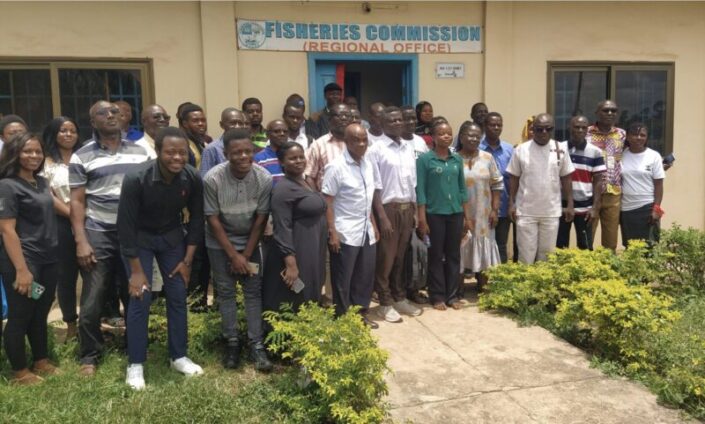
He was speaking at a biosecurity training workshop for about 58 fish farmers in the Ashanti region.
The training was to help the farmers acquire the requisite skills and knowledge in biosecurity, to help secure their investment by preventing unnecessary fish mortality through the introduction and spread of infections and diseases.
Biosecurity involves management plans and measures put in place to prevent the introduction and spread of infections and diseases among organisms.
Mr Owuani pointed out that though fish mortality should be expected it should not be above 15 per cent of stocked fish, and asked farmers to always contact their zonal officers to introduce them to good hatchery to purchase their brood stock.
This is because, some hatcheries were abusing the use of antibiotics in their farms, and this could cause problems for them, he said.
He indicated that, disease and infection outbreaks depended on three factors which included pathogens, which already existed in the water (environment), the environment and the host (fish).
Mr Owuani, the disease or pathogens in the water manifested when the fish was stressed through overstocking in ponds leading to fish competing for oxygen, poor handling and water parameters.
“When the fishes are stressed, their immune systems break down making them vulnerable to infections and diseases,” he stated.
He named other factors that contributed to infections and disease spread on and between farms as not quarantining new brood stock, poor feed storage, contaminated water and equipment, vectors and others.
Mr Owuani said biosecurity plans were specific to every farm because they had different challenges which needed varied solutions.
He mentioned some biosecurity plans and measures as covering ponds with nets, using clean pathogen-free water sources, sourcing fingerlings from certified hatcheries, and making a pest management programme.
Latest Stories
-
Knights and Ladies of Marshall group backs Catholic Bishops’ stance on anti-LGBTQ+
8 minutes -
Bright Simons writes: All the Filla in the Ibrahim Mahama/E&P – Gold Fields Saga
33 minutes -
Monetise Idiocy In Ghana
40 minutes -
The Ghanaian prophet and the mysterious death of his scottish wife Charmain Speirs
1 hour -
Nearly 400 sentenced in Nigeria for links to militant Islamists
2 hours -
Ghana’s recovery supported by gold strength despite global oil price pressures – Standard Bank Research
2 hours -
‘Excellence is our inheritance’ – Nana Sam Brew-Butler hails Mfantsipim’s 150-year reign in leadership
2 hours -
Kwaku Azar writes: A-G vs OSP
2 hours -
Mfantsipim–Adisadel rivalry built excellence, not division – Sam Jonah
3 hours -
Vice President launches Mfantsipim’s 150 years of shaping Ghana’s greatest mind
3 hours -
I assure Otumfuo, Mahama will join him to commission KNUST Teaching Hospital by end of this year – Haruna Iddrisu
4 hours -
Barcelona dominate derby to extend La Liga lead
4 hours -
Gov’t to roll out free special education for persons with disabilities from July 1 – Education Minister
4 hours -
Importers and Exporters Association declares full support for Publican AI port system
4 hours -
“We used it to test our officiating officials’ readiness” – Bawah Fuseini after CAA Athletics event
5 hours