

Audio By Carbonatix
Nadogobo Suglo remembers the night his son got hurt.
There had been an accident. The boy needed a hospital, fast. But Suglo's village sits far from town, at the end of a road full of holes and loose stones. There was no ambulance to call. No car nearby. Just neighbours, and a long, slow search for someone, anyone, with a way to move a dying boy.
Help never came in time.
"It was difficult to get someone to help take him to the hospital, because of the bad road," Suglo says. "Before help could arrive, he lost his life."
Years have passed. Suglo says he has never been the same.
Not far away, Sadia Razak carries a similar grief. She is a mother of five, and she remembers her aunt, pregnant, going into labour with no way to reach a hospital. There was no ambulance then either. No car. By the time anyone found a way to move her, it was too late.
"Because there was no means to take her to the hospital, she ended up losing her life," Razak says.
Two families. Two different villages. The same story.
This is daily life in parts of Ghana's Upper West Region, where five small clinics, at Kataah, Kulkpong and Kpaglahi, and at Vieri and Egu, serve villages scattered far apart, along some of the worst roads in the country.
These clinics are called CHPS compounds. It stands for Community-Based Health Planning and Services. Think of them as small first-aid posts, run by one or two nurses, built to treat coughs, fevers, and small wounds. They can weigh a baby. They can treat malaria. But when something serious happens, a difficult birth, a bad accident, a child who won't stop bleeding, a CHPS compound can only do one thing: send the patient somewhere bigger, and hope they survive the trip.
Bright Addae, a community health nurse, says serious emergencies have to be referred to higher-level facilities.
"If it’s a serious emergency, we have to call for ambulance, then we transfer the person to the regional hospital or the municipal."
But even when an ambulance is called, there is no guarantee that one will arrive.
"The ambulance, you might call them, you might not get them. So, what you do is you work in the community and you get the tricycle, or the motorking [motorbike]," Addae says.
The trip is the hard part.
The roads here are not paved. In the rainy season, they turn to mud. Motorbikes are often the only vehicles that can survive them, and even those struggle. There is no ambulance stationed nearby. When someone falls seriously ill, families go looking, house to house, for anyone with a motorbike willing to help, and willing to go, sometimes for hours, in the middle of the night.
Abboudi Idrisu has been that person for 27 years. He rides the sick to hospital on his motorbike, sometimes with three people balanced on it at once, the driver, the patient, and someone holding the patient steady from behind. "Carrying a pregnant woman with this small motorbike is always difficult for me," he says.
Moses does the same job on a motorcycle he calls “Can Do”, whenever he isn't teaching at the local school. The calls come at any hour. "At times they wake me up around one or two in the morning," he says. The road doesn't spare him either. "We'll be stepping on potholes here and there... sometimes I feel pity when I hear my mother behind crying." Twice, he has raced a labouring woman toward hospital and lost the baby on the way. He believes the road is to blame. "It's not my fault," he says. "The nature of the road will not allow me to move on speed."
At Egu Health Center, a nurse, Joseph Dortaa has learned what it feels like to lose that race completely. One day, a patient needed urgent transfer. Joseph Dortaa and his staff searched the whole community for a vehicle. They searched all day. By the time they found one, it was too late. "We lost the patient," he says. "When you lose a patient in your hands, it's not easy. The trauma that you go through."
At Kpaglahi, nurse Doku Anvaitus says the same fear returns every time the sun goes down. "We don't have an emergency transport system," he says. "We have tricycles that move from here to Wa, and getting one is not always easy, especially at night."
Seidu Saweiba, the midwife of Egu Health Center, says the lack of transport becomes even more difficult when women arrive with complicated labour. Seidu says "Sometimes we do encounter difficult labor cases. In the case of a woman that have already gone through CS, we are not supposed to deliver the person here." But some women delay travelling to the regional hospital because of the distance to Wa, she says. When they eventually need urgent referral, the facility has no ambulance. "We don't have ambulance. We only have one teacher who is having a motorbike. So when he's around, you have to call him, even if it is midnight. So he will come and assist us to transport the woman to the regional hospital" Seidu said. And if that motorbike is unavailable, there may be no alternative.
"And sometimes if the motorbike owner is not there, you don't have any option. So if the woman can never sit on the motorbike, but you have to let the woman sit on the motorbike, because there is no option."
It is hard to say exactly how many families have lost someone this way. But the region's own health officials have tried to count. Ghana's Health Service recorded 19 maternal deaths in the Upper West Region in 2023, mothers who died from pregnancy or childbirth, up from 16 the year before. An earlier study found that almost half of all maternal deaths in the region happened within a single day of finally reaching a hospital, and that delay in getting there played a part in roughly one out of every two of those deaths. National survey data, gathered by the Ghana Statistical Service, shows the region also has the second-highest rate of child deaths under five anywhere in the country.
Ghana does have a national ambulance service. It has grown from just 9 vehicles in 2004 to 356 by 2023, with at least one stationed in every district. But researchers who study the service say that on the ground, in places like Upper West, a station on paper often does not mean help arrives on time. The country still has far fewer ambulances, relative to its population, than international health experts recommend, and the shortage is worst in exactly the kind of remote, low-income districts these five clinics serve.
This is the gap that a project called ‘Wheels of Hope’ was built to close.
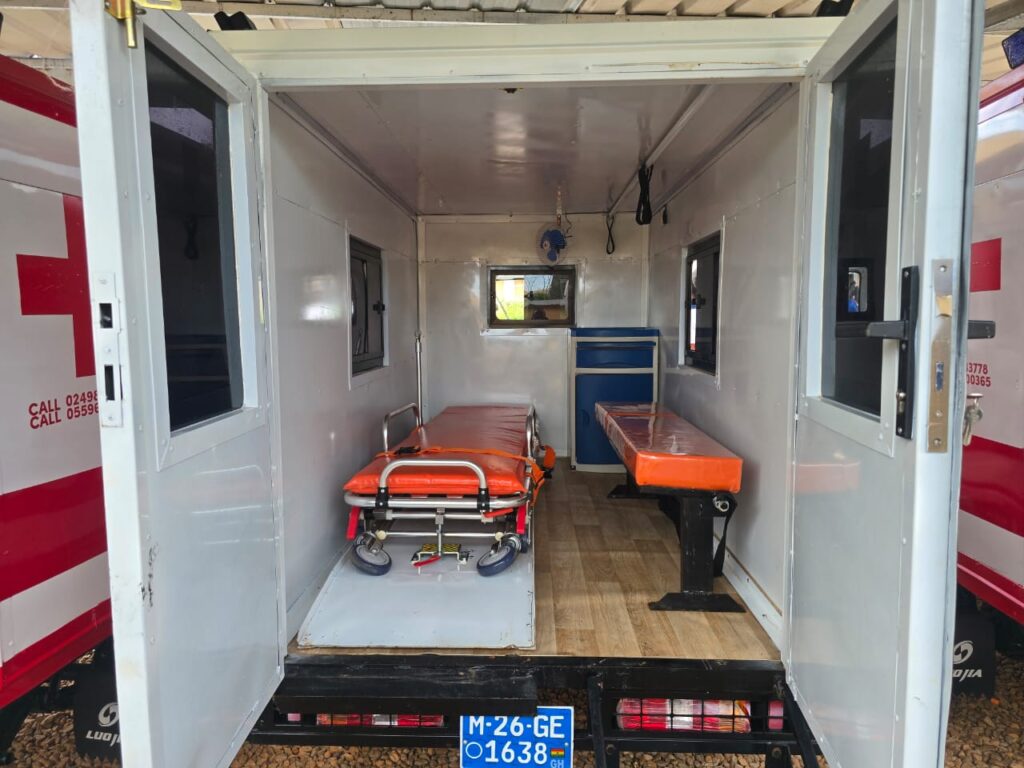
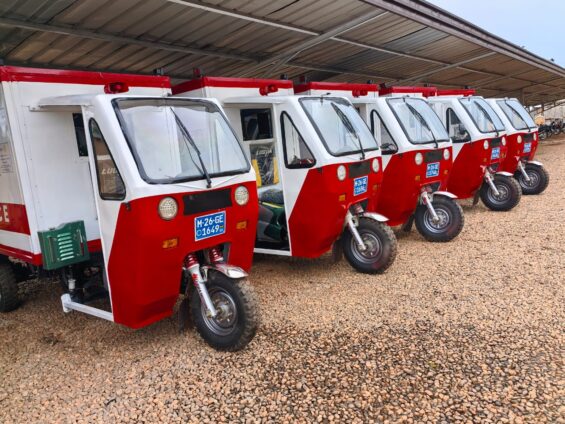
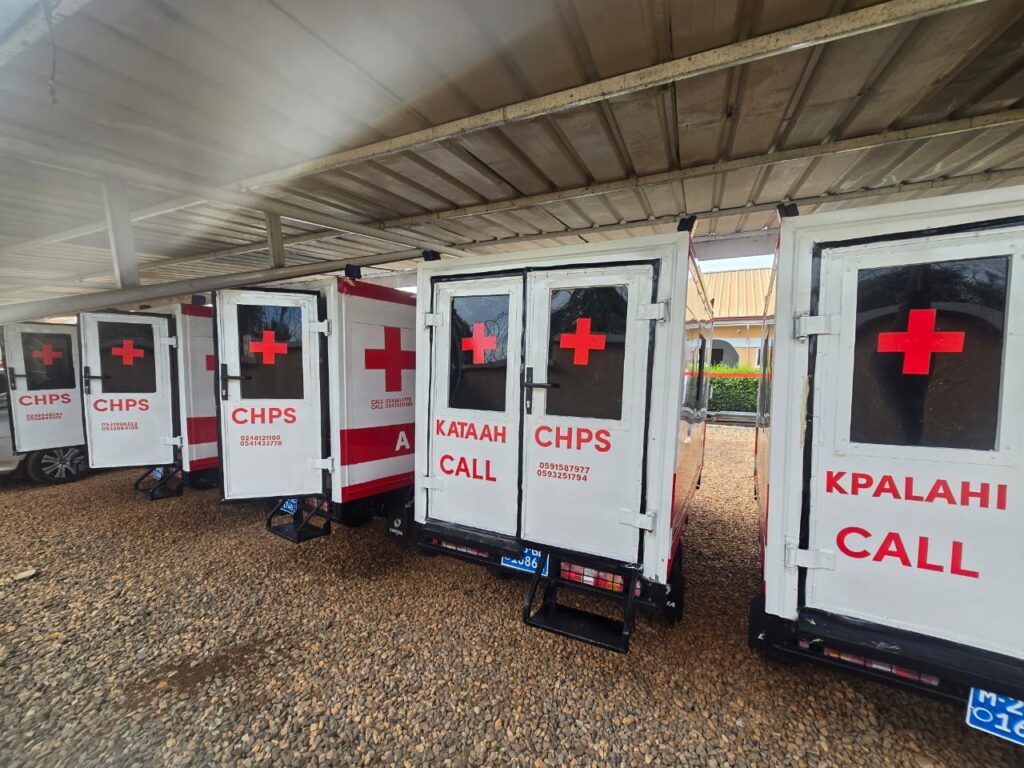
On 3 September 2026, after training sessions for local drivers and clinic staff, five brand-new tricycle ambulances were handed over to the five communities. Unlike a motorbike or an open tricycle, they have a stretcher, a covered cabin, and space for a health worker to travel alongside the patient. They were built by Moving Health, an organisation whose founder, Emily Young, first sketched the design as an engineering student at MIT, aiming to build something tough enough for roads like these, but cheap enough for communities like these to keep running.
Moving Health, a Ghana-based NGO that manufactures ambulances and builds emergency transport systems, has built every Wheels of Hope unit locally rather than shipping vehicles in from abroad. This keeps costs down and means that when something breaks, the parts and the know-how to fix it are already in the country. Since its first deployment, Moving Health has put more than 30 tricycle ambulances into service across Ghana's Upper West and Upper East Regions.
"The goal is to address the delays that cost mothers and newborns their lives," says Basuglo Yahaya, Moving Health's programmes manager, "by using local materials and local artisans to make the ambulances affordable and easy to maintain."
Getting the ambulances here took a small international relay. The Rotary Club of Cambridge, in Massachusetts, helped raise funds through a Rotary Foundation Global Grant, together with Rotary clubs in Kyoto, Bedford, Concord, Boston and Berlin, and the Rotaract Club of Accra-East Legon, which managed the funds in Ghana. The Rotary Club of Wa carried the project the last mile, working directly with the five communities.
Karen Saltiel, Co-President of the Rotary Club of Cambridge, Massachusetts, says the ambulances are intended to bridge the gap between remote communities and lifesaving emergency care.
"These ambulances will play a critical role in bridging the gap between remote communities and lifesaving emergency care."
She says the hope is that the ambulances will bring greater safety, "faster access to healthcare, relief, and peace of mind to every household in your community. May it help save lives and give families greater confidence that, when an emergency occurs, help is within reach."
"Based on our needs assessment, we realised that the majority of these communities simply have no means of transport," says the Project Service Director, Felix Amonteba Petio of the Rotary Club of Wa. "These ambulances will make it possible for pregnant women, and anyone in an emergency, to reach a hospital."
Ruth Beulah, President of the Rotaract Club of Accra East Legon, says the project is designed to address the lack of reliable emergency transportation in the five beneficiary communities.
"This project demonstrates that young people and Rotaractors can move beyond simply identifying problems to helping deliver practical and sustainable solutions," Beulah says.
But there is a detail in this story that matters more than the machines themselves.
Before a single ambulance arrived, each of the five communities had already built a small shed to keep it safe from sun and rain. They paid for the sheds themselves, out of whatever little they had, what Basuglo Yahaya calls their "widow's mite." Nobody asked them to give money they don't have. They did it anyway, because they wanted to be ready.
In Egu, a community member, Martin Diibu helped build his village's shed. "We will maintain it well," he says, "protect it from the sun, from the rain." Joseph Joseph Dortaa, at the health centre, says his staff are already planning how they will care for the ambulance once it's theirs. "We are making sure that plans are already in place for how we will maintain it."
The plan does not stop at a shed. The communities have agreed to keep the ambulances running themselves, finding drivers willing to volunteer, and charging just enough for each trip to cover fuel and small repairs. "We are not a profit-making body," says Samuel Yendor, who represented the district health director for Wa East at the training session. "We charge minimal fees, just to buy fuel and keep a small reserve." Yahya has seen this kind of ownership work before, in other places, for more than five years at a time, as long as a community keeps treating the ambulance as something that belongs to everyone, and not to one family or one faction.
The people operating the ambulances will also need to know how to use and care for them safely. ADO 1 James Anafo, Wa Municipal Safety Officer of the Fire Service, says drivers must receive basic fire-safety training so they can respond appropriately if a fire breaks out.
He also cautions against overloading the ambulances or carrying foreign materials, particularly after transporting a casualty to a referral centre.
For the National Ambulance Service, training those using the vehicles is also critical. Omani Mahamud Ibrahim, Regional Manager of the National Ambulance Service, says transporting a patient is not simply about getting them to a hospital.
"It is important to train the people who use the ambulance because ambulance is to carry the sick and the injured to the hospital and all those who are supposed to be part of transporting the people must have knowledge in transporting the patient."
He says the operators must also be able to initiate basic life-support interventions before the patient reaches hospital.
The ambulances will have a contact number within the communities for people who need them.
"So if someone needs the ambulance there is a contact number of the ambulance within the community placed on the ambulance so the person first of all must call that number."
The call will go to the health facility where the ambulance is stationed. Health workers will establish the nature of the emergency before the driver is sent to collect the patient. The patient can then be assessed, vital signs taken and the receiving facility informed about the patient's condition before arrival.
Ibrahim also stresses that the ambulances have a specific purpose and are not intended to transport dead bodies from communities to hospitals or from hospitals back to communities.
"Handing over the keys is only the beginning," says Karikari Achireko, a member of the Rotary Club of Cambridge, Massachusetts. "The real success will be seeing these ambulances still working years from now, still helping people reach medical care in time."
For the people who have spent years riding motorbikes through the dark with someone dying behind them, that promise means everything. "I would say bravo, bravo to them," says nurse Doku Anvaitus. "I'm praying that, by God's grace, they will do this for us too."
Joseph Dortaa, still carrying the memory of the patient he lost, puts it more simply. "We are beggars," he says. "And as a beggar, you are always ready to open your hands to whoever comes to help you."
Sadia Razak, who lost her aunt to the same silence on the road, hopes other families will be spared what hers was not. "There are more villages which need this kind of support," she says.
And Nadogobo Suglo, who will likely carry his son's death for the rest of his life, allows himself something he has not had in a long time: a small measure of peace. "We pray we don't enter into such situations again," he says. "But it's good to know that, if we do, we will have help when it comes."
Latest Stories
-
Nana B denies claims that Kojo Bamba was his driver and bodyguard
16 minutes -
Engage Now Africa to construct a 10-unit classroom block for struggling Navrongo Vocational Training Centre
23 minutes -
One digital financial breach could expose linked accounts to fraud – Financial Crimes Manager
28 minutes -
Ghana Russia Centre signs ICT cooperation agreement with Moscow University
32 minutes -
The powerhouses of the village: Honouring Ghana’s rural women on International Rural Women’s Day
32 minutes -
Vincent Assafuah petitions CHRAJ to investigate alleged irregularities in 2026 World Cup visa arrangements
33 minutes -
12-year-old boy found dead in muddy pit at Opeikuma
34 minutes -
GHS begins Yellow Fever vaccination campaign in three Upper West districts
36 minutes -
Organised Labour pushes for higher 2027 base pay despite slowing inflation
38 minutes -
Parliament’s Human Rights Committee demands swift justice in Obuasi SHTS sexual abuse case
48 minutes -
From Campaign Propaganda to Gov’t Accountability: When the message-makers demand a seat at the table
1 hour -
Ashanti Region Security Coordinator warns sand winners to stay off Accra–Kumasi Expressway site
1 hour -
PZ Cussons Ghana promotes hand washing among schoolchildren through Camel campaign
2 hours -
30 NDC aspirants file nominations in Upper West as regional election approaches
2 hours -
UPSA launches laptop assembly plant, requiring new students to assemble their own devices
2 hours