

Audio By Carbonatix
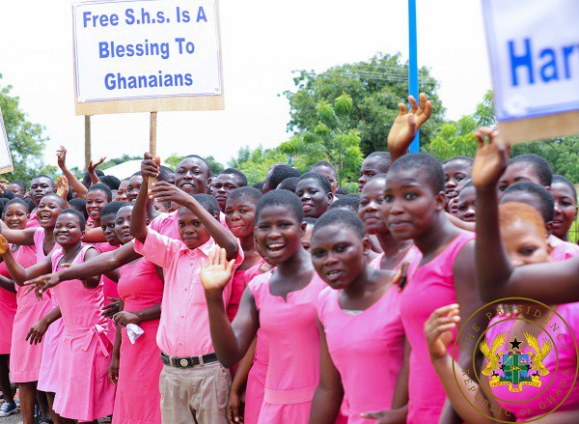
Executive Director of the Institute for Education Studies, Dr. Peter Anti, says that Ghana has admittedly downplayed on the variables of quality in its education policy resulting in the poor learning outcomes.
His comments are in agreement with an International Monetary Fund assessment of the Free SHS policy which had stated that while the policy had improved access to second cycle education, it had failed to meet quality requirements thus the poor learning outcomes.
The Fund had suggested government revised the policy to ensure that these quality variables are met to improve learning outcomes.
Speaking on PM Express, Dr. Anti noted that it appears the government had not fully anticipated the challenges the Free SHS policy will pose to second cycle education system thus their unpreparedness in addressing the falling quality of education in the sector.
“You see if you look at our education system, there have been variables that have been classified as quality variables by the Ministry of Education and then the Ghana Education Service. But these quality variables are used to assess how we are delivering education to the people who need it.
“So when you increase access, what you’re technically doing is that you are supposed to make sure that there is corresponding improvement in the quality variables to ensure that those quality variables do not suffer because of the increase in enrollment,” he said.
Listing some of the quality variables the government had failed to meet, he said;
“One of them is student to teacher ratio. And if you look at the number of students that are accessing secondary education now, you look at it and you see that the class sizes have increased. So if I’m an external evaluator and I come and I’m evaluating your programme, and I see that in your policy document you’re saying that you need a student to teacher ratio of one is to 25, between 25 and 35, and you’re having one teacher is to 65, one teacher is 58 students, it means that there is a problem with your quality variable in that perspective.
“The other quality variables including student to desk ratio, student to textbook ratio and all those things. And these things are supposed to lead to an expected outcome or output which is technically the performance that the students will put up when they write their BECE, and then an extension of the students’ contribution to the total development of the country which we call educational outcomes.”
According to him, the IMF must have noticed all these shortcomings before making their suggestion for reform.
“So I think that they looked at all these things and they realised that truly we’ve increased access but by extension, we have downplayed on the variables of quality and that is leading to the poor learning outcomes that they’re talking about.”
Latest Stories
-
Ghana housing finance conference adopts communiqué to improve affordable housing access
3 hours -
Special Initiatives Minister urges Wa Technical Institute to enrol more girls as EU-backed solar training lab opens
4 hours -
In the matter of my first year at the Bar
4 hours -
ActionAid Ghana calls for an end to child marriage, greater investment in girls’ rights
4 hours -
Newsfile to tackle World Cup visa scandal, beach demolitions, education strikes, BRICS bid
4 hours -
UK-Ghana Trade & Investment Summit: Trade Resource Centre to help businesses maximise UK-Ghana trade opportunities
5 hours -
Embassy of Denmark celebrates World Maritime Day
5 hours -
Linking LEAP to productive inclusion could cut extreme poverty by 2030 – UNICEF
6 hours -
Trade Ministry backs use of creative arts to rehabilitate prison inmates
6 hours -
Negotiations with government to continue despite strike suspension – GNAT
6 hours -
‘Ghana cannot afford to waste public resources; every cedi has a job’ – Ato Forson
6 hours -
Ghana expects economic boost as World Assemblies of God Congress brings 10,000 delegates to Accra
6 hours -
Joy in Nayilifong as Farouk Aliu Mahama donates 100kVA transformer to improve power supply
7 hours -
Chief Justice urges employers to tackle mental health stigma in workplaces
7 hours -
Analysis: Ghana’s yellow fever numbers reveal a gap between vaccination and protection
8 hours