

Audio By Carbonatix
The Upper Denkyira East Municipality has lost its huge acres of arable and swampy lands reserved for extensive rice and vegetable production, to widespread illegal mining activities also called ‘galamsey’.
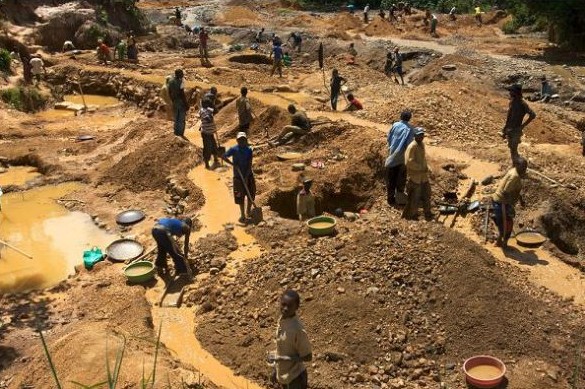
Mr. Obeng Nimoh, the Municipal Director of Agriculture told the Ghana News Agency, “Every evening, before nightfall, young miners trekked in single file, holding up pickaxes, head pans, hammers, and shovels to their sites to mine.
“They cut trees, excavate the ground, overturn rocks, and shove the rubble into the rivers. This has clogged the near stagnant water bodies around with mud thereby affecting irrigation.”
The Municipal Director of Agriculture expressed worry about the onslaught by the illegal miners on agricultural lands without regard to the dire consequences of their activities on the environment and national food security.
He underscored that the national fight against the menace remained an unsurmountable national disaster in waiting, if not tackled holistically with a bottom-up urgency approach.
Mr. Nimoh described the situation as dire in communities such as Opponso, Buabenso, Fawomanye, Denkyira-Fosu, Asmah-Camp, Kyekyewere, Akropong, Adwumam, Pokukrom, and Mmeredane.
In the farming communities, he narrated the vast devastation of acres of the marshlands where many had subsisted for years.
“You can see the way illegal miners have devastated not just the rice farms and vegetables but other crops as well. This is a sad situation that had destroyed the backbone of the country’s economy,” he lamented.
To him, illegal mining had not only degraded agricultural lands but decreased lands for agricultural production, resulting in the shortening of the traditional fallow period.
In principle, the Municipal Director of Agriculture explained that mining and agriculture were both pathways out of unemployment and poverty.
However, a disequilibrium can result in collateral damage for any economy; a situation where one sector grows abnormally or is mismanaged diminishes the progress of the other.
Mr. Nimoh noted that many smallholder farmers were regrettably wallowing in abject poverty and guilt after selling their farmlands to either illegal miners or multinational mining companies and misusing their proceeds from the sale.
He suggested that the mining sector management transition the degraded landscapes by planning trees, focus on poverty eradication and optimize the ecosystem for better livelihoods and more sustainable economic returns.
He asked farmers to stop selling arable lands to illegal miners saying, “the unsustainable practices could jeopardize the future of the young generation.”
“I suggest the traditional authorities, government, and the security agencies collaborate to effectively end the menace” he added.
Latest Stories
-
Ibrahim Mahama urges Ghanaians to overcome fear and venture into business
3 minutes -
2026 U-17 WWC: Black Maidens lose to China in pre-tournament friendly
7 minutes -
Who gave Gbande the EOCO remote control?
27 minutes -
Ghana begins review of 1999 National Land Policy, targets new framework by 2027
1 hour -
Tiptoe Lane’s tech takeover: The story behind Ghana’s booming informal phone market
2 hours -
Abanga vows to use social media to counter NDC messaging ahead of 2028 elections
3 hours -
Okai Mintah seeks Sabah Zita Benson’s support for NDC National Youth Organiser bid
3 hours -
Okai Mintah vows to strengthen NDC campaign machinery ahead of 2028
3 hours -
Mother of four and Jasikan teacher among new Telecel M’ahitti Promo winners
3 hours -
International Youth Shakers Conclave 2026 set to bring global young leaders to London
3 hours -
Gov’t is committed to addressing teachers’ conditions of service, deprived-area allowance – Education Minister
3 hours -
GoldBod’s structure encouraging galamsey – Afenyo-Markin
3 hours -
Tullow starts selling Jubilee, TEN crude to Ghanaian refineries
3 hours -
Local Government Service authorises rationalisation, redistribution of staff
3 hours -
PURC assures consumers of working to ensure quality services in Northern Region
3 hours