

Audio By Carbonatix
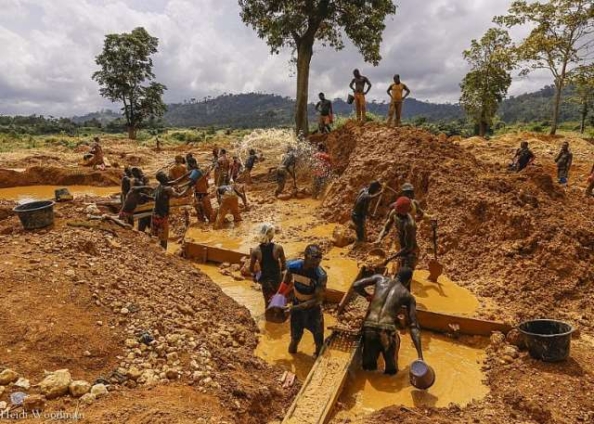
Air Commodore David Anetey Akrong, the Commandant of the Kofi Annan International Peacekeeping Training Centre (KAIPTC), has described illegal small-scale mining, popularly known as galamsey, as an existential threat to Ghana’s survival.
He warned that the menace had evolved into a national crisis with grave implications for the country’s environment, economy, and human security.
Speaking at the “Reflections on Security Series” seminar held at the KAIPTC in Accra, Air Commodore Akrong said the widespread degradation of forests, pollution of rivers, and destruction of arable lands had placed Ghana’s water security, public health, and sustainable development at serious risk.
The seminar, on the theme: “Galamsey as an Existential Threat to Ghana: A Call for Reflection and Action,” brought together policymakers, academics, security experts, civil society organizations, and media practitioners to deliberate on the multi-dimensional challenges posed by illegal mining and explore collaborative strategies to curb it.
Air Commodore Akrong said illegal mining, once seen as a livelihood activity, had transformed into a deeply entrenched network of organised criminality involving corruption, money laundering, and the exploitation of vulnerable populations.
He cautioned that, “If left unchecked, these dynamics threaten not only the sustainability of the country’s natural resources but also the legitimacy of governance institutions and the stability of local communities.”
He cited the contamination of major water bodies such as the Pra, Ankobra, Birim, and Offin with toxic chemicals, including mercury, cyanide, and arsenic, as evidence of the alarming scale of environmental destruction.
The Commandant said, “Entire communities are at risk, while the siltation of reservoirs is jeopardising access to potable water for several towns and cities,” emphasising that the crisis had far-reaching public health consequences.
According to him, galamsey had triggered a “silent public health emergency,” contributing to kidney diseases, respiratory ailments, birth defects, and the spread of waterborne and vector-borne diseases across mining communities.
He noted that the threat extended beyond environmental degradation, as illegal mining was now intertwined with transnational criminal networks that facilitate illicit financial flows and smuggling of industrial equipment and weapons, potentially fueling broader insecurity.
Air Commodore Akrong commended successive governments for their various interventions, including the establishment of the Inter-Ministerial Committee on Illegal Mining, Operation Vanguard, Operation Halt, the National Anti-Illegal Mining Operations Secretariat (NAIMOS), and the Responsible Community Mining Scheme.
However, he admitted that the persistence of illegal mining pointed to deeper governance and institutional challenges.
Participants examined how illegal small-scale mining had become a magnet for both local and foreign actors, driven by lucrative returns and weak enforcement mechanisms. The practice continues to undermine national security and development due to its links with organised criminality, corruption, and illicit financing.
Experts at the seminar interrogate several key issues, including the true extent of illegal mining, its existential threat to the nation, the effectiveness of response mechanisms, and reasons behind the limited success of past interventions.
Discussions also focused on identifying realistic, actionable measures that could galvanize cooperation between state and non-state actors to stem the tide.
Air Commodore Akrong reiterated that as a Centre of Excellence in research, training, and policy dialogue, the KAIPTC remained committed to providing an open and trusted platform for constructive engagement on national and regional security challenges.
He expressed optimism that the deliberations would “generate actionable insights that contribute meaningfully to the fight against illegal mining.”
The seminar formed part of KAIPTC’s ongoing “Reflections on Security Series,” a platform designed to promote open and evidence-based discussions on complex national and regional security challenges.
It brought together stakeholders from academia, civil society, the media, the security services, the extractive sector, and traditional authorities.
Latest Stories
-
Journalists look back on a decade of breast cancer reporting in Ghana
21 minutes -
President Mahama ends Resetting Ghana tour of Ahafo Region
2 hours -
African negotiators seek delivery of climate commitments at COP31
2 hours -
BoG develops AI rules for financial sector
2 hours -
‘Big Push’: Government assures contractors of prompt payments
2 hours -
Court fines miner for breaking into gold buying shop
3 hours -
Tarkwa court jails labourer for three years over GH¢123,000 theft
3 hours -
GAEC must retain nuclear scientists for Ghana’s nuclear ambitions – Minister
4 hours -
Man reportedly mistaken for game and shot by hunter dead in forest
4 hours -
19-year-old mason jailed 15 years for defiling seven-year-old pupil
4 hours -
Ghana’s banking sector assets rise 20.47% to GH¢500.2bn – BoG Governor
4 hours -
22 injured as Sprinter bus overturns at Sege after tyre burst
4 hours -
UN housing expert urges Ghana to strengthen Rent Control Department amid housing affordability concerns
4 hours -
Delta-BCI partnership reaches 166,000 people with breast cancer education
4 hours -
Power restoration fault suspected in Kumasi Central Market fire
10 hours