

Audio By Carbonatix
A US federal investigation has been launched into policing practices in the city of Minneapolis, a day after one of its former officers was convicted of the murder of George Floyd.
The justice department will look at whether there has been a pattern "of unconstitutional or unlawful policing", Attorney General Merrick Garland said.
It follows national outrage over the killing of Mr Floyd by Derek Chauvin.
The former officer was convicted of all charges against him on Tuesday.
Chauvin was filmed kneeling on Mr Floyd's neck for more than nine minutes during an arrest in May 2020. Mr Floyd, an unarmed African American, was pronounced dead an hour later.
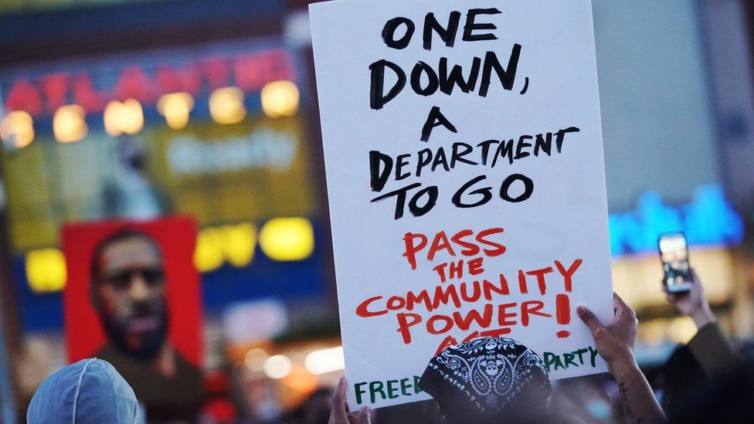
His death sparked protests across the US and worldwide, and calls for police reform
Tuesday's verdict has been welcomed in a country where police are rarely been convicted - if they are charged at all - for deaths which occur in custody.
But Mr Garland told reporters that he knew the verdict would not "address potentially systemic policing issues in Minneapolis".
What will the investigation look at?
The attorney general said the investigation would "include a comprehensive review of the Minneapolis Police Department's policies, training, supervision and use-of-force investigations".
It will also examine "whether its treatment of those with behavioural health disabilities is unlawful", while looking at the "effectiveness of current systems of accountability and whether other mechanisms are needed to ensure constitutional and lawful policing".
Mr Garland said both the community and law enforcement would have to take part if the investigation were to be a success, and he had already started reaching out to both.
If unlawful patterns or practices were found, he promised to issue a public report and bring a civil lawsuit.
What happened to George Floyd?
Police were called after a shop assistant believed 46-year-old Mr Floyd had used a counterfeit note to buy cigarettes.
Mr Floyd then refused to get into the police car, resulting in him being pinned to the ground with Chauvin pressing his knee to the back of Mr Floyd's neck for more than nine minutes.
Mr Floyd repeatedly told the officer he could not breathe during this time.
On Tuesday, a jury found Chauvin guilty of second-degree murder, third-degree murder and second-degree manslaughter, meaning he faces potentially decades in prison.
The three officers he was with during the arrest face trial later this year, accused of aiding and abetting murder in the second degree and aiding and abetting manslaughter in the second degree. If found guilty, the former officers - who were all fired - also face the possibility of decades in prison.
How have people reacted?
The conviction has been hailed as a watershed moment, and welcomed by thousands who took to the streets.
"Being able to know there is justice for African American people, just people of colour, period, in this world," Philonise Floyd, Mr Floyd's brother, said. "This is monumental. This is historic. This is a pivotal moment in history."
But many point to the fact that this is just one case. The fatal shooting of Duante Wright - another unarmed African American man - during a traffic stop on 11 April has once again highlighted the fact that black people are more likely to be shot dead by police in the US than people of other races.
The video of Mr Floyd's killing last May prompted outrage around the world, setting off days of demonstrations which spread across the entire US, with reformation of police departments at the heart of protesters' demands.
Former President Donald Trump faced criticism for his response to George Floyd's death, rejecting calls for comprehensive police reform. He did sign an executive order asking police departments to improve officers' training and create a database to track misconduct.
His successor Joe Biden has struck a different tone, welcoming the conviction of Chauvin on Tuesday, saying it "can be a giant step forward in the march toward justice in America".
Latest Stories
-
Nearly 400 sentenced in Nigeria for links to militant Islamists
18 minutes -
Ghana’s recovery supported by gold strength despite global oil price pressures – Standard Bank Research
25 minutes -
Kwaku Azar writes: A-G vs OSP
58 minutes -
Mfantsipim–Adisadel rivalry built excellence, not division – Sam Jonah
1 hour -
Vice President launches Mfantsipim’s 150 years of shaping Ghana’s greatest mind
2 hours -
I assure Otumfuo, Mahama will join him to commission KNUST Teaching Hospital by end of this year – Haruna Iddrisu
2 hours -
Barcelona dominate derby to extend La Liga lead
3 hours -
Gov’t to roll out free special education for persons with disabilities from July 1 – Education Minister
3 hours -
Importers and Exporters Association declares full support for Publican AI port system
3 hours -
“We used it to test our officiating officials’ readiness” – Bawah Fuseini after CAA Athletics event
3 hours -
Volleyball emerges as Ghana’s fastest rising sport
3 hours -
National Sports Fund needs strong leadership from the top – Administrator David Wuaku
4 hours -
JoySports Exclusive: Steve McLaren in talks with GFA after expressing interest in Black Stars job
4 hours -
Fire guts auto parts warehouse at Bubuashie, one fire officer injured
4 hours -
I owe my victory to coach Ofori Asare – Allotey after winning WBA Africa Gold Super Flyweight belt
4 hours