


Audio By Carbonatix
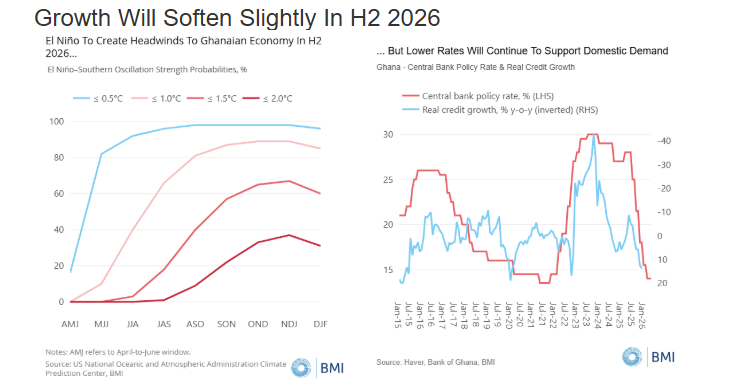
Ghana’s economic growth will moderate to 4.7% in 2027 from 5.7% in 2026, UK-based Fitch Solutions has disclosed.
This is as a result of less favourable base effects and weaker agricultural output.
According to Fitch Solutions, stagnant oil and cocoa production will constrain export growth.
“Fiscal pressures will also intensify as principal repayments under the Domestic Debt Exchange Programme, launched in December 2022, begin to fall due, while Eurobond debt-service obligations also increase. As a result, a larger share of government resources will be directed towards debt servicing at the expense of government consumption”, it pointed out.
It added that risks to its 2026-2027 growth outlook for Ghana are mixed but tilted to the downside.
“A tighter-than-expected monetary policy stance by the US Federal Reserve in response to elevated inflation would weigh on global gold prices and, by extension, Ghana’s export earnings. This would put pressure on the cedi, resulting in higher inflation than we currently forecast and a corresponding drag on household consumption and broader economic activity in H2 2026 and 2027”.
On the upside, the UK-based firm said domestic demand could prove more resilient than its anticipate. “Should consumer and business sentiment remain strong – despite rising inflation and geopolitical uncertainty – household spending and private investment would likely outperform our expectations. In this scenario, economic growth would exceed our current forecasts”.
Economic Activity to Remain Robust in Quarter 2
Meanwhile, the UK-based firm expects economic activity to remain robust in the second quarter of 2026 despite disruptions in global energy markets stemming from the US-Iran conflict.
“As we have argued previously, Ghana’s macroeconomic fundamentals are relatively insulated from the current energy shock, supported by its broadly balanced oil trade position and elevated gold prices, which provide a key external anchor. While domestic fuel prices have increased by 8.8% since the start of the US–Iran conflict and diesel prices are up 19.7% (in USD terms), price increases remain below market levels as the government has absorbed part of the cost”.
“As such, inflationary pressures have remained contained: headline inflation rose only modestly from 3.2% y-o-y in February to 3.7% in May, remaining well below the 2010-2025 average of 15.7%. This suggests that household purchasing power remains intact, supporting private consumption growth”, it added.
Ghana’s economy expanded by a robust 6.4% year-on-year in quarter one 2026, accelerating from 5.8% in quarter 4 2025.
.
Latest Stories
-
Turning invitations into arrests is making citizens reluctant to assist police – Twumasi Ankrah
10 minutes -
The Traffitech-GH SMS spot-fine system: The good, the sad, and the funny – Bright Simons writes
22 minutes -
Hawa Koomson pledges experienced and mature leadership of NPP women’s wing
1 hour -
Young woman found dead at Kasoa Peace Town
2 hours -
Playback: The Law examined lawful arrest in Ghana
2 hours -
Mahama urges African governments to treat healthcare as an investment, not budget cost
3 hours -
Bawumia congratulates John Boadu and new NPP executives, pledges support ahead of 2028
3 hours -
Aksa Energy delegation pays courtesy call on GRA Commissioner-General
3 hours -
‘No talent should be left out’ – Bawumia pledges inclusive NPP campaign for 2028
3 hours -
Prof. Mike Oquaye recounts how he blocked the Special Prosecutor’s attempt to arrest Bawku Central MP
3 hours -
Make health sovereignty a priority for Africa – Mahama
4 hours -
Dorimon Naa, Wa West DCE lead massive clean-up exercise; threaten sanctions against recalcitrant residents
4 hours -
Photos from Adom FM Y2K Jam
4 hours -
Praye Tiatia steals the show at Adom FM Y2K Jam [Watch]
4 hours -
Boakye Agyarko congratulates John Boadu, pledges support for NPP leadership
4 hours