

Audio By Carbonatix
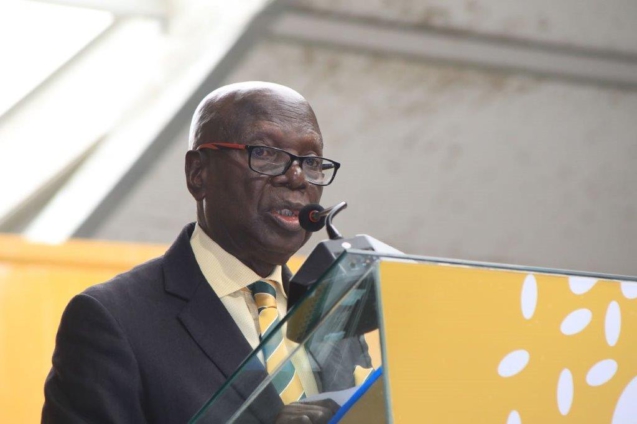
Economist, Dr. Ishmael Yamson says Ghana’s leaders are failing to admit that the country has a serious problem.
According to him, the admission that the country is in very difficult times would solve 80% of the challenges the country is currently facing as this would signal the government’s eagerness to look for a solution.
Speaking on PM Express Business Edition he stated that the country’s situation is so dire that for the first time Ghana is unable to access European funds to undertake developmental projects.
“My own experience is if you want to solve a problem, you must understand what that problem is and you must admit what the problem is. The admission that you have a problem to me is 80% of the solution. Because if you admit that you have a problem then you are more eager to look for a solution. But it doesn’t seem to me that we accept the fact that we’re in very difficult times.
“It is a very difficult situation we have to the extent that we can’t access Europe money. And don’t forget Europe money help this country a lot to stabilize the macro environment, the fiscal environment, and the moment we lost it, we were exposed,” he said.
He explained that much of the country’s problems stems from the fact that since independence, successive governments have failed to restructure the economy; heavily relying on the colonial structures which are rapidly becoming obsolete.
“We still have an economy which is the same as when I was a student of economics. The structure hasn’t changed. And why? How many years after independence? We have had all the opportunity to restructure the economy.
“And one thing that really shocked me recently was when I read that in 2021 Ghana produced 888,000 tonnes of cocoa and Cote D’Ivoire produced 2million tonnes. And yet just between the Kufuor administration and Atta-Mills administration, we had crossed a million tonnes, so what happened? Why are we now going backwards?”
He further noted that the country’s overreliance on oil money was a rather dangerous venture especially taking into consideration that most of the world’s superpowers have set into motion plans to phase out their production and use of fossil fuel products in the coming years.
According to him, even though the country may be enjoying a positive trade balance as a result of the Russia-Ukraine war, when the price of oil tumbles, the country will be hit very hard.
“I think we have been saved to some extent because global commodity prices have shot up. Oil price, this morning 230 dollars per barrel of brent crude oil. So that will tell you that Ghana has, you know, our trade balance has improved dramatically.
“But for me it’s just deceiving ourselves that our trade balance has improved. It has improved because there’s a crisis in the world that has pushed world market prices to 230, so if we’re producing oil but we’re a net importer we’ll pay the price. So the first point is that we haven’t been serious about changing the structure of our economy.”
He added that “Today people come here and if you look at the source of foreign exchange revenue, the oil money its simple. Everybody knows once you get there you’ll make money. But if we should think deep, oil is a sunset industry. Very soon all these fossil fuel products where will they be?
“The Europeans, the Americans, they’re all saying by 2030 they’re not going to produce oil. So if you are putting your faith in an industry which is disappearing and we’re so happy doing that, and we’re happy because we have improved our trade balance because oil prices has gone up tomorrow if oil prices crashes to 40 dollars where will we be?”
Dr. Yamson further bemoaned the failure of successive governments to develop the country’s manufacturing industry.
“I think the second thing we have done very badly is that we have not developed our manufacturing sector. Our manufacturing sector, I mean, if I take the big companies, in the last ten years which major factory have we established in the country? Very few. The Unilever, the Nestle, they all established in the 60s, the 70s and the 80s.”
He has thus called on the government to admit the country has a problem and accept all the help it can get before it is too late.
Latest Stories
-
Hubtel willing to contribute to Ghana’s proposed AI fund – CEO
1 minute -
Nkrumah family pays tribute to Gamal, says he died after prolonged illness
10 minutes -
Police arrest eight suspects in anti-narcotics operation at Okaishie Drug Lane
21 minutes -
Benjamin Danso pledges grassroots empowerment in NDC regional chairmanship bid
24 minutes -
GES recommends reposting of Obuasi SHTS headmaster after August 2026 campus riot
27 minutes -
Rocky Dawuni celebrates King Ayisoba for taking traditional music global
39 minutes -
Ghana targets $5bn in annual economic gains from AI – Sam George
40 minutes -
From childhood dreams to future careers: Ecobank’s Big Pitch seeks to promote early savings and investment
43 minutes -
Public office demands make party work difficult for NDC appointees – Mahdi Gibril
44 minutes -
AI could deepen rural-urban inequality without better connectivity – Sam George
47 minutes -
One of six inmates who escaped from Konongo police cells rearrested
52 minutes -
Sam George cautions ministers against reading unverified AI-generated speeches
56 minutes -
Ghanaian entrepreneur Mary Nyamekye Asamoah wins Africa Travel 100 award
59 minutes -
Obuasi SHTS abuse: Sanction all officials who failed to act – Moving Masculinity
1 hour -
Lucy Agyepong honoured for excellence in engineering education at maiden GAAS Women’s Awards
1 hour