

Audio By Carbonatix
A new study by the Institute for Fiscal Studies (IFS) has revealed that high transportation costs remain one of the biggest challenges confronting rice farmers in Ghana, significantly affecting their ability to market their produce and earn fair returns.
The findings, presented in a new policy document on Ghana’s rice sector, were based on field research conducted by the IFS team in the Volta and Oti Regions. The team engaged directly with rice farmers and millers to understand the real challenges facing the sector and how these issues impact its growth.
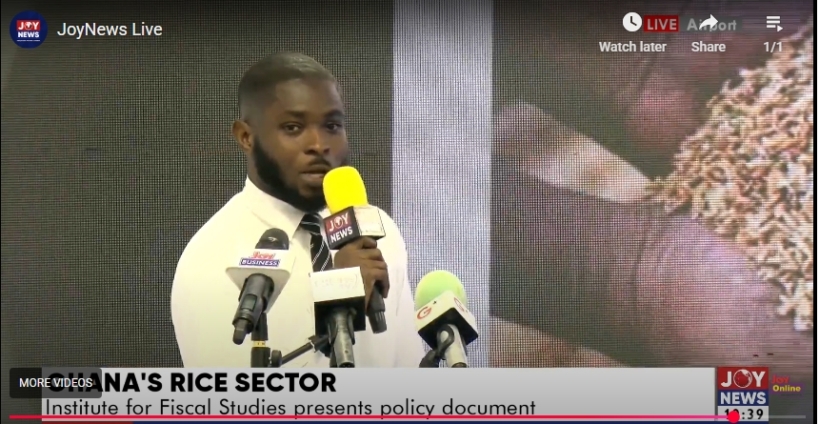
Presenting the findings, a Research Assistant at the Institute, Mr Frederick Amu, said marketing remains a major concern for rice farmers, with transportation costs standing out as a key burden.
“Another problem or challenge we faced with our engagement with these rice farmers is a marketing challenge,” Mr Amu explained. “This marketing challenge translates into high costs that these rice farmers mostly bear when they are transporting their rice produce to the final consumers. Sometimes they would have to split the cost of transport because when the transport takes produce to these consumers, it commands high prices, so they would sometimes have to take the transport cost themselves.”
He noted that the high cost of transporting rice from production areas to market centres often reduces farmers’ profit margins and discourages them from expanding production. In some cases, farmers are forced to absorb part of the transport costs to make their produce more competitive in the market.
Mr Amu added that apart from transportation, other marketing-related issues continue to compound the struggles of local rice producers. These include limited access to buyers, competition from imported rice, delayed payments, and low prices for locally produced rice.
He further observed that imported rice continues to dominate consumer preference, leaving local farmers at a disadvantage despite their efforts to meet demand. The combination of these challenges, he said, weakens the market position of local rice farmers and threatens the sustainability of the sector.
Latest Stories
-
He entered at eight. He is now 16: Ghana’s children growing up in prayer camps
4 hours -
‘Development must not always begin from Accra’ — Anwelle Foundation launched in Jirapa
4 hours -
PKO trio eye victories at Odwira Festival
6 hours -
346 Ghana Navy recruits pass out after 26 weeks of intensive training
6 hours -
Newsfile to discuss EOCO-MP arrest, drug trafficking, speech arrests and $235m water debt
7 hours -
JoyNews gets results as listeners raise GH¢40,000 to help 17-year-old student with cerebral palsy attend SHS
7 hours -
Vice President calls for stronger local pharmaceutical production to reduce medicine imports
8 hours -
The brewing tension at KNUST; Beware the Ides of October….
8 hours -
Health Ministry moves to integrate traditional medicine into mainstream healthcare
8 hours -
550 pupils in Kintampo South get educational lifeline as ‘Seeds of Hope’ reaches farming communities
9 hours -
Opoku Mensah urges Christian Council, House of Chiefs to speak up on democratic freedoms
9 hours -
Teacher unions’ strike: Minority demands immediate payment of teacher arrears, 20% deprived area allowance
9 hours -
The Accra-Kumasi Expressway: Building it right
9 hours -
Beyond gold exports: Building value and economic resilience from Ghana’s gold
9 hours -
2027 AFCONQ: Ghana under pressure as Gambia beat Somalia 2-1
10 hours