

Audio By Carbonatix
In the grand halls of the University of Professional Studies, Accra, a remarkable moment in Ghana’s legal and intellectual history unfolded, a moment not merely of celebration but of reflection, truth, and moral awakening. The organisers of the honourific lecture and awards ceremony must be profoundly commended for assembling such an illustrious gathering to celebrate a man whose name has become synonymous with legal brilliance and principled advocacy: Tsatsu Tsikata.
The presence of eminent dignitaries, the Vice President of the Republic, the Chief Justice, distinguished academics, seasoned practitioners, and aspiring lawyers gave the occasion a rare prestige. It was not only an event; it was a testament to the enduring relevance of law in the life of a nation.
Indeed wow! What a colossus of law. What a legal luminary. What a towering intellectual force.
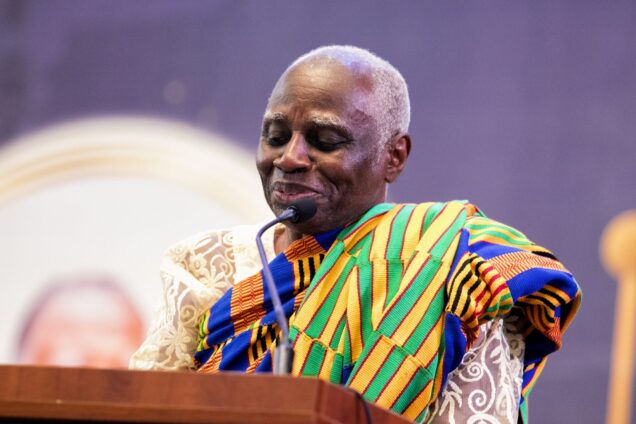
When Tsatsu Tsikata rose to speak, it was not merely a speech, it was a masterclass in jurisprudence, ethics, and national conscience. His words carried the weight of experience, the depth of scholarship, and the courage of one who has stood face-to-face with the harsh realities of power and injustice.
In a society where truth is often unwelcome, he spoke it plainly. And yes, truth is bitter. In Ghana, as in many places, those who speak truth are not always embraced but history has a way of honouring such voices.
At the heart of his address was a principle that should guide every constitutional democracy:
“Where power lies should not determine who is prosecuted.”
This is not merely a statement; it is a legal doctrine in itself. It reflects the very essence of the rule of law, which demands equality before the law, impartiality in its application, and integrity in its enforcement.
To weaponise criminal prosecution for political or personal vendettas is to erode the foundation of justice. As Tsatsu Tsikata rightly cautioned, such practices diminish public confidence and weaken democratic accountability.
The life of Tsatsu Tsikata is not one of mere academic excellence or courtroom brilliance; it is a life tested by adversity.
Persecuted, prosecuted, and imprisoned, yet never broken.
During the era of John Agyekum Kufuor, his encounter with the justice system revealed the dangerous intersection between law and political power. Yet, in the face of such trials, he did not abandon his belief in justice. Instead, he emerged stronger, his resolve deepened, his voice clearer, his legacy secured.
Today, he stands not just as a lawyer, but as a household name, an enduring symbol of resilience and intellectual courage. Many, inspired by his journey, have chosen the path of law, seeing in him a model of what it means to serve justice with integrity.
There is something profoundly compelling about the intersection of law and morality in his reflections. His biblical quotation during the election petition, once perhaps dismissed by some, now echoes with renewed significance in the corridors of political discourse.
Time, indeed, has a way of revealing truth. Whether one calls it justice, consequence, or simply karma, the principle remains: actions, especially those touching the sacred domain of justice, carry enduring implications.
The message delivered was clear and uncompromising:
The judiciary must remain fiercely independent
Legal processes must be transparent and consistent
Justice must not only be done, but must be seen to be done
These are not abstract ideals; they are the lifeblood of any functioning democracy.
Lawyers and judges alike are called upon to rise above partisan considerations and uphold the sanctity of the Constitution. For when law bows to power, society drifts toward arbitrariness; but when law stands firm, justice prevails.
To the organisers once again, your efforts have not only honoured a great man but have enriched the intellectual and moral fabric of the legal community.
And to you, Mr. Tsatsu Tsikata, the King of Law, as many would fondly describe. You have given us more than a speech; you have given us a compass.
We pray for your good health.
We pray that God grants you even greater wisdom.
We pray that your voice continues to echo in courtrooms, lecture halls, and the conscience of this nation.
May God’s abundant blessings be upon you.
Power is transient, but law, grounded in truth and justice, endures.
And as long as voices like that of Tsatsu Tsikata continue to rise, there remains hope that the law in Ghana will not merely exist but will truly serve justice.
Latest Stories
-
Ecobank Junior Saver Big Pitch to reward 10 winners with GH¢2,000 each
2 minutes -
AMA demolishes unauthorised pigsty obstructing Agbogbloshie waste evacuation exercise
2 minutes -
I was filled with disbelief – Akosua Achia Sarpong Esq. shares her first reaction
3 minutes -
Snake Village: A look at Volta Region’s hidden snake village and its tourism potential (Video)
10 minutes -
Election Watch Ghana calls for constitutional reforms to strengthen Electoral Commission independence
12 minutes -
NACOC, Postal and Courier Services Regulatory Commission intensify efforts to curb drug trafficking
14 minutes -
Ga Mantse chairs committee to drive Accra Green and Clean City Initiative
16 minutes -
Drivers threaten to remove traders from lorry stations over TrafficTech concerns
18 minutes -
AI could create 10 to 20 times more jobs despite current recruitment slowdown – Hubtel CEO
21 minutes -
Sexual abuse in schools persists because perpetrators are not held accountable – Dr Nyarkoa
28 minutes -
Chief Justice has designated Achimota Court to handle petroleum diversion cases – NPA CEO
31 minutes -
Philip Nai and friends gear up for bigger seventh Christmas outreach
33 minutes -
GSA strengthens electricity meter testing to protect consumers and improve energy reliability
34 minutes -
‘Dismissed or suspended? Ghanaians deserve clarity’ – NPP demands clarity on Ampofo Ankrah’s fate
37 minutes -
Teach consent and sexual boundaries from pre-school to prevent abuse – Gender advocate
43 minutes