


Audio By Carbonatix
A crowd runs in panic along a dusty street. Shots ring out. A woman wearing a purple jacket carrying a stick falls to the ground.
Another woman can be heard pleading, "Mama, mama, stand," as she tries to lift her. Blood is spreading around her stomach as another stain appears on her back.
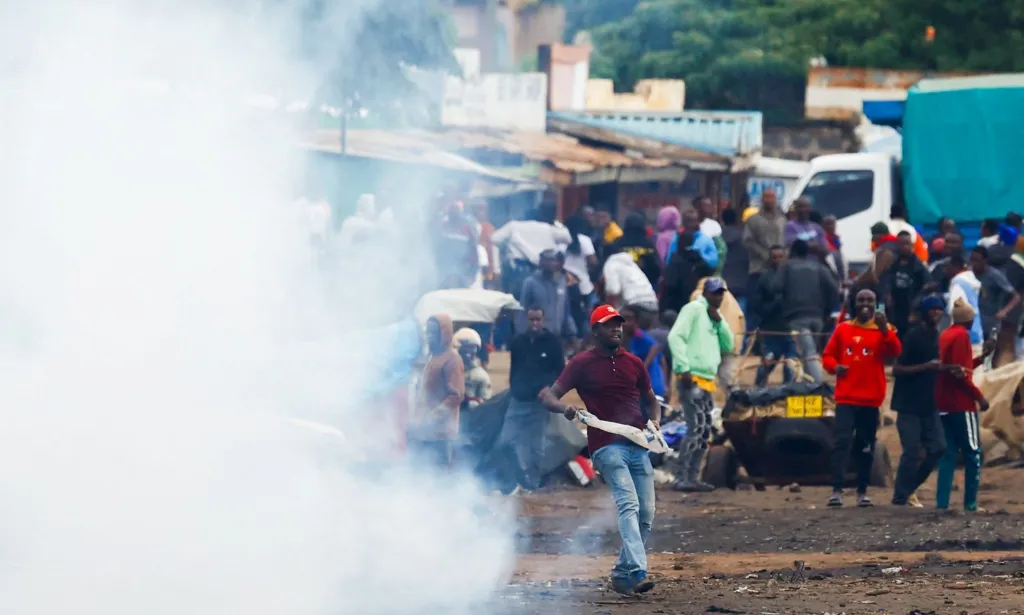
This verified footage, filmed in Tanzania's city of Arusha, is just one of many graphic scenes to have emerged showing the violent actions of police as they attempted to crush widespread protests last month during the country's presidential and parliamentary elections.
The protests started in the city of Dar es Salaam on 29 October and spread across the country over the following days. The demonstrations had largely been organised by young people left angry at what they see as a political system dominated by one party since Tanzania gained independence in the 1960s.
Several opposition leaders were arrested and others banned from standing during the elections while a number of opposition activists were detained. Incumbent President Samia Suluhu Hassan ultimately secured victory after the electoral commission declared she received 98% of the vote.
Since then the UN human rights office (OHCHR) said it had reports indicating that hundreds of people were killed during the protests, with many more injured or detained. A diplomatic source in Tanzania told the BBC there was credible evidence that at least 500 people had died.
President Samia has called for an official investigation into the unrest and asked prosecutors to "show leniency" towards those arrested.
Footage of the protests was suppressed for almost a week when the government imposed a near-total internet blackout and threatened to jail anyone caught sharing any videos from the protests, saying it could cause unrest.
Only once the block was lifted on 4 November did dozens of videos begin to emerge online showing violent scenes: uniformed officers appearing to fire at crowds, bodies lying on the streets, with others piled up outside a hospital.
To understand what happened, BBC Verify has analysed, geolocated and confirmed footage, building a clearer picture of how police responded to the demonstrations.

Violence in Tanzania's largest city
In the footage our team has verified the protests appear to have been dominated by groups of young men, drawing strong parallels with a global Gen-Z youth movement frustrated at economic decline and entrenched leadership in countries across Africa.
The first demonstrations we identified took place early on election day in Dar es Salaam, the country's largest city and economic hub. They spread to other urban areas across the country, including the cities of Mwanza and Arusha.
The internet blackout makes it difficult to establish a clear sequence of events, but what is clear from videos and images posted online is that protesters were confronted by heavily armed police units blocking their progress and firing tear gas to disperse crowds. In many of the videos, gunfire can clearly be heard as people scatter in the ensuing chaos.
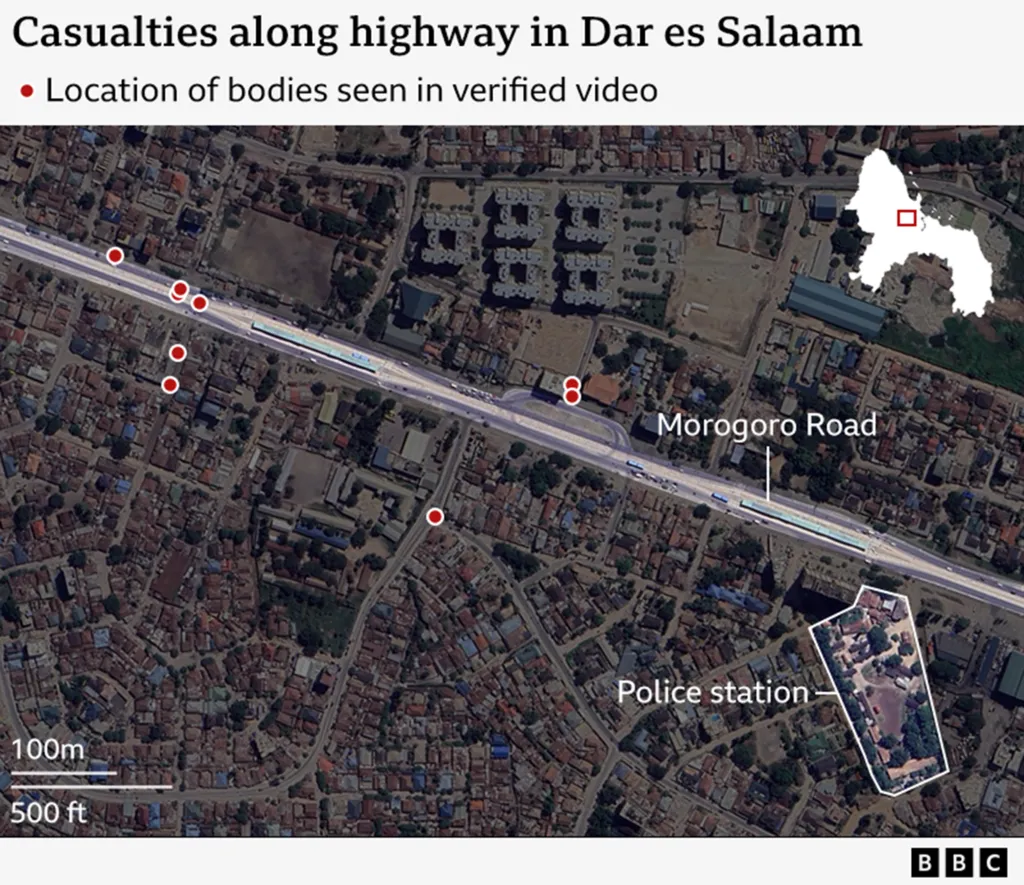
A key flashpoint was along the Morogoro Road, a main highway through Dar es Salaam. In two separate highly graphic videos, two bodies can be seen lying on the side road next to St Andrew's Anglican Church. One lies unresponsive, with heavy wounds visible on their head, surrounded by a pool of blood.
We identified more bodies lying nearby around the same stretch of road: one next to a bus stop and two more on the ground surrounded by blood. One body is later seen wrapped in a white shroud.
Further casualties are also visible along this stretch of highway and in the neighbouring side streets.
Footage from another location close to the Open University of Tanzania shows a motionless body on the ground with an open head wound. In a later video taken from the same scene we see the body covered in a cloth and carried towards a group of policemen standing by the university building.
"Killers, killers," the group chants at the officers, one of whom is armed with a rifle, another carries a pistol. The body is then placed in the back of a truck.
BBC Verify has confirmed at least a dozen other videos from Dar es Salaam showing people with a range of injuries, some of whom are being carried away.
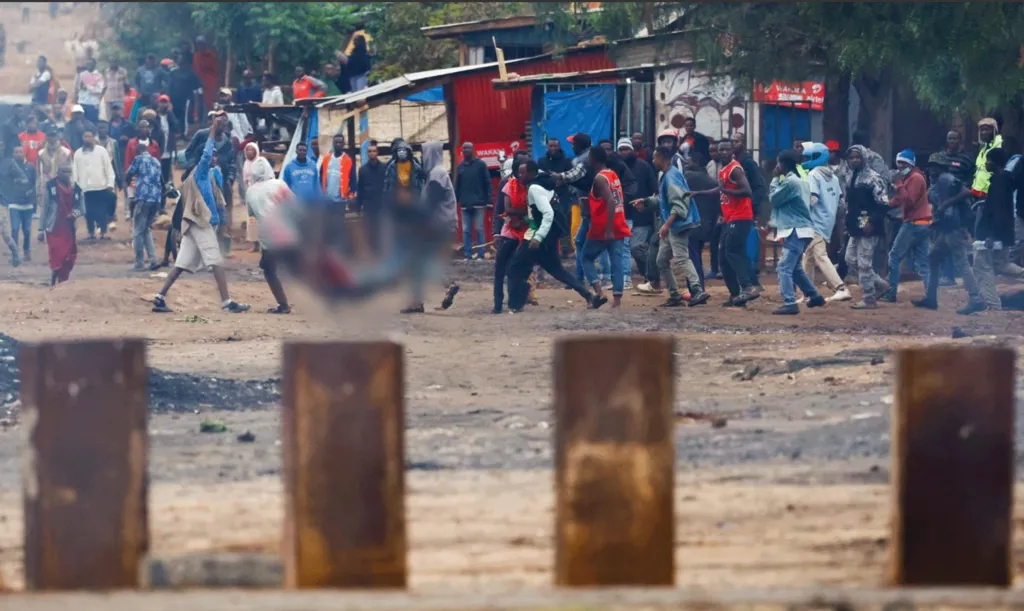
We have also documented casualties from protests more than 700 miles (1125km) away in Tanzania's second-largest city, Mwanza, that took place on election day.
Within the grounds of the city's Sekou Toure Hospital, several videos show a pile of 10 bodies, all of whom appear to be young men. Some of them have visible open wounds. Other footage from within the hospital shows bodies laid out in what appears to be a hospital morgue.
Footage shows police firing on crowds
We have verified multiple videos of police shooting towards groups of protesters.
In three videos posted online, police vehicles are seen chasing dozens of people as the attempt to flee along Nelson Mandela Road in Dar es Salaam. Several rounds of gunfire can be heard as the police advance.

In Arusha, footage shows a police vehicle passing a crowd of chanting youths. Gunshots ring out and people are seen scattering and running for safety. Another video taken shows an injured man with those around him saying he's been shot.
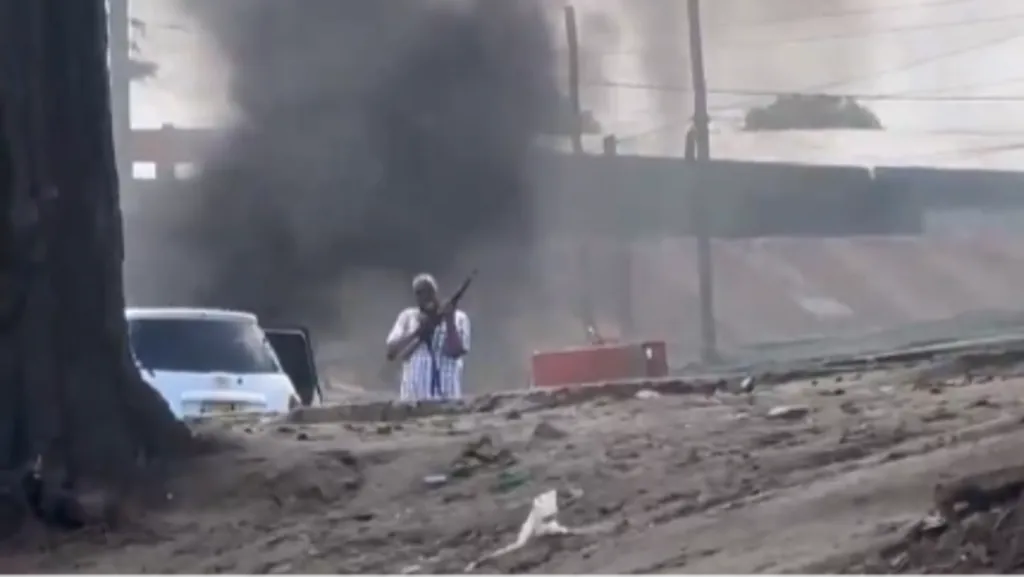
In the northern Kijitonyama area of Dar es Salaam, two men in uniform were filmed taking aim and firing along a main road in the direction of protests. We have confirmed the location next to a local school. The green uniforms and flat-topped peak caps worn by the two men closely match those worn by the Tanzanian police.
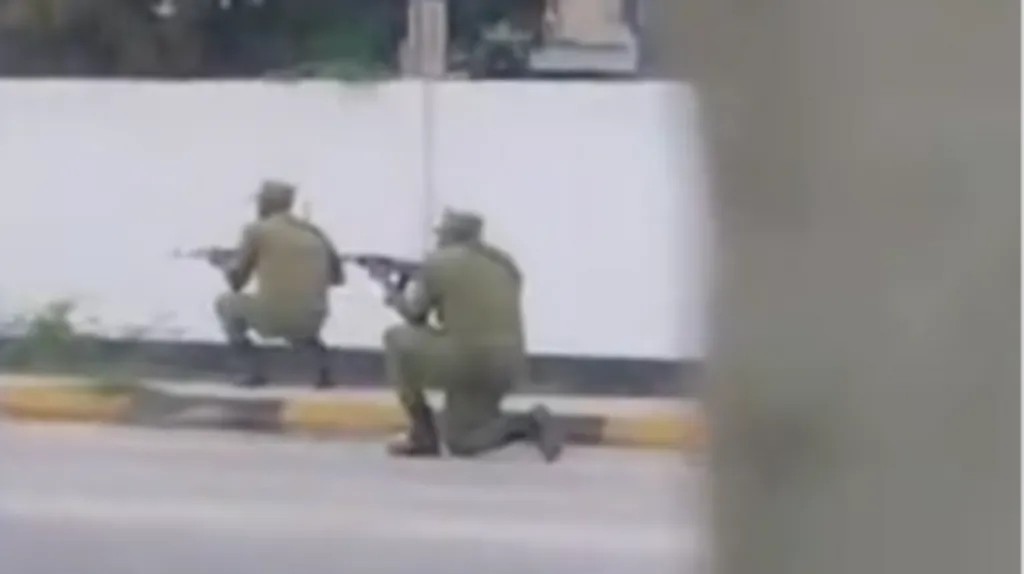
Less than 100 metres away a man is shown lying on the street with a bloody head wound. In the distance, men wearing similar green uniforms can be seen. Someone shouts: "He has been shot in the head. They have killed [him]." As the video continues, more gunshots can be heard.
There are also multiple videos seen by BBC Verify of men in the same green uniforms firing weapons - sometimes into the air, sometimes along open streets.
Investigators from audio forensics experts, Earshot, said what can be heard in those videos confirms live rounds were used on protesters.
After analysing the audio from the scene, they said: "Rubber bullets typically do not travel at supersonic speeds.
"The presence of these shockwaves therefore indicates the use of live rounds."
Not all the people we've seen carrying guns are wearing uniforms. In footage filmed in Sam Nujoma Road, Dar es Salaam, three men in civilian clothing are seen firing guns by a saloon car. It's unclear who they are.
The UN High Commissioner for Human Rights, Volker Türk, has called for an investigation into the killings and other violations committed during Tanzania's elections, and for the unconditional release of all those arrested before the vote took place and others who have since been detained.
The Tanzanian government and police have been contacted for comment.
Latest Stories
-
Chef Abbys: Feeding 50,000 people, putting food security on Ghana’s agenda
22 minutes -
Ho set to host Republic Bank–JoyNews Habitat Fair as multiple firms prepare to showcase housing solutions
29 minutes -
NPP demands public inquiry into alleged $600,000 World Cup visa fraud, wants Sports Minister, GTA CEO summoned
36 minutes -
I want my brand to be bigger than just music – Yaw Wazinga
40 minutes -
Houthi missile attack on Yemeni presidential palace kills two, minister says
40 minutes -
I hoped to win an award; I worked hard – 2026 Best Graduating Law Student
50 minutes -
Fraudsters increasingly target bank customers instead of banking systems – Fraud detection expert
51 minutes -
44 teacher sexual abuse cases tracked since 2015; school heads feature in 40% of recent cases — JoyNews Research
54 minutes -
Unchecked imports and the Middle East crisis threaten Ghana’s fragile food inflation anchor
1 hour -
Ecobank Junior Saver Big Pitch to reward 10 winners with GH¢2,000 each
1 hour -
AMA demolishes unauthorised pigsty obstructing Agbogbloshie waste evacuation exercise
1 hour -
I was filled with disbelief – Akosua Achia Sarpong Esq. shares her first reaction
1 hour -
Snake Village: A look at Volta Region’s hidden snake village and its tourism potential (Video)
1 hour -
Election Watch Ghana calls for constitutional reforms to strengthen Electoral Commission independence
1 hour -
NACOC, Postal and Courier Services Regulatory Commission intensify efforts to curb drug trafficking
1 hour