

Audio By Carbonatix
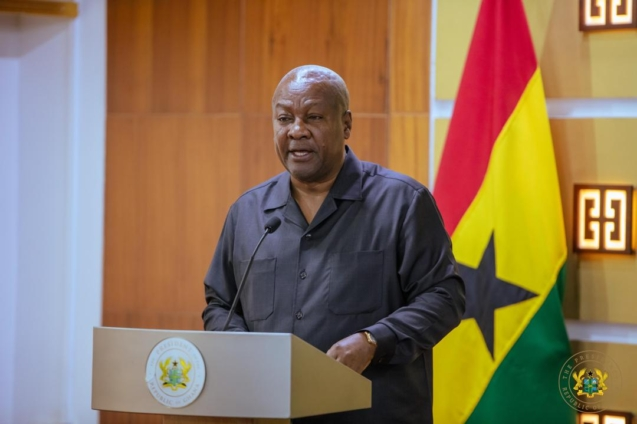
President John Dramani Mahama has charged African leaders to take firm ownership of the continent’s industrial and manufacturing future.
He warned that Africa’s economic independence will remain an illusion without tailored industrial policies.
Speaking at the Davos Convening, a forum held on the sidelines of the 2026 World Economic Forum Annual Meeting, the President highlighted the need for deeper regional cooperation, arguing that no single African country can successfully industrialise in isolation.
“No African country can industrialise alone by itself. We must create regional prosperity platforms, manufacturing zones, energy grids and digital infrastructure that give our businesses scale and our workers opportunity,” he stated.
“We must produce at home, from vaccines to semiconductors to solar panels. If we don’t make it, we’ll always be dependent on someone who does,” he cautioned.
Rejecting the notion that industrial policy is outdated, he described it as a survival strategy for the continent.
“Industrial policy isn’t old-fashioned. It is what will make us survive,” he said.
President Mahama outlined a four-point vision for Africa’s industrial transformation, anchored on regional cooperation, collective bargaining, and domestic production and skills development
He stressed that Africa must move beyond consumption and build a workforce equipped with practical, job-ready skills.
“First, we must invest in skills, not just education, but skills that match real jobs in the real economy,” he said. “Digital skills, green energy skills, manufacturing skills. We need a generation of young Africans who can build and not just consume.”
According to him, investing in the youth is central to Africa’s long-term economic freedom, particularly as the continent seeks to position itself competitively in global value chains.
On global negotiations, Ghana’s president called for a united African front, especially in discussions around minerals, trade, and climate finance.
“When we bargain separately, we’re weak. When we negotiate together on minerals, trade and climate finance, we can be formidable,” he said, adding that “unity should not be just a slogan; it must be our strategy.”
His remarks add to growing calls for a renewed industrial agenda across Africa, one that prioritises manufacturing, empowers the youth, and lays the foundation for true economic independence.
Latest Stories
-
Young Positivist Writes : My Experience with GCLP
22 minutes -
Strong Day 1 turnout sets tone for Day 2 of Republic Bank-JoyNews Habitat Fair Clinic
53 minutes -
Ghana Army warns new soldiers against social media misuse, uniform abuse
60 minutes -
AMA calls for science-led action to tackle environmental health risks in Accra
1 hour -
NPP Canada Organizer BigMo urges Diaspora to support Kodua Frimpong
2 hours -
He entered at eight. He is now 16: Ghana’s children growing up in prayer camps
5 hours -
‘Development must not always begin from Accra’ — Anwelle Foundation launched in Jirapa
5 hours -
PKO trio eye victories at Odwira Festival
8 hours -
346 Ghana Navy recruits pass out after 26 weeks of intensive training
8 hours -
Newsfile to discuss EOCO-MP arrest, drug trafficking, speech arrests and $235m water debt
8 hours -
JoyNews gets results as listeners raise GH¢40,000 to help 17-year-old student with cerebral palsy attend SHS
9 hours -
Vice President calls for stronger local pharmaceutical production to reduce medicine imports
9 hours -
The brewing tension at KNUST; Beware the Ides of October….
9 hours -
Health Ministry moves to integrate traditional medicine into mainstream healthcare
10 hours -
550 pupils in Kintampo South get educational lifeline as ‘Seeds of Hope’ reaches farming communities
10 hours