

Audio By Carbonatix
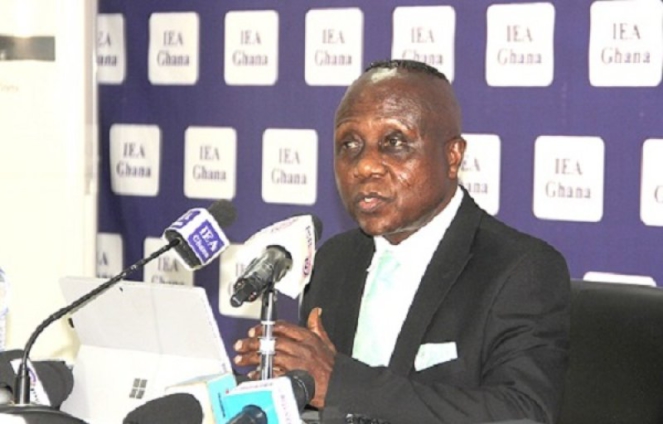
The Institute of Economic Affairs (IEA) is warning against any increase in the Policy Rate (PR), saying, it will be disastrous for the economy.
It is however projecting an unchanged policy rate of 22% as the Monetary Policy Committee (MPC) of the Bank of Ghana meets today to review developments in the economy.
In a statement, the IEA said it expects the Bank of Ghana to work closely with the government to adopt additional targeted measures to fight the inflation crisis.
“As we have argued constantly, it is also clear that the PR alone cannot be relied on to address the current inflation crisis, especially in view of the peculiarity of the causes. If we push the PR to the limit, the consequences on the real economy could be disastrous”.
“Indeed, many countries around the globe have come to this realisation, and are taking unprecedented measures, beyond their orthodox inflation-management frameworks, to deal with what is, obviously, an unprecedented inflation crisis. In view of this, our expectation is that the MPC will keep the PR on hold at 22%. We expect the Bank of Ghana, however, to work with Government to adopt additional targeted measures to fight the inflation crisis”, it explained.
In the current era where the exchange rate has been under so much pressure, the IEA added it behooves the MPC to keep its policy tight so as to counter potential risk of capital outflows that has been heightened by the domestic economic difficulties and monetary policy tightening in the US, UK and Europe.
The MPC decision, it said must therefore recognise the projected outlook for the exchange rate based on information available to the committee.
In terms of the inflation outlook, it said the risks, on balance, seem to be tilted towards the upside. “The upside-risk factors include recent increases in fuel price and utility tariffs as well as anticipated hike in transport fares. On the other hand, anticipated seasonal increase in food supply and expected stability in the exchange rate due to anticipated inflows, which may, however, only be transient, represent partly-offsetting downside risks”.
Fighting inflation requires both fiscal and monetary actions
Inflation hit 33.9% in August, a rate it said was driven by supply and cost factors, particularly food, fuel and the exchange rate.
This it pointed out the inadequacy of the Inflation Targeting framework in dealing with these supply and cost drivers of inflation, especially at the primary level.
“As we have argued above, the current inflation crisis is largely driven by supply and cost factors, particularly food, fuel, transport, and the exchange rate. The effects of these factors can be illustrated by breaking down the August headline inflation of 33.9%: diesel inflation was 116.9%; petrol inflation, 80.5%; transport inflation (embedding fuel costs), 45.7%; imported inflation (reflecting the effect of the exchange rate), 35.2%; and food inflation, 34.4%. Meanwhile, in terms of relative contributions to the August inflation, food contributed the most (45.4%), followed by transport (14.3%). These factors have consistently dominated inflation over more than a year”.
“We have repeatedly pointed out the inadequacy of the IT framework in dealing with these supply and cost drivers of inflation, especially at the primary level, although, we acknowledge its potential role in stemming second-round effects of these factors. The supply and cost factors should be directly targeted with appropriate policy interventions”, it mentioned
To this end, it called for collaboration between the Bank of Ghana and the government to target directly the underlying causes of the nation’s inflation.
It therefore recommended interventions aimed to boost supply and or introduce subsidies as relevant.
"Countries around the world, including major economies, where inflation tends to be mostly demand-driven, and where demand-management approaches, such as IT, may be more appropriate tools, have resorted to interventions directed to the supply factors attendant to Covid-19 and the Russia-Ukraine war. The US has passed the Inflation Reduction Act. The new UK Prime Minister has imposed caps on energy prices for two years. France has capped fuel prices and limited electricity tariff increases to 4%. If these countries are taking these unorthodox and innovative measures to cushion their citizens, who are far richer than us, why can’t our policymakers be equally proactive?"
Latest Stories
-
Standard Chartered Bank delivers strong returns and sustainable shareholder value
3 minutes -
Akufo-Addo’s role in the artificial cedi stability is indisputable — Facts do not bend to political convenience
6 minutes -
Breaking Bad actor RJ Mitte dies aged 34
13 minutes -
Wontumi pleads not guilty in GH¢30m Exim Bank loan case
18 minutes -
Beyond the Flyer: Awareness without screening is not enough
24 minutes -
Bekwai MP donates GH¢100,000 to hospital for specialist equipment
32 minutes -
Van Vicker sues Lil Win for defamation, demands GH¢10m
37 minutes -
FIFA/ FIBA agency Pep Sports moves to admit Ghana’s 7-Foot Basketball talent to its Ultra-Modern Sports campus after MyJoyOnline report
39 minutes -
GAUA strike disrupts academic plans at University of Ghana as students, parents express frustration
44 minutes -
Dad’s Army/African Polistas crowned champions of 2026 Accra Polo Club Trustees’ Cup
51 minutes -
Mahama approves Integrated Basic Education Model, with funding expected in 2027 under GETFund formula
54 minutes -
Money-driven elections fuelling corruption – Haruna Iddrisu
58 minutes -
Excessive borrowing ‘cracked’ Ghana’s economy under Akufo-Addo – Haruna Iddrisu
1 hour -
NPP’s silence on economic indicators suggests Mahama is doing better – Haruna Iddrisu
1 hour -
GoldBod must be more accountable to Ghanaians – Haruna Iddrisu
2 hours