

Audio By Carbonatix
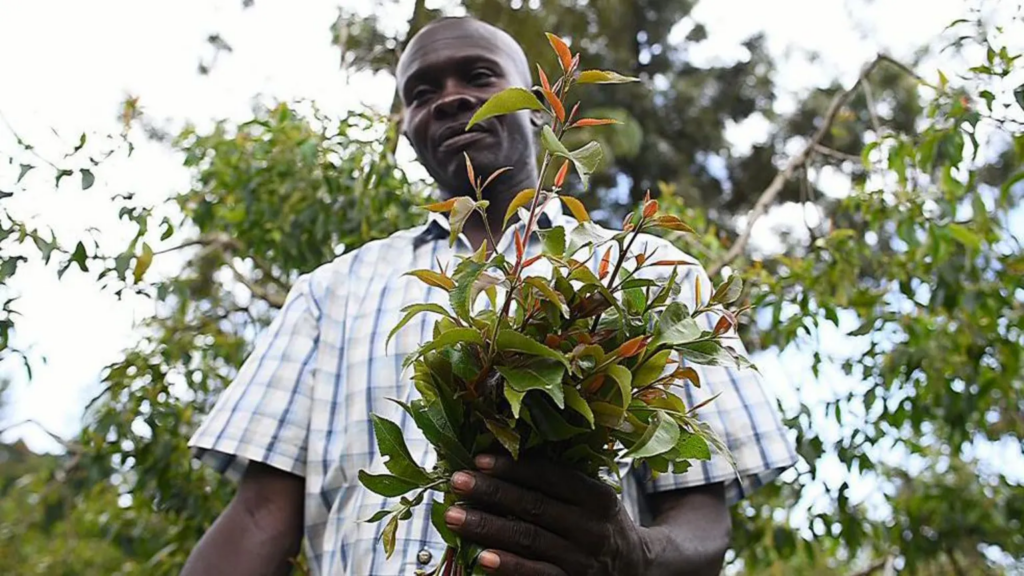
Kenya's President William Ruto has reversed a contentious ban imposed in parts of the country on muguka, a variety of the popular stimulant known as khat or miraa.
The consumption of the freshly plucked buds and soft leaves has been blamed for a rise in mental health issues and increased social ills, including crime.
Three county governors from the coastal region banned its sale and use last week, sparking anger in the areas where the crop is grown.
President Ruto on Monday said the muguka crop was legal and its sale should not be prevented.
Muguka, a cheaper, more potent and addictive variety of the plant, is popular in the coastal counties of Mombasa, Kilifi, Taita Taveta and Kwale.
Last week, Mombasa Governor Abdulswamad Shariff Nassir banned the entry, transportation, sale and consumption of muguka citing its harmful effects, especially on young people.
Governor Nassir said more than half the people recovering in Mombasa rehabilitation centres were muguka addicts.
A similar directive was issued by the governors of Kilifi and Taita Taveta counties who vowed to crack down on its sale and use.
It sparked protests in the muguka-growing county of Embu, with farmers and traders decrying the risk of closing businesses due to the ban on the lucrative crop.
On Monday, President Ruto held a meeting with local leaders from Embu in an effort to end the muguka row.
“With muguka having been recognised by national legislation, any other laws or orders that contradict national legislation is null and void,” Mr Ruto said in a statement issued by the president's office.
President Ruto said muguka was a legal crop under the Crops Act 2013 and the Miraa Regulations 2023.
He said the government would allocate $3.7m (£3m) in this financial year to expand khat farming in the country.
Two activists had also challenged the muguka ban in court.
More than 10 traders were arrested last Friday in the main coastal city of Mombasa as the ban on the stimulant took effect, local media reported.
The ban had gained widespread support from religious organisations, with Muslim leaders in Mombasa calling for muguka to be categorised as a restricted drug.
Although the National Agency for the Campaign Against Drug Abuse has not banned muguka, it has classified it as a harmful substance based on the stimulants cathinone and cathine found in the plant.
"The amounts of cathinone and cathine are very high in muguka because you are chewing the leaves, where the potency resides," John Mututho, the former chief of the anti-drug abuse agency, told a local TV station.
He said the chemicals in muguka had impaired normal body functions.
"Let's invest in other herbs like rosemary. Farmers will be very rich, and we will not have zombies," Mr Mututho added.
Latest Stories
-
Five-member committee to search for new Black Stars coach after Sports Ministry-GFA meeting
22 minutes -
Pinktober: Breast cancer survival exceeds 90% when detected early – Breast Society of Ghana
29 minutes -
TCDA to adopt Upper West’s MATCO mango farm as northern prototype, issues warning against felling shea trees
39 minutes -
Fear delegates tag: Afoko touts genuineness among delegates ahead of NPP delegates conference
42 minutes -
John Boadu: The leader our party needs at this time – Amb. Edward Akwasi Boateng
47 minutes -
Baffour Awuah: EOCO effected an arrest, detained MP after hours of waiting, questioning – Afenyo-Markin
1 hour -
EOCO court warrant authorised search of Baffour Awuah’s law firm, not residence – Afenyo-Markin
1 hour -
NPP delegates conference: 3,000 to 4,000 police personnel deployed for security in Kumasi – Anthony Karbo
1 hour -
KGL Foundation commits $200,000 to support juvenile football for the next two years
2 hours -
UNDP invites Mahama Ayariga to Northern Peace Conference in Tamale
2 hours -
Afoko can give NPP ‘new identity’ ahead of 2028 to overcome NDC – Political scientist, Dr Amakye-Boateng
2 hours -
2 injured amid gunshots during raid at Nawara Mining office at Nsuapemso
2 hours -
St Augustine’s College retains 2026 National Investment Quiz title
2 hours -
KNUST Nursing and Midwifery School staff recognised at 2026 Health Ministry Excellence Awards
2 hours -
JoyNews’ Esther Esi Nkrumah selected for UK Media Excellence for Emerging Technology Fellowship
2 hours