

Audio By Carbonatix
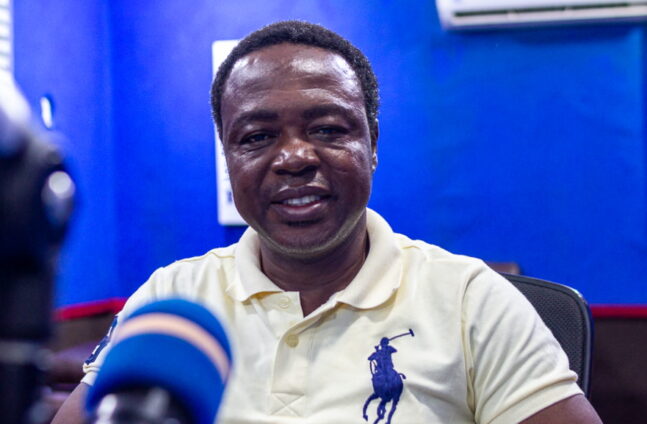
The Chief Executive Officer of Akuafo Nketewa, Dr. Charles Nyaaba, has described Burkina Faso’s decision to halt fresh tomato exports as an opportunity for Ghana to rebuild its local production capacity.
Speaking in an interview with Winston Amoah on Joy FM’s SMS, Dr. Nyaaba said the development should not alarm consumers but rather encourage investment in Ghana’s tomato sector.
According to him, Ghana has historically relied on imports from Burkina Faso mainly between December and April, while local farmers supply tomatoes for the rest of the year.
“Let’s look at the period we bring tomatoes from Burkina. It’s always between December to the latter part of April and early May. From May until December again, all the tomatoes we consume are from our local farmers,” he explained.
Dr. Nyaaba noted that Ghana previously produced enough tomatoes locally and did not depend on neighbouring countries.
“Some years ago, we didn’t go to Burkina Faso, Togo, Niger or Mali to bring tomatoes. We used to get enough tomatoes in this country, and even the prices were cheaper,” he said.
He dismissed claims that tomatoes from Burkina Faso are superior, explaining that production conditions in northern Ghana are similar.
“When people talk of Burkina tomatoes or Navrongo tomatoes, there’s no difference. The climate is the same, everything is the same,” he stated.
Dr. Nyaaba attributed the decline in local tomato production to market challenges and past policy failures, particularly the lack of reliable buyers for farmers.
He recalled that many farmers abandoned tomato farming after suffering losses when processing factories failed to absorb their produce.
“At the time when the Northern Star Tomato Factory was revived, farmers were encouraged to produce. But after production, the factory could take only about five per cent. Some farmers who took loans suffered greatly—some even committed suicide, while others abandoned their farms,” he recounted.
He added that farmers have since shifted to crops such as pepper and rice due to more reliable demand.
Dr. Nyaaba also pointed out that traders often prefer importing tomatoes, which discourages local production.
“When farmers produce, the women come and say they don’t want it; they go to Burkina Faso to buy. That alone has discouraged many farmers,” he said.
Despite the current situation, he expressed confidence that Ghana can become self-sufficient in tomato production within a short period if the right support is provided.
“The only problem with producing tomatoes today has to do with consistent water supply and the high cost of seeds. Sometimes you can’t even get the seeds to buy,” he noted.
He called on government to invest in irrigation infrastructure and ensure access to quality seeds to boost production.
“As long as government comes in to support us—develop the dams and provide the seeds—I’m sure within a year or two, we will regret that we’ve been going to Burkina Faso to buy tomatoes,” he said.
Dr. Nyaaba described the export ban as “good news” for farmers, as it could force greater attention on the local agricultural sector.
“For the farmers, it’s good news. This is the time for government to turn its attention to us. The tomato sector has been neglected for too long,” he said.
He criticised the focus of agricultural interventions, arguing that tomato farmers have not received adequate support.
“Look at all the interventions by the Ministry of Food and Agriculture—it’s always about rice, meat, cocoa and cashew. What are we getting as tomato farmers?” he asked.
Dr. Nyaaba assured consumers that while prices may rise temporarily, the situation can stabilise with the right policies.
“There will be a short gap, and prices may go up, but this will not be a long-term problem,” he said.
He emphasised that Ghanaian farmers are ready to meet national demand if given the necessary support.
“We are ready to produce. If government helps us develop the infrastructure and create the right market conditions, we will produce enough, and we won’t need to go to Burkina Faso,” he added.
Latest Stories
-
The 7-foot giant of Ngleshie Amanfro: Seven-foot Ghanaian Ephraim Saawa dreams of joining the national basketball team
21 minutes -
Government promises support for Kumasi Central Market fire victims
27 minutes -
Vibes The Movie: Big Ghun’s Ghanaian film earns five nominations at 2026 REFFA
58 minutes -
MamaCare CEO warns unresolved conflicts among health workers could undermine maternal and neonatal care
1 hour -
Health professionals urged to translate medical knowledge into practice to save mothers
1 hour -
Conflicts among care providers linked to maternal, neonatal deaths – Expert
3 hours -
GIS marks 10th TIME conference, champions improved teaching practices
3 hours -
BRICS Or Balance? What Ghana’s bid really means
4 hours -
GPRTU wants full TRAFFITECH-GH implementation to start in 2027
4 hours -
Mahama announces plans to import electric wheelchairs for PWDs
4 hours -
KGL U17 Colts 2026: Western beat Prempeh Elite Academy to set up final final with Greater Accra Region
4 hours -
Late Solanke strike salvages 10-man Spurs draw at Man United
4 hours -
Gender Ministry to monitor welfare of Nana Akua Addo’s children amid domestic violence case
5 hours -
Benedict Okyere Yeboah: Ghana’s football problem goes beyond sacking a coach
5 hours -
GPL 2026/27: Darkwah Wiafe’s winner sees All Blacks beat Kotoko
5 hours