

Audio By Carbonatix
The Institute of Economic is proposing a cap on the country’s annual borrowing to prevent further rise in the debt level, which has reached unsustainable levels and could throw gains chalked by the economy.
It therefore wants parliament to implement an Appropriations Bill for borrowing, similar to the policy imposing expenditure ceiling.
This system is used by the US Congress to rein in executive borrowing.
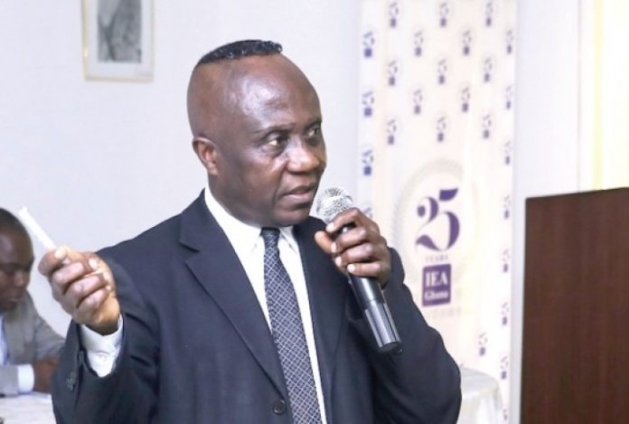
At a press briefing on the 2021 Budget and Economic Policy, Director of Research at IEA, Dr. John Kwakye, said if government wants to borrow beyond the initial borrowing, for whatever reason, it must return to Parliament for approval.
“Parliament should impose annual borrowing or debt ceilings at the same time that it approves the Appropriations Bill imposing expenditure ceiling. If Government wants to borrow beyond the initial borrowing/debt ceiling, for whatever reason, it must come back to Parliament for approval. This is the system used by the US Congress, for example, to rein in executive borrowing.”
Ghana’s public debt stock has reached alarming level, hitting ¢341.8 billion in September 2021.
Interest payment alone is projected at ¢37.4 billion, which is as much as 46.6% of the projected tax revenue of ¢80.2 billion. This the IEA said is very concerning and therefore it is important to adhere to the projected deficit path as to reduce the pace of borrowing and return the debt and debt service to sustainable levels.
The Finance Minister in the presentation of the 2022 Budget and Economic Policy indicated that government’s fiscal consolidation plan has been accelerated for the medium to long-term.
According to him, the 2022 primary balance is projected to be positive for the first time post-Covid 19 pandemic, adding, this was a very strong commitment of government to taper the debt to GDP ratio and also improve significantly the debt liquidity ratios.
He added that further to this objective, and to support the reduction in the rate of debt accumulation, the total limits set for concessional and non-concessional external borrowing have been scaled down from $2.500 billion to $2.000 billion.
Dr. Kwakye said these commitments are reassuring and should be followed through, adding, “in fact, we had proposed that to contain borrowing and debt accumulation, Parliament should impose annual borrowing or debt ceilings at the same time that it approves the Appropriations Bill imposing expenditure ceiling. If government wants to borrow beyond the initial borrowing/debt ceiling, for whatever reason, it must come back to Parliament for approval.”
Revenue mobilisation a long standing challenge for country
The IEA also expressed worry about the nation’s sluggish revenue mobilisation, saying revenue collection has been a long standing challenge, with Ghana’s effort falling considerably short of that of its peers.
Dr. John Kwakye said the argument has always been that substantial revenue is lost annually through various channels including tax exemptions, property taxes, illicit financial flows, amongst others, pointing out that the loopholes must be plugged for adequate revenue to be raised to support the country’s development.
“We have long argued that substantial revenue is lost annually through various channels, including tax exemptions, property taxes, illicit financial flows, noncompliance, informal sector, administrative lapses, and fraud and corruption. We have called for these loopholes to be plugged for adequate revenue to be raised to support the country’s development.”
“We are pleased to note that the budget proposed measures to plug some of these loopholes in addition to other measures to scale up revenue”, Dr. Kwakye mentioned
Budget contains initiatives to capacitate youth to be employable
On employment, the IEA said the budget contains important initiatives to capacitate the youth to become employable and also set up their own enterprises. The initiatives include the YouStart Initiative and the Ghana CARES Obataanpa programme.
“Government policies aimed at offering skills training to, and building entrepreneurial capacity of, the youth, while supporting the private sector to grow promise to help the unemployment situation and the should be followed through. The GhanaCARES programme contains important pillars for transforming the economy into a modern, resilient and, ultimately, “beyond-aid” economy if implemented as planned”.
Latest Stories
-
Trade Minister applauds GUTA as a pillar of economic growth; Prez Mahama honoured
3 minutes -
President’s brother’s takeover of Damang Mines is ‘untidy’ – Alhassan Tampuli
9 minutes -
It’s not true that gov’t decided not to renew the lease for Gold Fields – Bobby Banson
13 minutes -
Ghana to boost tomato production with 60-hectare irrigated farms and processing initiatives
31 minutes -
E&P’s takeover process of Damang Mines was very clean – Inusah Fuseini
34 minutes -
Damang takeover: There is not going to be any job loss; it is a lease change – Bobby Banson
1 hour -
Gold Fields didn’t stop mining at Damang mines; such claims are untrue – Bobby Banson
1 hour -
Engineers and Planners currently operate only in Ghana – Bright Simons
1 hour -
Lands Minister has no legal basis to restrict lease to Ghanaian firms – Bright Simons
1 hour -
Gov’t’s refusal to renew Gold Fields’ lease was simply untenable – Bright Simons
1 hour -
SOS Children’s Villages Ghana deepens partnership with Gender Ministry
2 hours -
Gender Ministry celebrates Christina Koch, reaffirms commitment to empowering girls
2 hours -
Live stream: Newsfile digs into E&P’s takeover of Damang Mines, OSP powers and Anti-LGBTQ Bill
2 hours -
Moody’s maintains Ghana’s rating at Caa1, revises outlook to positive
3 hours -
Zambia elevates tourism education to national priority as President Hichilema backs continental summit
4 hours