

Audio By Carbonatix
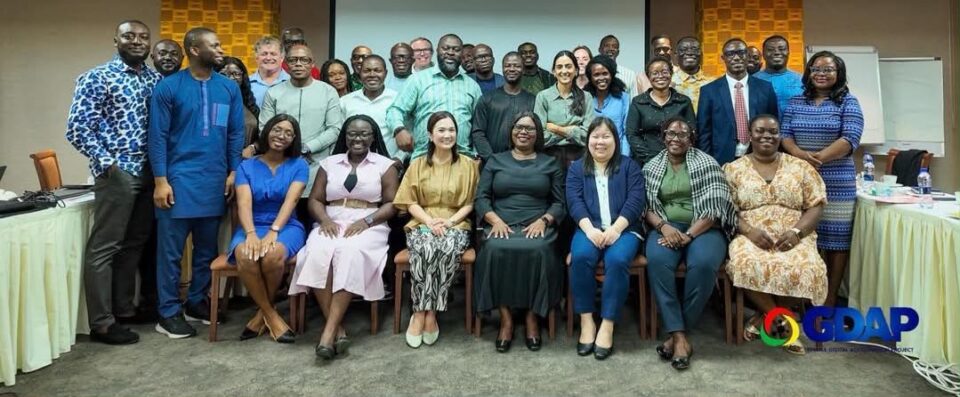
In what is being described as a fundamental shift in how the state interacts with its citizens, a high-powered coalition of government officials, digital architects, and international development partners has commenced an intensive three-day operational strategy session to completely overhaul the Ghana.gov.gh platform.
The closed-door workshop, which opened on Tuesday, 19 May 2026, at the Peduase Valley Resort, marks a departure from traditional, technology-heavy state updates.
Instead, the opening sessions established a remarkably practical agenda, targeted at answering a single, pressing question: How can the state make everyday government services genuinely accessible and painless for the ordinary Ghanaian?
Dismantling the Digital Silos
The redesign brings together key local players—including the National Information Technology Agency (NITA) and the Project Coordination Unit of the Ghana Digital Acceleration Project (GDAP)—alongside global institutions like the World Bank, the Tony Blair Institute (TBI), and Public Digital, a highly rated UK-based digital transformation consultancy.
The central critique raised during the opening round of discussions was that citizens are currently forced to figure out government to execute basic transactions. Bureaucratic silos mean that a user often has to navigate multiple, unconnected ministerial platforms just to complete a single regulatory task.
Setting the tone for the overhaul, Steve Davenport, the World Bank’s Senior Digital Specialist for Western and Central Africa, successfully steered the conversation away from technical jargon, algorithms, and infrastructure. Instead, he forced participants to confront the lived reality of the consumer: the gruelling physical queues, confusing online forms, and the frustrating multiplication of administrative stops.
The consensus in the room was clear: Ghana.gov has the underlying architecture to centralise public services, but it can only succeed if Ministries, Departments, and Agencies (MDAs) strip away their institutional territory and operate under a unified, one government banner.
Learning from the Best: The GOV.UK and Irembo Blueprints
To anchor the practical exercises, international experts introduced case studies of world-class digital governance. Sessions led by Edwin Amoako (GDAP PCU Coordinator), Solomon Richardson (Infrastructure Specialist at NITA), James Stewart and Praise Olutuase (Public Digital), and Amber Rosier (Senior Advisor with the Tony Blair Institute) dissected the mechanics behind successful international models.
The panel specifically analysed the United Kingdom’s GOV.UK and Rwanda’s acclaimed Irembo platform, demonstrating how public trust and state revenue surge when a government prioritises a user-focused, frictionless interface.
Rather than shying away from internal structural flaws, state participants spoke openly about the systemic gaps that currently slow down processing times, the confusing terminology that deters users, and the critical failure points where state databases simply refuse to connect with one another.
From Talk to Tarmac
By the conclusion of the opening day, the atmosphere at the Peduase summit had transformed from a standard technical briefing into a highly collaborative, hands-on taskforce.
The remaining forty-eight hours of the workshop will see participants engage in intensive, rapid-prototyping exercises to completely redesign priority citizen services—ranging from passport applications and business registrations to tax payments and permit acquisitions.
The underlying philosophy driving the Peduase declaration is that this project is fundamentally not about launching another flash website. It is a concerted effort to leverage the GDAP framework to strip away unnecessary bureaucracy, eliminate corruption risks, and make daily life noticeably easier for the millions of Ghanaians who rely on state services every single day.
Latest Stories
-
NPP Delagates Congress: Confusion delays voting at Ashanti Region TESCON centre
45 minutes -
Fire ravages shops, houses near Koforidua Central Police Station
53 minutes -
NPP Delegates conference: The wisdom of the masses will prevail – Napo
1 hour -
Flydubai co-pilot attacked captain with axe, UAE official says
2 hours -
NPP Bosome Freho Constituency Chairman reportedly arrested over ballot paper incident
2 hours -
Medical plane with 6 on board missing off Massachusetts coast
2 hours -
Bolt driver jailed 25 years for robbing beautician
2 hours -
Happy 76th Birthday to the Daily Graphic!
2 hours -
Amin Adam celebrates Prof. Alhassan Musah on appointment as KAAF University Vice-Chancellor
2 hours -
Mahama reaffirms commitment to Volta development at Asogli Te Za
3 hours -
Bawumia urges NPP aspirants to accept results, reunite party after elections
3 hours -
Double fibre cut disrupts Telecel services, 72,754 subscribers affected
3 hours -
Bawumia demands probe into financiers behind Ghana-linked cocaine shipments
3 hours -
Spain beat Czech Republic to maintain winning run
3 hours -
Ronaldo ‘greatest symbol’ of Portugal – Fernandes
3 hours