

Audio By Carbonatix
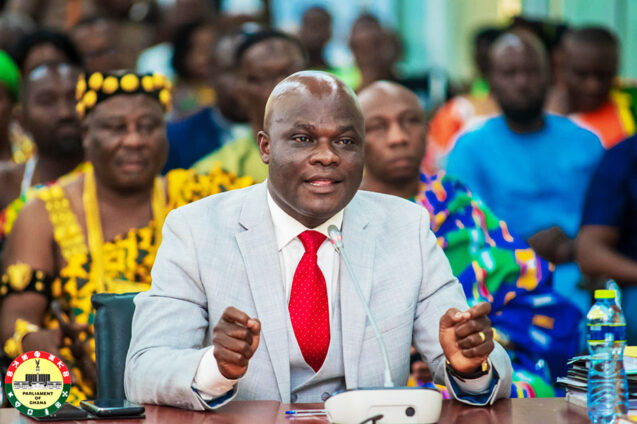
The Local Government Minister, Ahmed Ibrahim, has criticised the previous administration, accusing it of leaving behind a weak and under-resourced local governance system.
According to him, the situation significantly affected the ability of Metropolitan, Municipal and District Assemblies (MMDAs) to deliver essential services and implement development projects.
“The John Mahama government inherited in 2025 a dysfunctional local governance sector and decentralisation structure, occasioned by lack of adequate resources for the MMDAs to perform,” he said.
He explained that this had hampered the assemblies’ capacity to fully discharge their statutory responsibilities, ultimately affecting service delivery and infrastructure development across the country.
Mr Ibrahim stressed that concerns about the state of the sector were not only being raised by the current administration, particularly in its handling of the District Assemblies Common Fund (DACF).
“This was highly and fervently voiced out by the former administrator of the District Assemblies Common Fund. As a party, the New Patriotic Party… did not take decentralisation seriously. The District Assemblies Common Fund was not forthcoming. It was not regular. It was very erratic,” he stated.
He added that over nearly seven years, less than half of the fund was consistently transferred directly to the MMDAs, alleging that the previous administration failed to provide operational guidelines for the fund's use after its first year in office.
“Less than 50 per cent of the DACF was transferred directly to the MMDAs consistently for almost seven years. They only issued guidelines for the first year, 2017, and stopped,” he said.
He described this as a breach of the Local Governance Act, explaining that the law requires the Minister, in consultation with the Finance Minister, to issue guidelines governing the use of the fund.
“This is what controls the internal system and ensures the proper use of the money,” he added.
Meanwhile, the Minister outlined measures to strengthen accountability and improve sanitation at the local level. He explained that sanitation officers, described as sanitation ambassadors, would assess cleanliness in various areas as part of a new monitoring system.
He said motorbikes had been procured for sanitation officers to enhance monitoring in communities.
Mr Ibrahim also announced the introduction of dedicated phone lines and a call centre to allow the public to report sanitation issues.
“Motorbikes have been bought; youth have been recruited. They will be patrolling all the principal ceremonial streets. When you see any filthy area, you call the call centre, and that one will be registered,” he said.
Latest Stories
-
PAC summons Takoradi doctor over GH¢341,229 study leave salary
31 minutes -
37 Military Hospital traders given 7-days to clear pedestrian walkway
36 minutes -
Wontumi challenges EOCO’s handling of Exim Bank loan dispute
41 minutes -
Government keeps appealing to striking teachers to resume work – Apaak
45 minutes -
Chief Justice urges employers to tackle mental health stigma in workplaces
48 minutes -
52,000 teachers’ promotion payments targeted for October 15
50 minutes -
Nzema chiefs honour Lands Minister, demand sustainable revival of Adamus Resources
54 minutes -
ExxonMobil return talks emerge as GIPA CEO holds back details
54 minutes -
Council of State meets teacher unions over strike today
60 minutes -
Ntim Fordjour appeals to Mahama to abandon regulation restricting preaching in buses
1 hour -
Volta youth farmers commend Agric Minister, appeal for markets for cassava growers
1 hour -
Mahama commissions expanded production line at Nestlé Ghana Ltd
1 hour -
Chief of Staff urges journalists to uphold accuracy, fairness
1 hour -
Mahama pays a working visit to Three Dreamer Manufacturing
1 hour -
Shell, Chevron sign exploration MoU as Petrobras eyes Ghana’s oil blocks
2 hours