


Audio By Carbonatix
A new study has revealed a significant mismatch between the skills young people acquire in Ghana’s Technical and Vocational Education and Training (TVET) institutions and the demands of employers, raising fresh concerns about youth unemployment and the future of work.
The ‘Skills Supply and Demand-Side Assessment Report’ for the Ashanti Region, commissioned by UNICEF Ghana, in collaboration with the Government of Ghana, highlights wide gaps between school learning and industry expectations.
The study compared the training offered by public and private TVET schools with the needs of employers in key sectors such as agriculture, ICT, manufacturing, and construction.
Among the most striking findings is the underrepresentation of agriculture training in a region where farming and agro-processing are major employers.
Out of 57 pre-tertiary TVET institutions surveyed in the Ashanti Region, only one offered agriculture-related training, despite high labour demand in the sector.
Similarly, ICT skills, increasingly critical in today’s digital economy, were available in only four schools.
Meanwhile, oversupply persists in trades like fashion and garment design, even though employers say they struggle to find workers with the practical experience, technical know-how, and soft skills needed to succeed on the job.
Chairman of the Governing Council of the Ghana TVET Service and Member of Parliament for Kpando Constituency, Sebastian Deh, noted that keeping pace with the fast-evolving world of technology remains a challenge, largely due to limited resources.
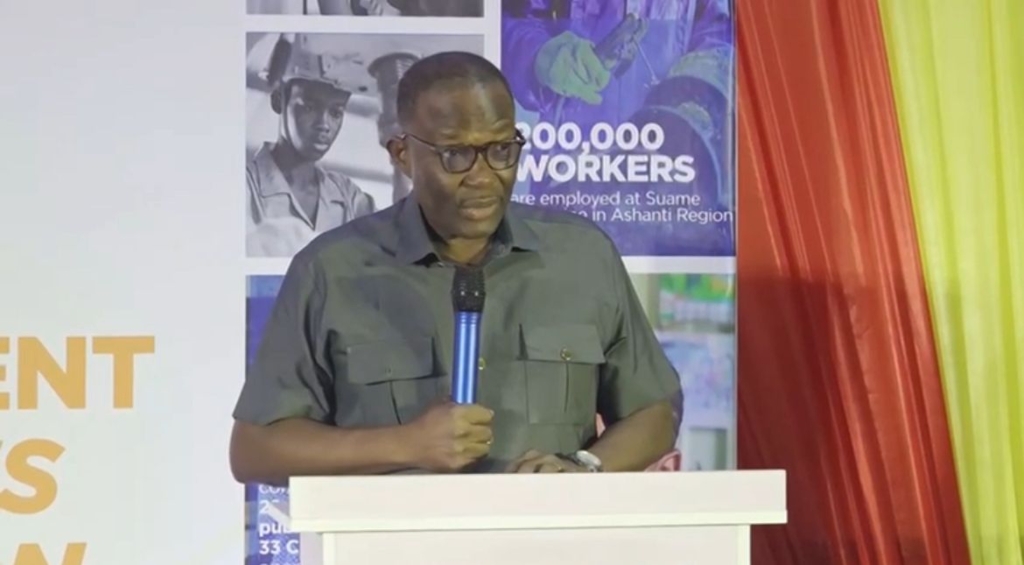
“The reason technology is far behind is because of resources. It’s a fast-paced sector and evolving by the day. I’m glad the research has exposed this as a challenge. Going forward, our investments will be appropriately directed,” he said.
The report also flagged structural challenges within the TVET system. The expansion of free TVET education has boosted enrollment, but overstretched infrastructure is undermining Competency-Based Training (CBT). Private TVET institutions were found to have higher CBT accreditation rates than public ones, raising questions about the effectiveness of government-run schools.
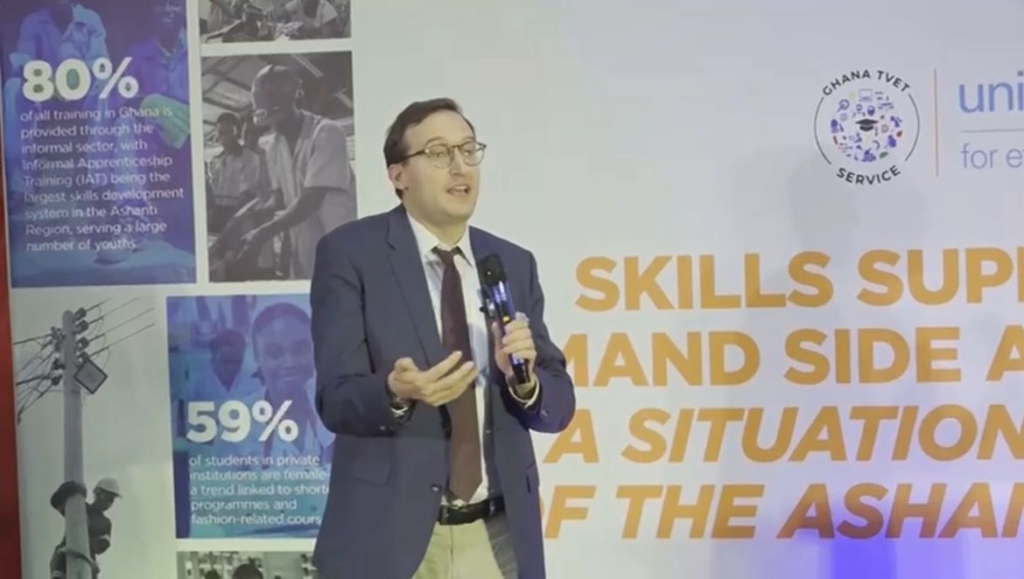
UNICEF’s Dr Tillmann Guenther, presenting the research findings, explained that the Ashanti Region was chosen for the pilot study because of its economic significance and population size – home to over 5.4 million people and is the country’s second-most populated region and a hub for agriculture, commerce, and industry.
UNICEF Ghana and the Ghana TVET Service say the findings will guide reforms to ensure that investments in vocational training better align with labor market demands.
With Ghana’s large youth population projected to drive future economic growth, aligning TVET with industry is seen as crucial to reducing unemployment and harnessing the demographic dividend.
“We have invested a lot into TVET as a country. This research sought to find out the level of impact that has been made and the means to inform actions going forward,” Sebastian Deh added.
The report says government, businesses, and partners must work together to improve curricula, upgrade facilities, and provide more training in areas where skills are needed. Without these measures, experts warn, Ghana risks missing out on its youth-driven economic potential.
Latest Stories
-
Police blur the line between invitations and arrests – Reindorf Twumasi Ankrah
19 minutes -
Turning invitations into arrests is making citizens reluctant to assist police – Twumasi Ankrah
53 minutes -
The Traffitech-GH SMS spot-fine system: The good, the sad, and the funny – Bright Simons writes
1 hour -
Hawa Koomson pledges experienced and mature leadership of NPP women’s wing
2 hours -
Young woman found dead at Kasoa Peace Town
3 hours -
Playback: The Law examined lawful arrest in Ghana
3 hours -
Mahama urges African governments to treat healthcare as an investment, not budget cost
4 hours -
Bawumia congratulates John Boadu and new NPP executives, pledges support ahead of 2028
4 hours -
Aksa Energy delegation pays courtesy call on GRA Commissioner-General
4 hours -
‘No talent should be left out’ – Bawumia pledges inclusive NPP campaign for 2028
4 hours -
Prof. Mike Oquaye recounts how he blocked the Special Prosecutor’s attempt to arrest Bawku Central MP
4 hours -
Make health sovereignty a priority for Africa – Mahama
4 hours -
Dorimon Naa, Wa West DCE lead massive clean-up exercise; threaten sanctions against recalcitrant residents
5 hours -
Photos from Adom FM Y2K Jam
5 hours -
Praye Tiatia steals the show at Adom FM Y2K Jam [Watch]
5 hours