


Audio By Carbonatix
The Office of the Special Prosecutor (OSP) has recorded its first convictions since its creation in 2018 under the Office of the Special Prosecutor Act, 2017 (Act 959).
After years of criticism for failing to deliver results, despite receiving over GH¢1 billion in budget allocations since inception, the OSP has now secured seven convictions. All were obtained through plea bargains.
The office was allocated GH¢146 million in the 2025 budget.
In 2024, it received 95% of its GH¢149 million allocation and since inception, over GH¢1 billion has been allocated for the OSP.
While questions remain about the timing and consistency of disbursements in earlier years, the claim that funding shortfalls explain the lack of results has become harder to defend.
Still, the convictions mark a milestone.
Six convictions involved payroll fraud uncovered in the Northern Region. The seventh relates to the trial of Charles Bissue, former secretary of the defunct Inter-Ministerial Committee on Illegal Mining. The second accused in that case has been convicted and is reportedly cooperating with prosecutors in the ongoing proceedings against Mr Bissue.
The OSP has been noticeably more active in the first half of 2025. It is currently investigating several high-profile cases, including former Finance Minister Ken Ofori-Atta, the controversial GRA–SML contract linked to former GRA Commissioner Rev Ammishaddai Owusu-Amoah, and the former NPA Chief Executive Dr Mustapha Abdul-Hamid.
The investigation into Charles Bissue is also ongoing.
These headline cases form part of a broader expansion. In the first half of 2025 alone, the OSP has opened 70 new investigations. This marks a sharp increase from previous years.
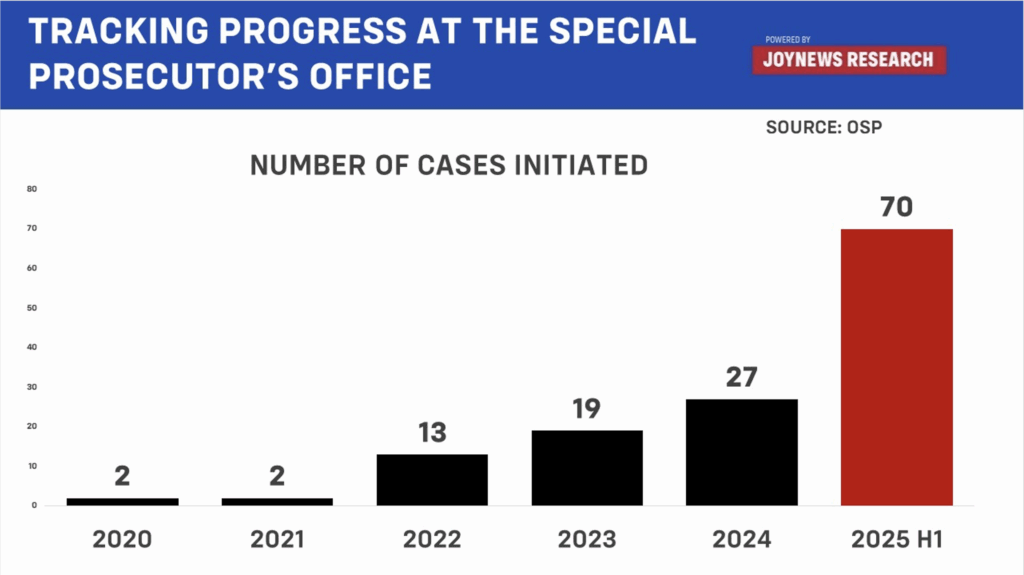
The office initiated only two cases each in 2020 and 2021. That figure rose to 13 in 2022, 19 in 2023, and 27 in 2024. The current surge brings the cumulative total to at least 133 cases since the OSP began operations.
The rise in enforcement activity comes at a time when Ghana’s Corruption Perceptions Index, measured by Transparency International, has shown little progress. After holding at a score of 43 for four years, Ghana fell to 42 in 2024.
The index runs from 0 to 100, with higher scores indicating lower perceived corruption. Ghana’s highest-ever score was 48 in 2014. The trend since then has been downward.

The OSP’s recent convictions are a step forward. The office has also recovered over GH¢4 million for the state.
But after more than GH¢1 billion in allocations, including this year’s GH¢146 million, Ghanaians are right to expect more than seven plea bargains in seven years.
The office has shown it can bring cases to a close. The next challenge is proving that it can hold the powerful to account and deliver the kind of justice the public has been waiting for.
Latest Stories
-
Nigeria set to launch National Digital Address System 9 years after Ghana showed the way
3 minutes -
Policy rate decision takes time to reflect in lower lending rates – BoG
13 minutes -
Western Regional Minister applauds Karpowership’s role in Ghana’s power sector
38 minutes -
Livestream: Road safety crises: Where are we getting it wrong?
40 minutes -
Enterprise Life celebrates 25 years of protecting families and building trust
47 minutes -
ICC London rules in favor of Ghana against Tullow over $400m tax charge
57 minutes -
We are disappointed in ICC’s ruling over our corporate income tax assessment in Ghana – Tullow Oil
1 hour -
Cost of building inflation for August 2026 increases to 4.6% – GSS
1 hour -
Today’s front pages: Wednesday, September 30, 2026
2 hours -
Bawumia highlights agricultural, compulsory insurance reforms in IBAG engagement
2 hours -
Ghana will secure Tullow tax revenues while protecting Jubilee, TEN investments – Ato Forson
2 hours -
Ghana wins $393m Tullow tax arbitration as tribunal upholds GRA assessment
2 hours -
Gender Minister assures women’s group of action on Affirmative Action, Development Bank
3 hours -
Over 2,000 teachers in Dormaa comply with strike – GNAT Secretary
3 hours -
Food Buffer Stock seeks stronger liquidity buffer despite record profit
3 hours