

Audio By Carbonatix
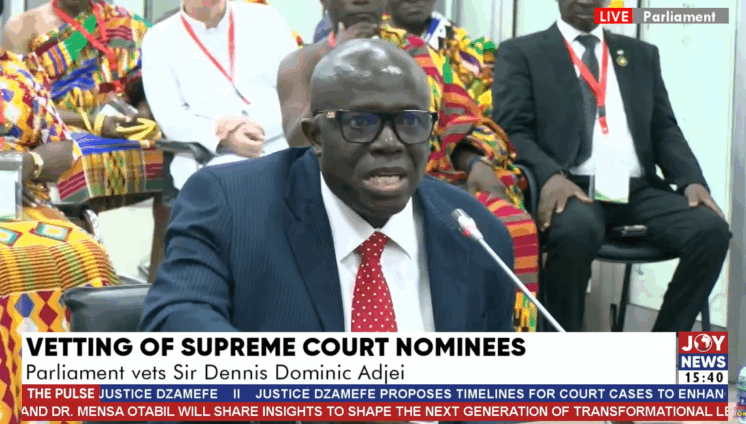
Supreme Court nominee Justice Dennis Dominic Adjei says Ghana’s presidential succession must be strictly limited to the President, Vice President, and Speaker of Parliament, excluding the Chief Justice.
His argument, framed as "capping legitimacy," was communicated during his parliamentary vetting on Monday, June 16.
Appearing before Parliament’s Appointments Committee on Monday, Justice Adjei stressed that the 1992 Constitution intentionally restricts presidential succession to three key figures to ensure orderly transitions.
“When we talk about the absence of the President, there is something in interpretation, which we call capping legitimacy, meaning that whenever you are interpreting or wherever you are providing events, it should end somewhere."
"So if you look at the intention of the lawmaker or the purpose of the law at any point in time, one of the three must be in Ghana. You cannot extend it to the Chief Justice, because the law does not say so."
His remarks directly countered suggestions from past legal opinions, including obiter dicta in the 2003-2004 Asare v. Attorney General case, where Prof Klutse had proposed the Chief Justice as a potential successor.
Sir Adjei dismissed this view as non-binding, stressing that "an obiter does not bind any court."
For him, this interpretation risks creating a power vacuum if all three successors are incapacitated.
“In that sense, you will also go to say that in the absence of the Chief Justice, then in the absence of that person in that sense of that person, then what is the essence of providing leadership in your country. What is the essence?”
Prior to this, Justice Senyo Dzamefe, who also appeared before the committee, ignited a constitutional debate during his vetting before the Committee.
This was when he shared his perspective on the conventional interpretations regarding the presidential succession when the head of state is temporarily outside Ghana’s jurisdiction.
Justice Dzamefe argued that strict adherence may not always be necessary for short-term absences.
"This, my opinion, please, if the president should be out of the country, let's say for one day, and coming back, yes, the Constitution is there should be no vacuum. But technology can make you work from outside your office," he said on Monday.
"But well, the law says if you are out of the jurisdiction, fine, but if you are in contact with those you work with... and the period is that short, maybe one day, I don't think there should be this ceremony when you are coming back the following day for somebody to swear an oath, and then the following morning, the president's or whoever is swearing a news oath to take his place," he worried.
Vice Chairman of the Appointments Committee, Alexander Afenyo-Markin, challenged the nominee’s stance, noting its apparent contradiction with Dzamefe’s earlier insistence that "the law is the law" during discussions on judicial impartiality and asset declarations.
The Justice responded: "So, Mr Chairman. What I said was my opinion? It may not certainly be the law.
Afeno-Markin: "My Lord, it is your opinion that becomes the law. At the Supreme Court, it is policy decisions."
Justice Dzamefe: It doesn't override the Constitution.
Subsequently, the nominee explained that the situation remains a "lacuna" which "has to be filled up".
"It shouldn't be that vacuum. So I think the Supreme Court that has the power to interpret, can come out to make it definite that when those three people are not there, this person takes over.... When the President is not there, the Vice takes over. When the vice is not there is a speaker. And if the speaker is not there, I think there should be some express provision to say that there shouldn't be a vacuum.
The Vice Chairman of the Committee pressed further regarding who he believes to take over when the Speaker is absent.
He answered that "in my opinion, the next should be the Chief Justice."
Latest Stories
-
GAEC must retain nuclear scientists for Ghana’s nuclear ambitions – Minister
25 minutes -
Man reportedly mistaken for game and shot by hunter dead in forest
27 minutes -
19-year-old mason jailed 15 years for defiling seven-year-old pupil
31 minutes -
Ghana’s banking sector assets rise 20.47% to GH¢500.2bn – BoG Governor
36 minutes -
22 injured as Sprinter bus overturns at Sege after tyre burst
37 minutes -
UN housing expert urges Ghana to strengthen Rent Control Department amid housing affordability concerns
45 minutes -
Delta-BCI partnership reaches 166,000 people with breast cancer education
55 minutes -
Power restoration fault suspected in Kumasi Central Market fire
6 hours -
The 7-foot giant of Ngleshie Amanfro: Seven-foot Ghanaian Ephraim Saawa dreams of joining the national basketball team
7 hours -
Government promises support for Kumasi Central Market fire victims
7 hours -
Vibes The Movie: Big Ghun’s Ghanaian film earns five nominations at 2026 REFFA
7 hours -
‘I’m a fulfilled man’—Justice Korbieh on missing out on Supreme Court despite two nominations
8 hours -
MamaCare CEO warns unresolved conflicts among health workers could undermine maternal and neonatal care
8 hours -
Health professionals urged to translate medical knowledge into practice to save mothers
8 hours -
Retired judge Justice Francis Korbieh charges 1,568 new lawyers to uphold integrity
9 hours