

Audio By Carbonatix
QNET has reaffirmed its commitment to supporting law enforcement agencies in the fight against human trafficking, migrant smuggling and organised fraud, highlighting its partnership with Ghana's Economic and Organised Crime Office (EOCO) as a successful model of public-private collaboration in tackling increasingly sophisticated criminal networks across West and Central Africa.
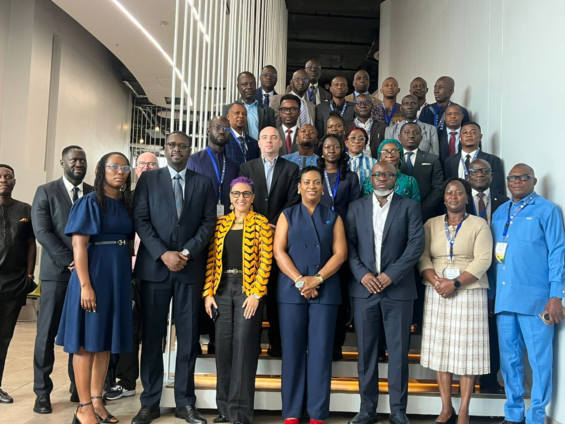
The commitment was reiterated by the Chief Communications Officer of the QI Group, Ramya Chandrasekaran, during the EOCO–INTERPOL Three-Day Regional Coordination and Case Resolution Workshop on Combating Human Trafficking and Migrant Smuggling held at the Ecobank Headquarters in Accra on Monday.
The workshop brought together investigators, prosecutors, intelligence officers, financial crime experts, immigration officials and representatives from INTERPOL, ECOWAS and several West and Central African countries to strengthen regional cooperation against emerging organised crime threats, particularly the sophisticated trafficking model known as "Model Q."
While security agencies outlined the growing complexity of the criminal enterprise, QNET used the platform to reinforce the importance of partnerships between law enforcement institutions and responsible private sector organisations in protecting vulnerable communities.
Addressing participants, Ms Chandrasekaran described QNET's collaboration with EOCO as one of the company's most significant anti-fraud initiatives in Africa.
She said the Memorandum of Understanding (MoU) signed between the two organisations had created an effective framework for intelligence sharing, public education and joint operations aimed at dismantling criminal networks that misuse QNET's name to deceive unsuspecting victims.
"Our collaboration with EOCO has shown us the value of sustained public-private cooperation," she said.
"No single institution can address this problem alone. Criminal networks operate across borders, so our response must also be coordinated, practical and cross-border."
According to her, the partnership has already produced tangible outcomes, including support for investigations that have led to the arrest of suspected criminals and the rescue of more than 300 victims believed to have been caught up in fraud and suspected migrant smuggling operations.
She said the experience demonstrates that collaboration between private companies and state institutions can strengthen enforcement efforts while improving protection for vulnerable communities.
Ms Chandrasekaran acknowledged that organised criminal groups have increasingly exploited QNET's brand, products and business model to gain credibility when targeting victims.
She stressed, however, that the greatest damage is suffered not by the company but by individuals and families who lose money, are trafficked or become victims of organised fraud.
"QNET has experienced this directly. Our brand, products and business model have been misrepresented by fraudulent individuals and criminal networks," she said.
"But while this affects our company, we recognise that the greater harm is done to the victims and communities who are deceived, trafficked and exploited."
She explained that criminal syndicates deliberately impersonate legitimate businesses, creating false employment opportunities, business ventures and overseas recruitment schemes to attract unsuspecting victims.
Beyond supporting investigations, QNET has intensified public education campaigns across several West African countries to help communities identify fraudulent schemes before becoming victims.
According to Ms Chandrasekaran, awareness campaigns have been undertaken in Ghana, Nigeria, Senegal, Sierra Leone, Burkina Faso and other countries through television, radio and community engagement programmes.
She said the company has deliberately expanded its communication strategy beyond digital platforms to reach people who may not have regular access to the internet or social media.
The company has also introduced financial literacy programmes designed to help vulnerable groups distinguish legitimate business opportunities from fraudulent "get-rich-quick" schemes commonly promoted by organised criminal networks.
"Our objective is to ensure that people understand how these scams work and avoid falling victim to them," she explained.
Ms Chandrasekaran said QNET has complemented education initiatives with stronger compliance measures aimed at preventing criminals from abusing its business platform.
Among the key reforms is the introduction of mandatory Know Your Customer (KYC) verification, requiring prospective independent representatives to register using valid national identification.
She said the measure helps prevent the use of false identities and cross-border abuse of the company's registration system.
The company is also investing in additional technology-driven screening mechanisms capable of identifying suspicious activities and reducing opportunities for organised criminal infiltration.
The workshop heard that organised criminal groups across West and Central Africa are increasingly adopting a sophisticated modus operandi known as Model Q, which combines human trafficking, migrant smuggling, financial fraud, psychological manipulation and digital recruitment into a single criminal enterprise.
Ms Chandrasekaran expressed optimism that the collaboration would encourage similar partnerships across the region.
"We are grateful to EOCO and INTERPOL for bringing together the right people in this room," she said. "This workshop provides an important opportunity to share intelligence, understand emerging criminal patterns and strengthen cooperation across West and Central Africa."
She reaffirmed QNET's commitment to supporting regional initiatives aimed at preventing fraud, protecting vulnerable communities and assisting law enforcement agencies in disrupting organised criminal networks.
The Director-General of the Criminal Investigations Department (CID) of the Ghana Police Service, DCOP Lydia Yaako Donkor, described the model as one of the most dangerous developments in transnational organised crime.
She warned that traffickers have shifted from traditional recruitment methods to highly coordinated digital operations that exploit social media platforms, fraudulent employment websites and online communication channels.
"Traditional methods of trafficking are being aggressively replaced by digital deception," she said.
According to DCOP Donkor, victims are frequently persuaded to pay recruitment or processing fees through mobile money systems before being transported across borders, where they are subjected to exploitation, psychological coercion and forced labour.
She further revealed that many victims are eventually compelled to recruit additional victims, allowing the criminal enterprise to expand while obscuring the distinction between victim and perpetrator.
The Executive Secretary of EOCO, Raymond Archer, said recent investigations had confirmed that Model Q represents a significant evolution in organised crime across West and Central Africa.
He explained that the criminal enterprise seamlessly integrates trafficking, migrant smuggling, financial fraud and digital recruitment, making it increasingly difficult for individual countries to tackle independently.
"Because these networks operate seamlessly across multiple countries, regional cooperation is no longer optional—it is essential," he said.
Mr Archer urged participants to strengthen intelligence sharing, judicial cooperation, coordinated investigations and victim support while remaining guided by the five pillars of prevention, protection, prosecution, partnership and policy.
Supporting the call for stronger partnerships, INTERPOL's Assistant Director for Vulnerable Communities, Rosemary Nalubega, said no country could dismantle sophisticated trafficking syndicates acting alone.
She noted that criminal groups exploit differences in national legal systems and enforcement capacities, making regional cooperation indispensable.
"Together, through harmonised cooperation, shared intelligence and unified strategies, we can strike decisive blows against traffickers and migrant smugglers," she said.
Ms Nalubega commended EOCO and the Government of Ghana for convening the workshop, describing it as an important platform for developing practical, evidence-based regional strategies.
She urged participants to ensure that rescued victims remain at the centre of all interventions through protection, rehabilitation and access to justice.
For QNET, the partnership with EOCO illustrates how structured cooperation can complement public enforcement through intelligence sharing, public education, compliance reforms and community outreach.
Latest Stories
-
Bono Regional Minister calls for investor education to drive economic growth
3 seconds -
Ghana seeks long-term mining investments that benefit local communities – Armah-Kofi Buah
22 minutes -
Ghana’s Ambassador to China, Kojo Bonsu, presents credentials to Nepalese President
35 minutes -
Fairtrade Africa’s Cocoa Hubs Project strengthens rural service centres in cocoa-growing communities
40 minutes -
MPs are not development officers – Edem Kpotosu
40 minutes -
SEC cautions investors against fraudulent investment schemes
41 minutes -
Land Ministry urges rCOMSDEP operators to reserve earnings for land reclamation
45 minutes -
Commercial drivers give authorities one week to clear traders from lorry terminals, bus stops
49 minutes -
Trump calls off livestream of Fort Hood attacker’s execution by firing squad
51 minutes -
Nana B denies claims that Kojo Bamba was his driver and bodyguard
1 hour -
Engage Now Africa to construct a 10-unit classroom block for struggling Navrongo Vocational Training Centre
1 hour -
One digital financial breach could expose linked accounts to fraud – Financial Crimes Manager
1 hour -
Ghana Russia Centre signs ICT cooperation agreement with Moscow University
2 hours -
The powerhouses of the village: Honouring Ghana’s rural women on International Rural Women’s Day
2 hours -
Vincent Assafuah petitions CHRAJ to investigate alleged irregularities in 2026 World Cup visa arrangements
2 hours