

Audio By Carbonatix
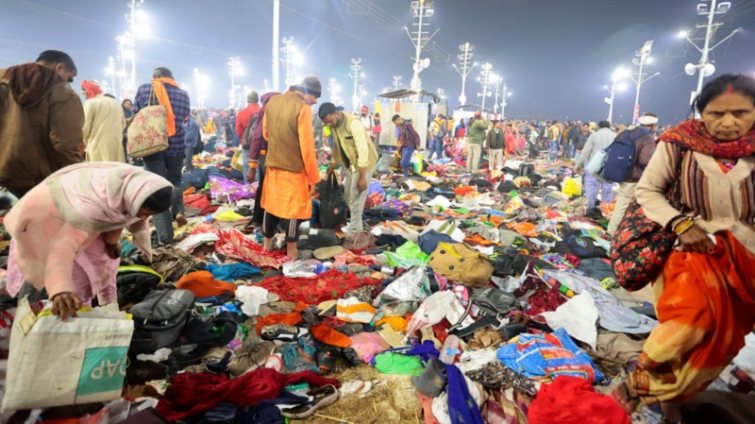
Several people were feared dead and many more injured in a stampede early Wednesday as tens of thousands of Hindus rushed to take a holy bath in the river at the massive Maha Kumbh festival in northern India‘s Prayagraj city, local media reported.
Distressed families lined up outside a makeshift hospital inquiring about their missing relatives, rescuers were helping the injured and police tried to manage the crowds.
People’s belongings like clothes, blankets and backpacks were strewn around the scene of the stampede. It was not immediately clear what triggered the panic or how many people had been hurt. Some local news websites said 10 people had died.
Wednesday was a sacred day during the six-week festival, and authorities were expecting a record 100 million devotees to engage in a ritual bath at the confluence of the Ganges, the Yamuna and the mythical Saraswati rivers.
The ritualistic bathing’s main draw are thousands of ash-smeared Hindu ascetics who arrive in massive processions towards the confluence to take a holy dip in the waters.
The incident did not appear to have deterred millions of Hindu pilgrims who continued to throng the site even as police officials urged them over megaphones to keep away from the confluence.
Yogi Adityanath, chief minister of the Uttar Pradesh state, also urged people to not head towards the confluence and instead take baths at other riverbanks. Adityanath, in a post on social platform X, did not make any reference to the stampede but warned people not to “pay attention to any rumors.”
The Maha Kumbh festival, held every 12 years, started on Jan. 13 and is the world’s largest religious gathering. Authorities expect more than 400 million people to throng the pilgrimage site in total.
Authorities built a sprawling tent city on the riverbanks to accommodate visitors. It has 3,000 kitchens and 150,000 toilets, plus roads, electricity and water, communication towers and 11 hospitals.
About 50,000 security personnel are stationed in the city to maintain law and order and manage crowds. Authorities also installed more than 2,500 cameras, some powered by AI, to send crowd movement and density information to four central control rooms, where officials can quickly deploy personnel to avoid stampedes.
In 2013, at least 40 pilgrims who were taking part in the same festival were killed in a stampede at a train station in Prayagraj.
Deadly stampedes are relatively common around Indian religious festivals, where large crowds gather in small areas with shoddy infrastructure and few safety measures. In July at least 116 people died, most of them women and children, when thousands at a religious gathering in northern India stampeded at a tent in Hathras town.
Latest Stories
-
Sosu challenges EOCO’s basis for attempted arrest of Manhyia South MP
3 minutes -
KMA plans to convert Adum railway enclave into cargo truck terminal
5 minutes -
2026/27 cocoa season: COCOBOD engages international trading partners in London
22 minutes -
Fire contained at Dansoman’s Dayspring School, no casualties reported
26 minutes -
Nyankyerenease gets furnished CHPS compound to improve healthcare access
36 minutes -
Sky Train trial moves to defence as Asamoah, Ameyaw-Akumfi file witness statements
38 minutes -
AFCON 2027Q: Ghana will face Ivory Coast, Gambia unscathed – Sports Minister
40 minutes -
Heavy security at Accra High Court ahead of Salomey Baffoe bail hearing after EOCO’s attempted arrest of Manhyia South MP
51 minutes -
Teen rocker Nene Royal becomes first Thai to win America’s Got Talent
56 minutes -
Skills Bridge Ghana Foundation trains 50 professionals in solar energy
1 hour -
Photos: Mahama Ayariga inspects waste evacuation exercise at Agbogbloshie
1 hour -
Photos: Mahama meets world leaders at 81st UN General Assembly
1 hour -
From the Accra Reset to Reparatory Justice: Inside President Mahama’s diplomatic agenda in New York
1 hour -
Photos: Ghana-China relations strengthened at China’s 77th anniversary celebration
1 hour -
Majority says stronger enforcement drove rise in NACOC arrests
1 hour