


Audio By Carbonatix
Using social media isn't directly harming teenagers - but it can reduce the time they spend on healthy activities, such as sleeping and exercising, a study suggests.
Parents should ban phones from bedrooms after 22:00 and encourage more physical activity, the UK researchers said.
Girls were particularly vulnerable to cyber-bullying on social media, which could lead to psychological distress.
But what drove boys' distress needed more research, the study said.
In the UK, nine out of 10 teenagers use social media and there is growing concern about its impact on the mental health and the wellbeing of young people.
So far, research has thrown up contradictory evidence because of the lack of long-term data.
 In this study, in The Lancet Child & Adolescent Health, a representative group of more than 12,000 teenagers at school in England was interviewed over three years, from the age of 13 to 16.
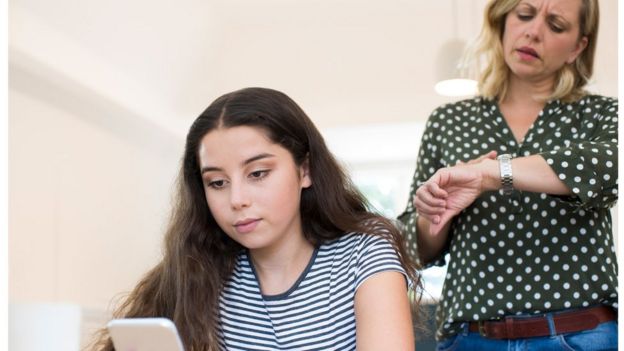
 Get them exercising outdoors instead of worrying about their social media use, researchers say
Also involved in the study, reader in child psychiatry Dr Dasha Nicholls, from Imperial College London, said: "It's not the amount of social media per se, it's when it displaces real-life contact and activities.
"It's about getting a balance."
Get them exercising outdoors instead of worrying about their social media use, researchers say
Also involved in the study, reader in child psychiatry Dr Dasha Nicholls, from Imperial College London, said: "It's not the amount of social media per se, it's when it displaces real-life contact and activities.
"It's about getting a balance."
In this study, in The Lancet Child & Adolescent Health, a representative group of more than 12,000 teenagers at school in England was interviewed over three years, from the age of 13 to 16.
What did the study do?
Teenagers in Year 9 were asked how often they checked social-media sites such as Instagram, Facebook, Whatsapp and Twitter each day - but not how long they spent using them. Most (51%) of the girls and 43% of the boys used social media more than three times times a day, rising to 69% of boys and 75% of girls by Year 11. When they were in Year 10, the same young people completed a questionnaire on their mental health and were asked about their experiences of cyber-bullying, sleep and physical activity. In Year 11, the teenagers were asked about their levels of happiness and how anxious and satisfied with life they were.What did the research find?
The boys and girls who checked social-media sites more than three times a day had poorer mental health and greater psychological distress. These girls were also more likely to say they were less happy and more anxious in subsequent years - but the boys were not. The researchers said there was evidence of a strong link between social media use and mental health and wellbeing. But in girls, the negative effects were due to disrupted sleep, cyber-bullying and, to a lesser extent, lack of exercise. In boys, these factors had an impact, but it was much smaller.Should parents worry?
Lead study author Russell Viner, professor in adolescent health at UCL Great Ormond Street Institute of Child Health, said: "Parents get tied up in knots about how much their kids are on social media each day. "But they should worry about how much physical activity and sleep they're getting because social media is displacing other things." Social media could have a positive effect on teenagers and "played a central role in our children's lives", he added.
Get them exercising outdoors instead of worrying about their social media use, researchers say
Also involved in the study, reader in child psychiatry Dr Dasha Nicholls, from Imperial College London, said: "It's not the amount of social media per se, it's when it displaces real-life contact and activities.
"It's about getting a balance."
Is it different for boys?
The research team said there were differences in the way girls and boys used social media that were not yet understood. And more work was needed to find out what was influencing boys' psychological distress from using social media.What about cyber-bullying?
Dr Nicholls said parents should keep an eye on their children's social-media use and make sure they were not accessing toxic content, particularly at night. "Cyber-bullying is important - we need to be asking about it and addressing it," she said. "In cyber-bullying, even your bed is not a safe place. And if your phone is downstairs, you can't be bullied in your bed." Dr Louise Theodosiou, from the Royal College of Psychiatrists' child and adolescent faculty, said: "More studies are needed to understand how we can prevent the more negative impacts of social media, particularly on vulnerable children and young people and the negative impacts of digital technology generally. "It is only right that social-media companies contribute to fund this important research and do more to support young people to use the internet safely."DISCLAIMER: The Views, Comments, Opinions, Contributions and Statements made by Readers and Contributors on this platform do not necessarily represent the views or policy of Multimedia Group Limited.
DISCLAIMER: The Views, Comments, Opinions, Contributions and Statements made by Readers and Contributors on this platform do not necessarily represent the views or policy of Multimedia Group Limited.
Latest Stories
-
GPL 2026/27: Opoku Agyemang strike sends Kotoko third after Karela win
18 seconds -
Government ‘cannot dissolve’ GFA – Sports Minister Kofi Adams
13 minutes -
Baffour Awuah granted GH¢50m bail after EOCO detention
47 minutes -
“Every genre we create doesn’t have to be ‘Afro’ something” – M.anifest
59 minutes -
GMTF marks first anniversary with lifesaving equipment for 9 more hospitals
1 hour -
NAIMOS seizes 10 excavators in raid on illegal mining sites blocking River Pra’s flow
1 hour -
Pump prices may stay unchanged as government holds TOR, Sentuo prices
2 hours -
Akra Reads! 2026: Ladé Wosornu poetry contest expands to JHS
2 hours -
K9 dog sniffs out 72lbs of prohibited Ghanaian food items at JFK
2 hours -
If family planning is our choice, why isn’t it in our budget?
2 hours -
Mahama, Lordina to attend World Assemblies of God Congress opening in Accra
2 hours -
‘The power play is disgusting’ – Atta Akyea questions Baffour Awuah’s detention by EOCO
2 hours -
Ghana to review all public-sector AI acquisitions under new directive
2 hours -
NPP ready for national elections; 7,121 delegates to vote
2 hours -
‘I didn’t expect this under Mahama’ – Annoh-Dompreh on Baffour Awuah’s detention at EOCO
2 hours