

Audio By Carbonatix
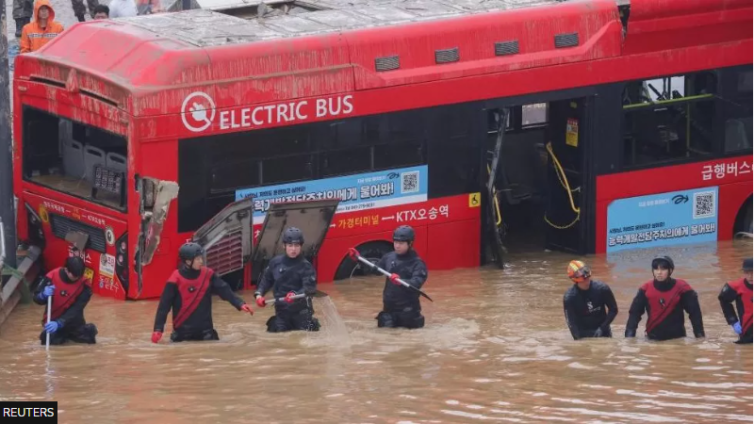
Rescuers working to reach cars trapped in a flooded tunnel near the South Korean city of Cheongiu have recovered nine bodies.
Flood water caused by days of torrential rain poured so quickly into the underpass that passengers and drivers were trapped in their cars, unable to escape.
At least 35 people have died in total after flooding, landslides and power cuts across much of the country.
More than ten people are missing.
It is unclear how many people are still trapped in the 685-metre long tunnel in the town of Osong, but 15 vehicles are thought to be submerged.
Several of the bodies were recovered from inside a bus. Nine survivors were rescued on Saturday.
Most of the other fatalities have been in the mountainous North Gyeongsang region, where landslides have swept away whole houses.
Almost 300mm (11.8in) of rain is reported to have fallen across South Korea on Saturday.
The country typically sees 1,000mm (39.4in) to 1,800mm (70.9in) a year, according to the Korean Meteorological Association - although much of that does fall during the summer months.
Aerial pictures from flood-affected areas show brown mud and flood waters so deep, only the tops of roofs can been seen sticking out.
Thousands of people have been affected by evacuation orders issued by various local governments and Prime Minister Han Duck-soo has asked the military to help with the rescue efforts.
Early on Saturday morning local time, some 6,400 residents were evacuated after the Goesan Dam, also in North Chungcheong, began to overflow, the agency said.
A number of low-lying villages near the dam as well as many of the roads connecting them were submerged, leaving some residents trapped in their homes.
Late on Friday, a landslide caused a train to derail in North Chungcheong. One engineer was injured, but the train was not carrying passengers at the time.
Korail, the country's national rail operator, has announced the suspension of all slow trains and some bullet trains, and said other bullet services would be disrupted.
The Korea Meteorological Administration forecast more rainfall through to Wednesday next week. It warned that the weather conditions pose a "grave" danger.
Extreme rain has caused floods and landslides across several countries - including India, China and Japan - over the past fortnight.
While many factors contribute to flooding, scientists say a warming atmosphere caused by climate change makes extreme rainfall more likely.
The warmer it becomes, the more moisture the atmosphere can hold, resulting in more droplets and heavier rainfall, sometimes in a shorter space of time and over a smaller area.
Latest Stories
-
Media urged to intensify awareness campaigns on breast cancer
4 minutes -
Interior Minister urges public to share drug intelligence
10 minutes -
Afadzato South DCE commissions water projects, teachers’ bungalow
15 minutes -
Council of State urges sustained dialogue, negotiations as teachers resume work
20 minutes -
We are committed to leaving a legacy in Mandari – Bole-Bamboi MP
24 minutes -
Greater Accra teachers resume work after strike suspension
32 minutes -
Education Minister assures teachers of salary adjustments by October 16
37 minutes -
Abass Osabutey declares bid for NDC Deputy National Organiser position
39 minutes -
Education Minister inaugurates NDU Governing Council, announces $25m seed funding
47 minutes -
THE LAW 101: La Beach Demolitions – The State’s own documents, the courts’ orders – and the bulldozers
50 minutes -
DVLA contributes GH¢17.7m to Consolidated Fund in 2025
53 minutes -
Why disaster risk reduction must connect early warnings, preparedness and financial protection to household-level resilience
1 hour -
Fentuo Tahiru narrates how 2018 Commonwealth Games visa scandal became an international embarrassment
1 hour -
The AI Gold Rush: Who strikes gold and who gets left behind?
1 hour -
Australia visa scandal: Pius Hadzide says failed checks left him carrying the blame
2 hours