

Audio By Carbonatix
Every Saturday, Zhang Xinsheng travels two hours for a movie date with friends, navigating Beijing's confusing subway system with his white cane and a speaking map that screams directions on his mobile phone.
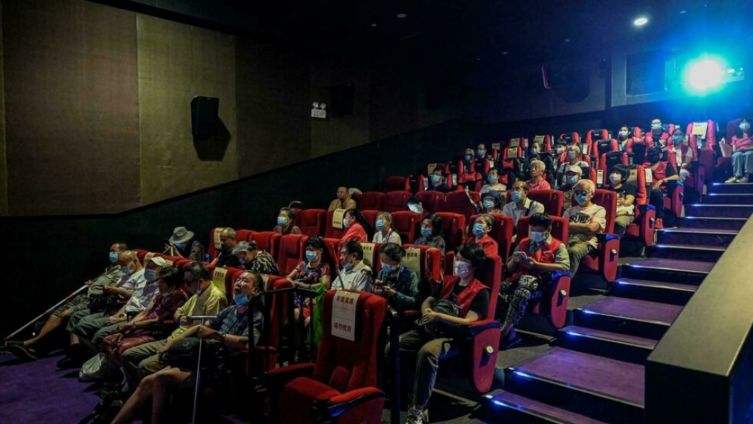
Zhang lost his sight in his early twenties due to a degenerative condition, but since going blind has discovered a love for cinema at the "talking film" club, where volunteers give vivid narrations to an auditorium of blind or partially sighted cinemagoers.
"After I listened to a film for the first time in 2014, it felt like a (new) world had opened up for me," he said.
"I felt I could understand the film despite my blindness. There were clear images forming in my mind's eye... as (the narrator) described the scenes... of laughter, the crying."
Now 51, he makes the weekly pilgrimage to a theatre in Qianmen, in the heart of old Beijing, without fail.
Dozens of blind moviegoers come to the Saturday screenings organised by Xin Mu Theater, a small group of volunteers who were the first to introduce films to blind audiences in China.
Their method is surprisingly low-tech. A narrator describes what is happening on screen, including facial expressions, unspoken gestures, the setting and costumes.
They relay visual clues that would otherwise be missed, like a sudden change of scenery from falling leaves to snow that conveys the passage of time.

Last month the group screened "A Street Cat Named Bob" -- a story of a ginger feline who helps a homeless man in London quit drugs and become a bestselling author.
Narrator Wang Weili described what is happening on-screen:
"There is snow falling over London, a city in England. It's a little like Beijing but the buildings aren't that tall," he says in between the dialogue dubbed in Chinese.
"A man with binoculars -- two long round cylinders used to see things that are far -- is watching James as he sings on a street corner with Bob the cat."
There was pin-drop silence as he spoke. No one whispered or crunched snacks -- instead, the audience listened intently.
- 'Tell me what you see' -
Wang was inspired to introduce films to blind audiences after narrating "The Terminator" to a friend.
"I saw sweat pouring from his forehead when I described the action scenes. He was so excited," he said. "He kept saying tell me what you see!"
Wang rented a small room in an old Beijing courtyard with his savings in 2005 and started the talking film club with a small flat-screen TV, a second-hand DVD player and about 20 chairs.
His 20-square-metre (215-square-foot) makeshift cinema was always packed.
Explaining films to blind audiences can be challenging, especially if the plot has historical or imaginary elements that audience members are yet to encounter.

Before screening "Jurassic Park" for instance, Wang lets the audience feel several dinosaur models.
"I watch a film at least six or seven times... and write my own detailed script," the businessman-turned-disability activist said.
Xin Mu now partners with bigger cinemas for their screenings. The pandemic has also pushed the team to introduce a streaming service with recorded audio narrations.
The group has screened nearly a thousand films over the past 15 years.
- 'Limited opportunities' –
China has more than 17 million people who are visually impaired. Eight million of them are completely sightless, according to The China Association for the Blind.
Over the past decade, cities across the country have built more blind walkways, added braille markings on elevator panels and allowed blind candidates to take exams for government jobs and colleges.
"But the blind community have limited opportunities to participate in cultural activities," said Dawning Leung, Founder of the Audio Description Association in Hong Kong.
"They are shut out of cinemas, theatres or art exhibitions because there is no awareness about the need for audio narrations."
"Even audio descriptions at museums are written with sighted people in mind. They tell you about the history of an object or where it was found but rarely describe what it looks like," she said.
Activists have for years pushed for legislation mandating audio descriptions for films, television programs or artwork in mainland China, like those in Hong Kong, with little progress.

The free film screenings by Xin Mu offer a rare chance for blind moviegoers to be part of the world's biggest box office.
"Movies help enrich my life... they help me understand life's challenges," Zhang said.
His favourite film is Bollywood blockbuster "Dangal," where a strict dad coaches his daughters to overcome social taboos and become champion wrestlers.
"At times I think, just like the protagonists in that film, I can change my fate by working hard," he said.
Latest Stories
-
Photos: Housing solutions take centre stage at Day 2 of the 3rd Republic Bank-JoyNews Habitat Fair
19 minutes -
Video: Immunity should be exercised without creating classism – Inusah Fuseini on cocaine bust
52 minutes -
Ghana Air Force passes out 293 recruits after six months of intensive training
60 minutes -
EOCO vrs Baffour Awuah: EOCO should have secured warrant before arrest attempt at court – Inusah Fuseini
1 hour -
Triple fibre cuts disrupt telecom services across Northern, Oti regions – Sam George
1 hour -
Politicisation could undermine parliamentary probe into cocaine seizures – Dr Osae-Kwapong
1 hour -
EOCO chases MP: Can Section 41 cure lacuna in EOCO Act? – Inusah Fuseini asks
1 hour -
GNFS, GWL inspect fire hydrants in Ministries enclave; 23 found faulty
1 hour -
Gov’t directs release of 50,000 bags of grain to ECOWAS
1 hour -
Ghana, Germany deepen cooperation on railways, labour mobility
1 hour -
Huge crowds greet Pope in Paris for open-air Mass
2 hours -
‘I never said I’ll declare a state of emergency’ – President Mahama on galamsey
2 hours -
Bobby Banson condemns EOCO’s attempted arrest of Nana Agyei Baffour Awuah
3 hours -
When Kumasi begins to look like somebody is in charge
3 hours -
Parliamentary probe into cocaine seizure would be a waste of time – Inusah Fuseini
3 hours