

Audio By Carbonatix
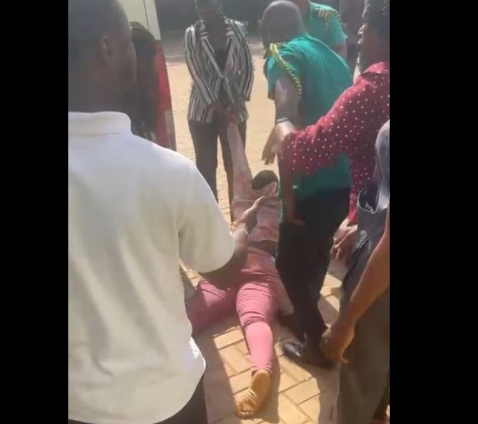
A dramatic and tense situation unfolded at the VICSEM Hotel in Ogbojo, Accra, on Tuesday afternoon, November 11, 2025, as Ghana Immigration Service (GIS) officials attempted to forcibly remove a group of deportees recently repatriated from the United States.
Eyewitnesses at the scene reported that the effort to relocate the deportees, who are part of an ongoing arrangement between the U.S. government under President Donald Trump and Ghana, generated confusion and significant distress among the returnees.
Immigration officials were spotted in viral videos dragging a woman on the floor into a waiting vehicle.
The intention of their action is not clear but the attempted removal suggests officials were trying to move the individuals from the hotel facility where they were initially accommodated upon arrival.
The incident highlights the sensitive nature of Ghana’s agreement to receive its citizens deported from the U.S.
The current group arrived as part of a deal governed by a Memorandum of Understanding (MOU) with the United States.
Crucially, the government maintains that this arrangement is legally binding but does not require parliamentary ratification, distinguishing it from treaties or defence agreements.
Ghana's decision to accept the deportees has been publicly framed as being driven purely by humanitarian concerns, responding to reports of harsh treatment and poor conditions faced by deportees from abroad.
The confrontation at the hotel comes amid heightened political scrutiny over the repatriation policy.
The government had previously faced sharp criticism from the Minority in Parliament following the earlier acceptance of a group of 14 deportees.
The Minority accused government officials of attempting to sidestep parliamentary approval for the controversial arrangement.
This apprehension is compounded by the recent announcement from the Minister of Foreign Affairs, Samuel Okudzeto Ablakwa, that Ghana was expecting an additional 40 West African deportees from the United States.
In a related development, a human rights lawyer and legal representative to some of the deportees, Oliver Barker-Vormawor, is alleging that Ghana is now facilitating the return of these individuals to their home countries, where their lives are at risk.
Barker-Vormawor's post highlights that the U.S. government cannot legally deport these individuals directly to their home countries because they have been "granted protection" based on a "genuine fear of persecution."
By accepting them, Ghana essentially becomes an intermediary.
Latest Stories
-
Power restoration fault suspected in Kumasi Central Market fire
5 hours -
The 7-foot giant of Ngleshie Amanfro: Seven-foot Ghanaian Ephraim Saawa dreams of joining the national basketball team
5 hours -
Government promises support for Kumasi Central Market fire victims
5 hours -
Vibes The Movie: Big Ghun’s Ghanaian film earns five nominations at 2026 REFFA
6 hours -
MamaCare CEO warns unresolved conflicts among health workers could undermine maternal and neonatal care
6 hours -
Health professionals urged to translate medical knowledge into practice to save mothers
6 hours -
Retired judge Justice Francis Korbieh charges 1,568 new lawyers to uphold integrity
8 hours -
Conflicts among care providers linked to maternal, neonatal deaths – Expert
8 hours -
GIS marks 10th TIME conference, champions improved teaching practices
8 hours -
BRICS Or Balance? What Ghana’s bid really means
9 hours -
GPRTU wants full TRAFFITECH-GH implementation to start in 2027
9 hours -
How 10-mile walks for basic education birthed a 50-year legal career for Justice Korbieh
9 hours -
Mahama announces plans to import electric wheelchairs for PWDs
9 hours -
KGL U17 Colts 2026: Western beat Prempeh Elite Academy to set up final final with Greater Accra Region
9 hours -
Late Solanke strike salvages 10-man Spurs draw at Man United
9 hours