


Audio By Carbonatix
Neha Satpute and Akshay Pise felt ready to welcome their first child.
Having worked in the US for more than a decade, the Indian couple who are engineers on H-1B visas for skilled foreign workers, expected their son - due on 26 February - to be born an American citizen.
Employed at a large tech firm with a supportive parental leave policy, they had carefully built their life in San Jose, California.
But President Donald Trump recently threw a wrench in their American dream by announcing a rule that would deny automatic US citizenship to children born to temporary foreign workers. Until now, birthright citizenship had been a given regardless of parents' immigration status.
A federal judge in Maryland has blocked the order, extending an initial two-week block imposed by a Seattle court. This means the ruling cannot take effect until the case is resolved in court, although there remains a possibility of a higher court overturning any decision.
The looming uncertainty, along with the multiple lawsuits and legal challenges, have left Akshay, Neha and thousands of others in limbo.
"This impacts us directly," says Akshay. "If the order takes effect, we don't know what comes next - it's uncharted territory." Their biggest question: What nationality will their child have?
Their concern is valid, says New York-based immigration attorney Cyrus Mehta: "US law has no provision for granting non-immigrant status to a person born here."
With their baby's due date fast approaching, they consulted their doctor about an early delivery. The advice? If all goes well, they could induce labour in the 40th week, but they've chosen to wait.
"I want the natural process to take its course," says Neha. Akshay adds: "My priority is safe delivery and my wife's health. Citizenship comes second."
Dr Satheesh Kathula, president of the American Association of Physicians of Indian Origin (AAPI), reached out to obstetricians of Indian origin in the US after media reports of families seeking early C-sections. Except for "a few instances in New Jersey", most doctors reported no such inquiries.
"In a country with strict medical laws, I strongly advise against preterm C-sections just for citizenship," said the Ohio-based doctor. "Our physicians are ethical and won't perform them unless medically necessary."
US citizenship is highly coveted, especially by skilled H-1B visa holders. Indians are the second-largest immigrant group in the US.
Immigration policy analyst Sneha Puri warns that a birthright citizenship order would hit Indians hard - more than five million Indians in the US hold non-immigrant visas.
"If enforced, none of their future US-born children would get citizenship," she told the BBC.
South Asian parents-to-be are flooding online groups with concerns about the order's impact and next steps.
Trump's executive order says it does not affect the ability of the children of lawful permanent residents to obtain documentation of US citizenship.
But Indians in the US face the longest wait of any foreign nationality to receive a green card conferring lawful permanent residency.
Current US rules mean that the number of green cards given to people of any one country cannot exceed 7% of the total number of green cards awarded.
Indians receive 72% of H-1B visas annually. According to the Cato Institute, Indians made up 62% of the employment-based backlog of people waiting for green cards - that's 1.1 million - in 2023. Indians receiving employment-based green cards today applied back in 2012.
In his report, Cato's director of immigration studies David Bierwarns: "New Indian applicants face a lifetime wait, with 400,000 likely to die before getting a green card."
In contrast, most other immigrants get permanent residency within a year, speeding up their path to citizenship.
If implemented, Trump's executive order would also affect undocumented migrants in the US, whose US-born children had previously automatically gained citizenship - and who could then go on to sponsor their parents to apply for a green card when they turn 21.
Pew Research estimates 725,000 undocumented Indian immigrants in the US as of 2022, making them the third-largest group. In contrast, the Migration Policy Institute puts the number at 375,000, ranking India fifth. Unauthorised immigrants make up 3% of the US population and 22% of the foreign-born population.
The main concern for Indians on H-1B or O visas is their children's quality of life.
Such visa-holders must leave the US periodically to have their visas stamped in a US embassy abroad. Those who return to India for this purpose frequently face delays in getting an appointment for this purpose.
These immigrants don't want their US-born children to endure the same bureaucratic struggles.
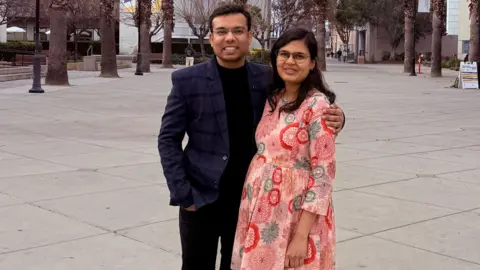
Waiting in the green card queue for several years, Akshay is aware of the ease US citizenship brings.
"We have been here for more than 10 years. As I see my parents getting older, it's very important for me to have citizenship. Travelling becomes tricky for us with coordinating visa stamping timings, and now with my baby it might be more difficult," he said.
Many physicians in the US oppose Trump's decree, highlighting the role foreign skilled workers play in providing vital services.
Dr Kathula says Indian doctors in rural areas such as North and South Dakota are crucial. "Without them, healthcare would collapse. Now, they're in limbo about starting families," he said.
He is calling for the process of getting a green card to be sped up and for these workers' children to be granted birthright citizenship because of their parents' contributions to America.
Trump's order has also heightened anxiety among Indians on student and work visas, already aware of their precarious legal status. The one guarantee - their US-born children's citizenship - is now in doubt.
San Jose resident Priyanshi Jajoo, expecting a baby in April, is searching for clarity on potential changes. "Do we need to contact the Indian consulate for a passport? Which visa applies? There's no information online," she said.
Counting the days until her son's arrival, Neha said the uncertainty was an additional source of anxiety.
"Pregnancy is stressful enough, but we thought after a decade here it would get easier - then this happens on top of everything," she said.
Her husband Akshay adds, "As legal, tax-paying immigrants, our baby deserves US citizenship - it's been the law, right?"
Latest Stories
-
World Cup visa scandal: Sports Ministry not shielding anyone – Sports Minister’s special aide
18 minutes -
World Cup visa scandal: Over 30 people misrepresented as GTA board members to US Embassy – Vincent Assafuah alleges
19 minutes -
Fire destroys wooden structure near Yesu Mo Villa at Bush Road
21 minutes -
NDC threatens sanctions over oversized campaign posters, gives aspirants 5 days to comply
1 hour -
Star Oil paid GH¢2.7bn in taxes, levies in nine months of 2026
1 hour -
Samson’s Take: The rule of law is cheaper before the bulldozer
1 hour -
GRA blames system failure for delay in issuing receipt over passenger’s customs duty
2 hours -
Livestream: Newsfile discusses World Cup visa scandal, beach demolitions, education strikes, BRICS bid
2 hours -
NC-PTAs welcomes end of teachers’ strike, urges parents to prepare children for Monday
2 hours -
Government procures over 2,000 transformers as Ghana’s electricity access hits 89.13% – Energy Minister
2 hours -
UTAG-UG threatens strike on October 19 over unpaid allowance
3 hours -
Let The Constitution direct Chieftaincy to deliver “All Development Is Local”
4 hours -
John Jinapor outlines renewable energy, nuclear power priorities for 2027
4 hours -
Ghana explores centre of excellence for hearing, communication and cochlear implant care
5 hours -
Schizophrenia-related disorders lead mental health cases recorded in Ghana
6 hours